ARTS / CULTURE & LEISURE
UN issues stamps for Year of the Horse inspired by Eastern Han Dynasty bronze figure
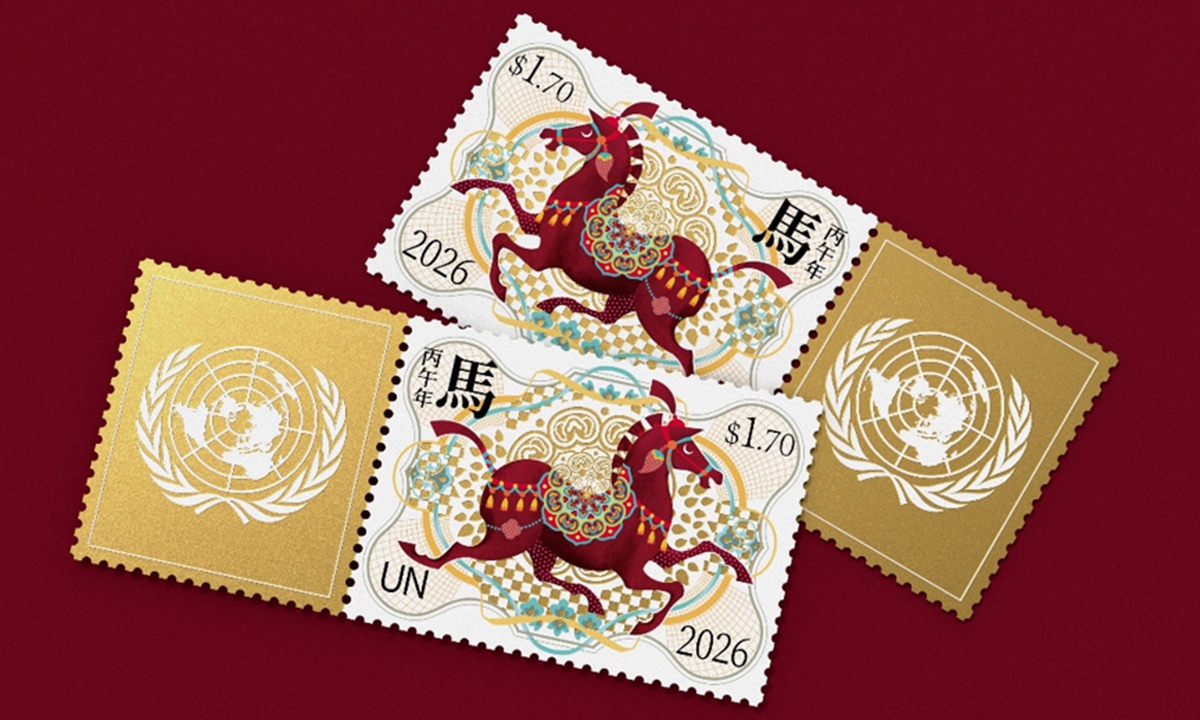
The stamp for the 2026 Chinese New Year and the Year of the Horse issued by the United Nations Postal Administration Photo: Courtesy of Tiger Pan
A galloping red horse bursts forward amid swirling Dunhuang-inspired patterns, its mane streaming upward in a blaze of motion. The United Nations Postal Administration (UNPA) on Saturday issued a special-event sheet of stamps to celebrate the upcoming Chinese New Year, the Year of the Horse.The sheet consists of 10 stamps of a denomination of $1.70 each. The stamp was designed by Chinese artist Tiger Pan, who also illustrated the UN Lunar Calendar series for the 2018 Year of the Dog, 2022 Year of the Tiger, 2023 Year of the Rabbit, 2024 Year of the Dragon and the 2025 Year of the Snake.
The latest stamp draws inspiration from an Eastern Han Dynasty (25-220) bronze figure of a galloping horse while reimagining it through a contemporary design lens. The result, Pan says, is an attempt to root the work firmly in the traditional Chinese culture while speaking to modern, global aesthetics.
Color plays an important role in that dialogue. The stamp's palette is derived from mineral pigments commonly found in Dunhuang murals. Behind the horse, there are geometric patterns inspired by Dunhuang's Zaojing. Zaojing is caisson ceiling, a distinctive feature of classical Chinese architecture.
"I didn't simply copy the traditional Zaojing motifs," Pan told the Global Times. "I deconstructed them, simplified them into geometric forms, and then reconstructed them in a continuous, layered structure. This allowed the ancient visual language to feel fresh and alive, and to better highlight the horse's motion."
Over the years, Pan has distilled some guiding principles into his zodiac stamp designs: They must be clearly recognizable, relevant to contemporary life and aesthetics, have a strong connection to the Chinese New Year's hopeful spirit and possess broad appeal.
Among the 12 zodiac animals, Pan considers the horse uniquely elegant. Its upright posture and flowing musculature naturally convey nobility and forward momentum, qualities long associated with progress and aspiration in Chinese culture. Ironically, those very strengths also made the design especially difficult.
"There are already countless outstanding artworks centered on horses," Pan said. "From earlier zodiac stamps to paintings and sculptures, the visual legacy is immense. For a new design to stand out, you have to find a distinct perspective and a different temperament."
In the design, he seeks to balance the horse's sense of strength with an impression of lightness. The image conveys the vitality of forward motion, while subtle refinements in the details soften animals' inherent aggressiveness, presenting a calm and composed presence instead. This distinctive quality allows the "Horse Stamp" to express its theme in a way that resonates easily with audiences both at home and abroad.
The 12 Chinese zodiac signs are a core element of traditional Chinese culture, with each person associated with an animal sign from birth. In many countries and regions around the world, zodiac-themed stamps are issued regularly, and their significance has long extended beyond their practical role in mail delivery, according to Pan.
Designing for the UN adds another layer of complexity. The imagery must remain distinctly Chinese while remaining legible and meaningful across cultures. Pan noted that balance requires more than simply exporting traditional symbols.
"International expression of Chinese culture is not a simple cultural transportation," he said. "It's about modern reconstruction and careful adaptation to a global context."
Confidence comes from a deep engagement with traditional culture - understanding the rich meanings and spiritual core behind each cultural symbol, Pan emphasized.
RELATED ARTICLES