ARTS / CULTURE & LEISURE
Ancient academy culture exhibition in Beijing showcases millennia-old wisdom
By Published: Jan 19, 2026 08:59 PM
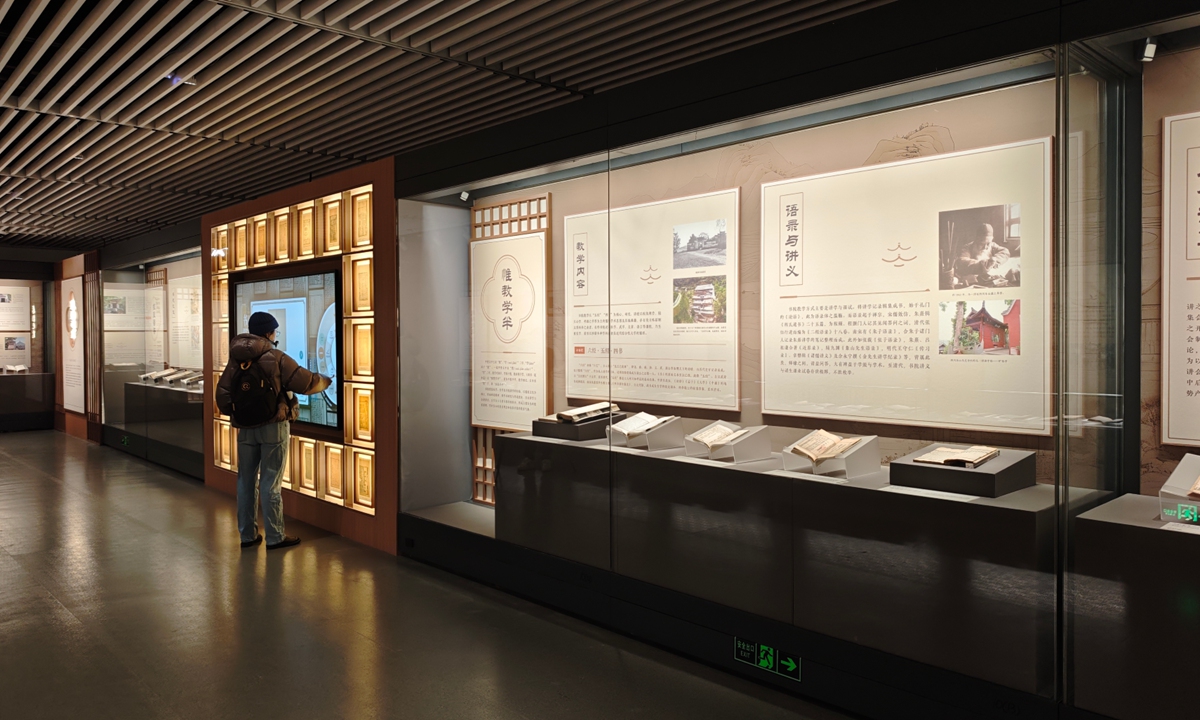
Photo: Chen Xi/GT
An exhibition delving into the profound legacy of China's ancient academies, known as Shuyuan, opened Monday at the National Library of China, showcasing the enduring spirit of education that has shaped Chinese civilization over a millennium.Featuring over 110 types of artifacts spanning 3,000 years, the exhibition offers spectators a glimpse into the world of the ancient Chinese academies that served as hubs of learning, scholarship and cultural preservation throughout the ages.
Standout pieces include the "Jiaoshu" oracle bone, a 3,000-year-old artifact etched with characters documenting early Shang Dynasty (c.1600BC-1046BC) education, fragments of the Xiping Stone Classics, Han Dynasty (206BC-AD220) stone stele inscribed with The Analects of Confucius, and a Tang Dynasty (618-907) manuscript of imperial examination answers from the Dunhuang Mogao Caves that serve of evidence of China's early meritocracy system.
Also on display are rareprecious Song Dynasty (960-1279) editions of works by Confucian scholars Zhu Xi and Lü Zuqian, alongside a 1938 copy of Lunxinjieduan (lit. On the New Stage) published in Yan'an, Northwest China's Shaanxi Province, drawing a direct line between the academies' "seek truth from facts" ethos and modern Chinese thought.
Wei Chong, a deputy director of the National Library, told the Global Times that academies have always been closely linked with academic development.
From the Neo-Confucianism of Cheng Yi and Zhu Xi in the Song Dynasty to the School of Mind of Wang Yangming, and further to the text-critical studies of the Qing Dynasty (1644-1911), academies consistently served as crucial cradles of academic innovation.
They functioned not only as core bearers of Confucian culture but also as a repository of spiritual wisdom for Eastern civilization, whose humanistic spirit continues to exert profound influence within East Asian cultural spheres to this day.
What sets the exhibition apart is its immersive tech integration. Visitors don VR glass to "wander" through the iconic Yuelu Academy in Central China's Hunan Province, while 3D projections in the "Four Seasons at Academies" zone recreate dawn readings, scholarly debates, ancestral rituals and ancient book-engraving scenes.
Moreover, LED screens bring to life pivotal moments like the 12th-century Goose Lake Debate, a legendary clash of Confucian ideologies, and the founding of Jiangxi's Bailudong Academy, which is often called the "cradle of Chinese academies."
For international visitors, the exhibition highlights the academies' global footprint, which reflects their enduring cross-cultural relevance.
Deng Hongbo, a leading scholar on Chinese academies at Hunan University's Yuelu Academy, explained how these institutions spread beyond China's borders from the 15th century onward.
Deng told the Global Times that since the Ming Dynasty (1368-1644), academy culture gradually spread to regions such as Korea, Japan, Southeast Asia, and even Europe and the Americas, forming a cross-border network of cultural exchange.
According to statistics, hundreds of academies historically emerged in places like Japan and Korea, while church-affiliated academies for cultural exchanges were also established in Europe and North America.
"This not only promoted the global reach of Chinese civilization but also infused local cultural development with Eastern wisdom," he said.
He pointed out that although South Korea successfully inscribed "Seowon, Korean Neo-Confucian Academies" on the UNESCO World Heritage List, its the academy culture actually originated from China.
Emerging in the Tang Dynasty and flourishing in the Song Dynasty, "Shuyuan" integrated teaching, research, book collection and rituals, fostering values still cherished today, including academic rigor, truth-seeking, humanism and patriotism, Deng added.
Today, the academy revival is in full swing: overMore than 3,000 active academies operate across China, blending traditional teachings with contemporary issues.
"In an era of cultural exchange, these ancient institutions offer a model for dialogue," Deng said, referencing the "Second Combination" of Marxism with Chinese traditional culture. "Their spirit of openness and innovation is exactly what the world needs now," he said.
RELATED ARTICLES