ARTS / CULTURE & LEISURE
Exploring the forbidden Aotai Trail on the Qinling Mountains
Most dangerous hike
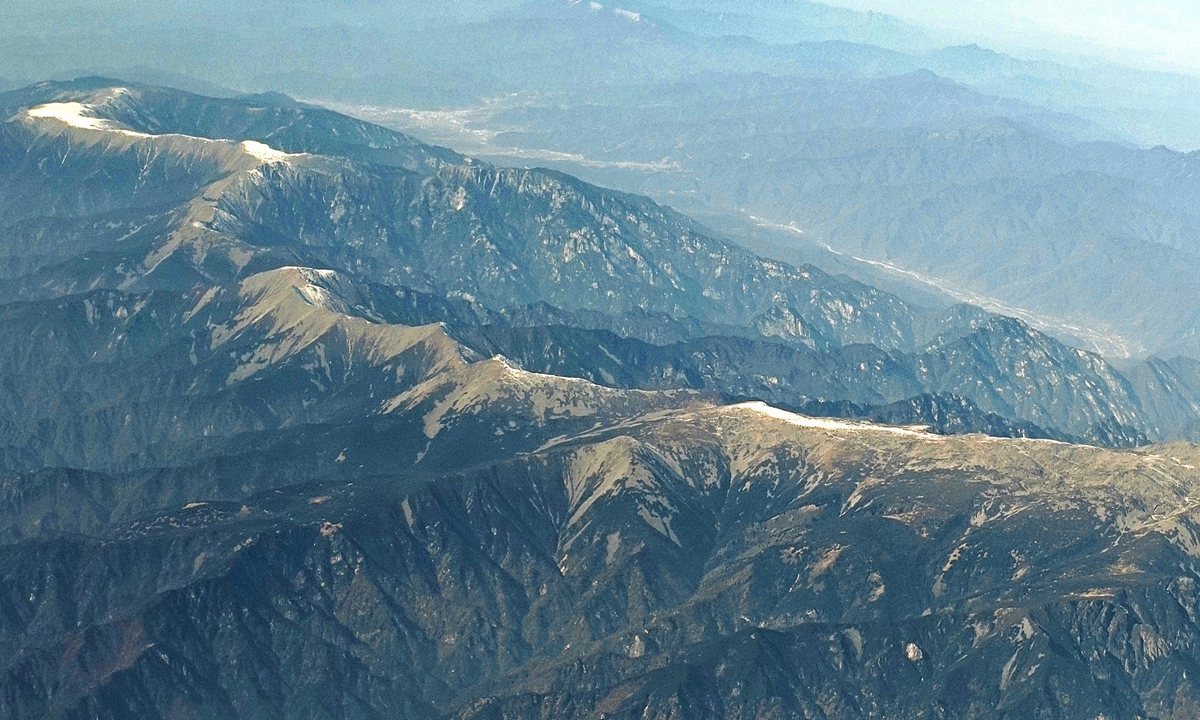
An aerial photo of the Qinling Mountains Photo: VCG
"Four seasons in a day. Walk 10 miles and see 10 different types of weather." Hikers often use this saying to describe the wildly unpredictable weather along the Aotai Trail deep in the Qinling Mountains in Northwest China's Shaanxi Province. But the warnings are rarely about the changing scenery - what really captures people's attention is the trail's extreme risks.A fatal accident in January that occurred when five people attempted to illegally cross the Aotai Trail has once again drawn people's attention to the heart of the Qinling Mountains. This route is well-known for its geographical significance and the way it repeatedly enters public discourse through incidents such as this one, in which three of the five lost their lives.
The Qinling Mountains, stretching more than 1,600 kilometers from east to west, form a natural boundary between northern and southern China. At the heart of this range lies the Aotai Trail, which links Mount Ao - the Qinling's second-highest peak - with Mount Taibai, its highest summit.
Among hikers in China, the Aotai Trail has earned a fearsome reputation as one of the Qinling Mountains' most daunting routes. Cutting through the core of the Qinling Mountains, it stretches over 170 kilometers and traverses 17 peaks above 3,400 meters, much of it in uninhabited terrain beyond the reach of mobile signals.
"It requires extended travel along the main ridges in uninhabited areas, leaving very little room for retreat or adjustments once entered," Sun Weigang, a professional mountain and outdoor guide with the Chinese Mountaineering Association, told the Global Times.
For this reason, travel along the trail has been officially banned since 2018. Yet the ban has not fully quelled the urge to "take on the challenge." Despite the known high risks, some adventurers continue to tackle the Aotai Trail, often resulting in tragedies that highlight its dangers.
An unforgiving trail
The label "China's most dangerous hiking trail" comes from years of accumulated accidents and rescues.
This risk is closely tied to the trail's geographic location. As the core of China's north-south climate divide, cold and warm air currents frequently collide along the Qinling main ridge.
Sun explained that the speed of weather changes here often exceeds hikers' ability to adapt. "Clear skies, sudden fog, temperature drops, they can occur in quick succession, and predicting them in advance is extremely difficult."
However, weather is just the beginning. What really causes many hikers to get trapped is the terrain underfoot.
"Large sections of the Aotai Trail consist of moraine fields created by glacial activity," Sun said. "Walking is not just walking, it's a constant process of judging, stepping, and adjusting your balance."
This "drained" state often becomes fully apparent at the most dangerous moment - getting lost. Moraine fields don't have permanent trails, and in heavy fog, the gap between the recorded route on a map and reality can grow exponentially.
"Many people think that having a route marked on a map ensures safety, but such a route doesn't tell you precisely what direction your next step should take," Sun said.
"Once you deviate from the main ridge, you are highly likely to enter a canyon or untouched forest area - and then you can go missing."
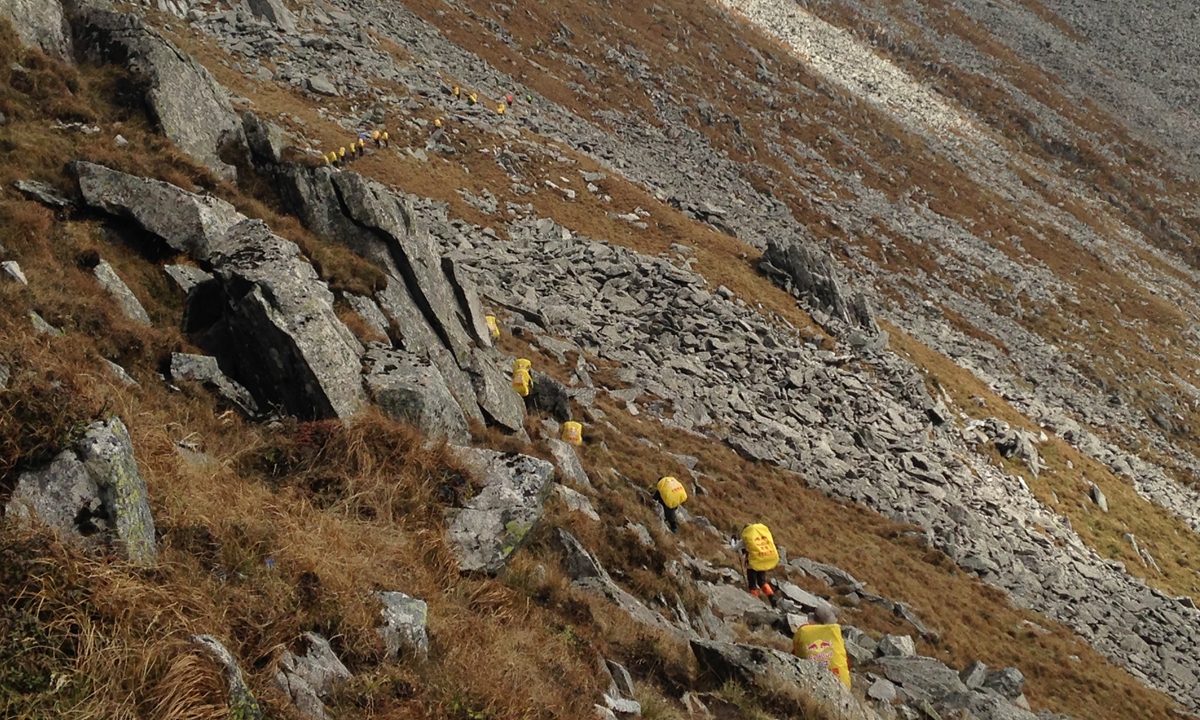
A group of hikers travel the Aotai Trail prior to it being closed to the public. Photo: Courtesy of Sun Weigang
Unseen perilsIt is precisely when weather, physical endurance, and sense of direction all fail simultaneously that the true danger of the Aotai Trail becomes apparent.
Among past accidents and emergencies, those who found themselves in life-threatening situations were not all inexperienced "novices."
Extreme outdoor athlete Chen Xiong, who has repeatedly undertaken high-intensity trails in the Qinling Mountains, told the Global Times that the Aotai Trail is so perilous that even hikers who perform well on other high-altitude routes can quickly "collapse."
Chen recalled an experience that still haunts him. At the time, he was hiking the Aotai Trail with an 18-year-old companion.
The real test, however, came later. While crossing a ridge near Baiqimiao, a key waypoint along the Aotai Trail, the team was caught in a sudden blizzard. His companion, inadequately protected against the cold, suffered severe loss of body heat in the head and torso.
"If I hadn't brought him down the mountain, I truly don't want to imagine what could have happened," Chen said. This experience made him acutely aware that courage doesn't mitigate the risk on the Aotai Trail; its deadliest aspect is not whether it is "difficult," but that it is "uncontrollable."
And yet, what can be even more dangerous than nature itself is misjudgment.
Some hikers passionate about traversing the Aotai Trail point out that the images circulating on social media often show the trail only under good, clear conditions, concealing its harshest and most unforgiving realities.
"A common misjudgment among those attempting the Aotai Trail is overestimating their own physical capacity at high altitude," Chen noted.
"If they fail to reach their planned campsites, they quickly face the compounded risk of dehydration and hypothermia," he said.
These physical and environmental challenges highlight a larger point emphasized by Sun, who noted the essence of outdoor hiking is not about testing one's abilities but about exploring rationally with a full understanding of nature.
"To love the mountains is also to respect them," Sun said. "Never overestimate your abilities, and never underestimate the power of nature."
In the depths of the Qinling Mountains, it is not courage or daring that matters, but the uncompromising law of nature. Let this serve as a solemn reminder to all hikers: The mountains do not forgive recklessness. No photograph, no thrill, no moment of glory is worth stepping onto this forbidden ridge, remarked Sun.
RELATED ARTICLES