BRASIL 247 / MORE
Brazil's energy minister presses DiDi/99 on safety and discusses e-mobility investment in Shanghai
Talks highlight cameras, tougher ride-hailing rules, and Brazil's clean power mix as an advantage for electrification
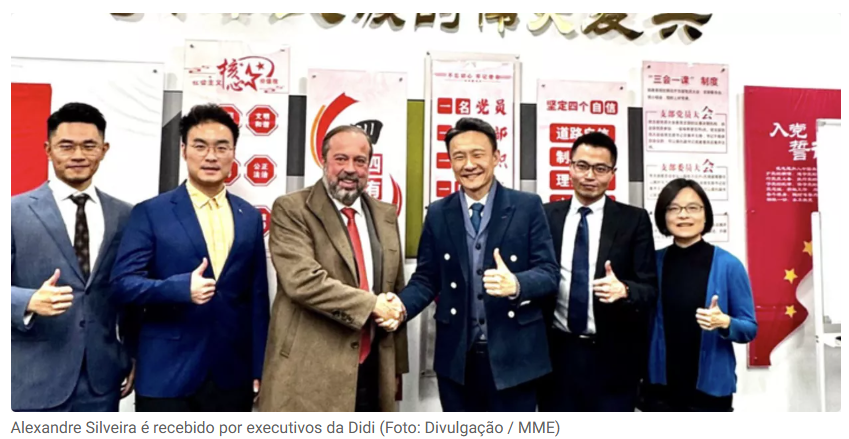
Photo: screengrab from the official website of Brasil 247
By Brasil 247 - Brazil's Mines and Energy Minister Alexandre Silveira met executives from DiDi Global, the company that controls ride-hailing platform 99 in Brazil, on Monday (Jan. 19) in Shanghai, China, to discuss investments in electric mobility and press for stronger safety measures for app users and drivers, with a special focus on women.
According to a statement released by Brazil's Ministry of Mines and Energy, Silveira was received by Jacky Chen, the executive responsible for DiDi's Automotive Ecosystem Development, and the meeting centered on linking safety, digital technology, clean energy and urban mobility in an effort to build a more modern, secure and investment-friendly regulatory environment in Brazil.
Silveira argued that Brazil should strengthen the legal framework for ride-hailing services to increase protections for passengers and drivers, stressing that safety is a structural pillar for the sector's long-term expansion and for broader public trust in app-based urban transport.
During the talks, the minister urged the adoption of filming technologies modeled on practices observed in China, calling for both internal and external vehicle cameras to improve security for riders and drivers. He added that he intends to meet Brazil's new Justice and Public Security Minister Wellington César to discuss possible legal initiatives aimed at the sector, seeking coordinated rules that expand prevention mechanisms and reinforce public-private cooperation.
Beyond safety, Silveira presented Brazil's electricity mix as a strategic advantage for the expansion of electric mobility, noting that roughly 90% of the country's power generation comes from clean and renewable sources and emphasizing the robustness and growth potential of Brazil's national power system.
"The Brazil has unique conditions to lead the transition to electric mobility. We have a clean, renewable and robust electricity mix, with abundant energy and strong growth potential, which allows us to move forward with safety, competitiveness and sustainability," Silveira said, according to the ministry's statement.
The minister also referenced market information suggesting DiDi could invest around 10 billion reais in Brazil over the coming years, considering its acquisition of 99, investments in delivery services, and structured programs to support couriers and electrification efforts.
Silveira said the Brazilian government plans to create a dedicated unit within the Ministry of Mines and Energy to oversee the electric mobility agenda, focusing on policy coordination, regulatory improvements, and incentives for investment in electric vehicles, charging infrastructure and transportation-related innovation.
He also highlighted efforts to reduce electricity costs through battery storage solutions, described as strategic for stabilizing the grid and maximizing renewable generation—particularly solar and wind in Brazil's Northeast, a region with significant energy availability.
As part of the broader electrification strategy, Silveira defended the expansion of charging stations with differentiated pricing, including lower rates during periods of greater electricity supply, aiming to promote smart charging, improve system efficiency and cut costs for users and operators.
The minister further stressed the importance of access to advanced technology and financing from Chinese banks, which he described as key tools to accelerate Brazil's electric mobility rollout, scale up projects and reduce investment costs.
(Reported by Brasil 247 on Jan 19, 2026)
