SPORT / MISCELLANY
Amateur football boom quietly points to shift in Chinese football’s development logic
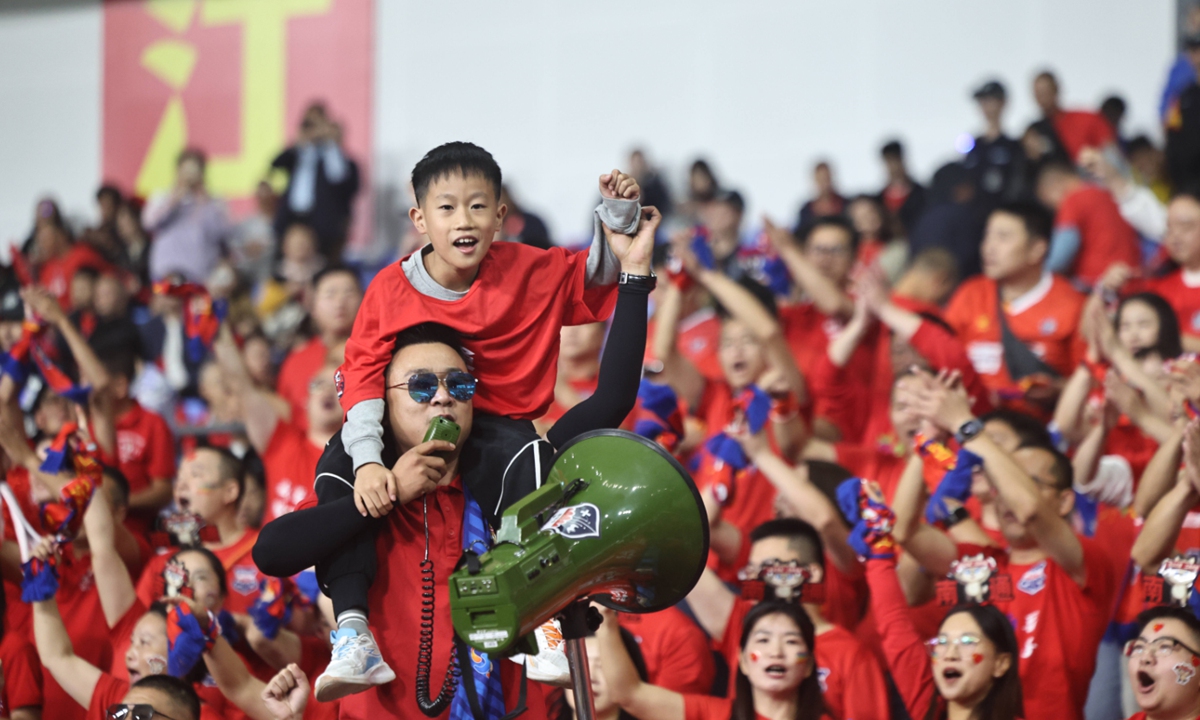
Supporters of the Nantong team cheer for their team during a Suchao match in Nantong, Jiangsu Province. Photo: VCG
For decades, debates about Chinese football have revolved around a familiar axis: the fortunes of the national team, the rise and fall of professional clubs, and the recurring cycle of reform and disappointment. Yet the most meaningful shift in domestic football in 2025 is unfolding far from the spotlights of top-tier stadiums.At the third session of the 12th Chinese Football Association (CFA) Member Congress held in Beijing on Tuesday, CFA President Song Kai revealed that the domestic amateur football competition system has begun to take shape, with 16 provincial-level regions now hosting city leagues. The number of registered amateur players has reached 980,000, nearly doubling year-on-year.
These figures point to a fundamental shift in Chinese football's development logic. For the first time in years, growth is emerging not from the top down, but from the bottom up.
One of the most persistent misconceptions surrounding football development in China is the belief that success can be engineered primarily through professional leagues or elite national teams. While those elements are important, global football history suggests they are never sufficient on their own.
Football's world governing body FIFA has long emphasized grassroots participation as the foundation of sustainable football systems, precisely the layer that Chinese football has historically lacked. Countries with deep football cultures, be they Spain, Germany or England, rely on broad-based amateur participation to sustain talent pipelines, coaching ecosystems and fan engagement. Without a wide base of regular players, elite performance becomes fragile and unsustainable.
China's football problem has never been a shortage of ambition or investment at the elite level. It has been the weakness of the base. For years, there had been limited access to pitches and a lack of organized amateur competitions.
The rapid expansion of community football in 2025 suggests that this structural imbalance is finally being addressed. A near 95 percent increase in amateur players is not just a statistical jump; it indicates that football is increasingly "happening around people" rather than being confined to televised events or professional clubs. When participation becomes habitual rather than exceptional, the sport begins to regenerate itself organically.
This matters because football talent does not emerge on command. It emerges from volume, repetition and competition. A broader amateur base increases the probability that late bloomers, overlooked players and athletes from non-elite backgrounds can still find pathways upward.
Equally significant is where these competitions are happening. More amateur tournaments are now embedded within local communities, bringing football back into ordinary social spaces rather than sports complexes.
Recent grassroots invitation tournaments in Yongzhou, Central China's Hunan Province, offer a notable example. Despite the absence of teams from Jiangsu's highly popular amateur league, commonly known as "Suchao," the event attracted large numbers of Jiangsu supporters who traveled long distances to attend the event. Some spectators reportedly resorted to creative methods, including watching from trees, to catch the matches.
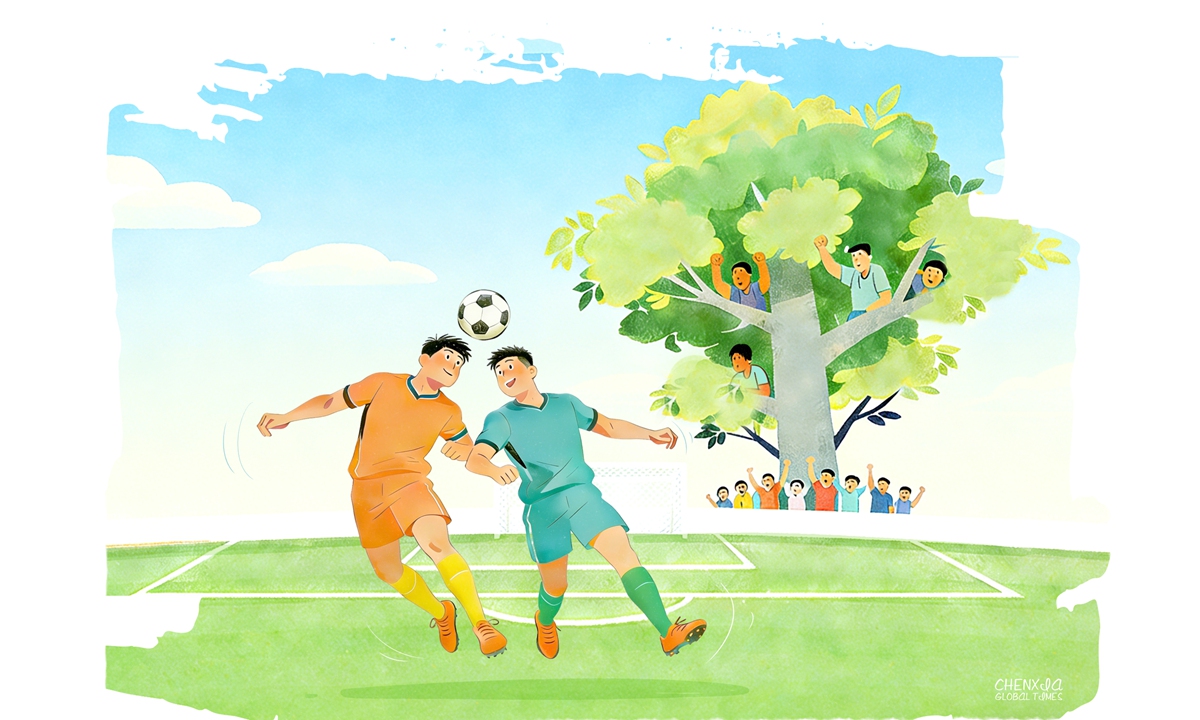
Illustration: Chen Xia/GT
What unfolded was not merely a football event, but a social exchange. Fans interacted through shared supporter culture, local advertising collaborations and the exchange of regional specialties. Football has become a vehicle for connection rather than a closed competitive product.Football culture cannot be built solely through trophies or rankings. It is cultivated when people associate the sport with friendship, identity and shared memory. In this sense, China's amateur leagues are doing cultural work that professional competitions alone cannot achieve.
However, quantity alone does not guarantee sustainability. A crowded calendar of amateur tournaments, if poorly organized, risks fragmentation and burnout. Recognizing this, the CFA has signaled that the next phase of development will focus on institutional support rather than simple expansion. It aims to construct a multi-layered, interconnected social football competition network, with a long-term target of surpassing 2 million registered players nationwide.
An important element of this strategy is integration. Initiatives that combine football with tourism, cultural activities and local commerce are being encouraged, allowing amateur events to generate broader economic and social value. Such "football plus" models mirror practices seen in countries where local tournaments double as community festivals and regional showcases.
Just as importantly, promotion pathways are being clarified. Some regional competitions, including leagues such as the Hunan Super League, are expected to align with the fourth tier of China's football league system. This creates a tangible upward channel for high-performing amateur teams and players, connecting grassroots participation with professional opportunity. While only a small fraction will reach professional levels, the existence of a pathway fundamentally changes motivation, standards and competitive intensity.
The significance of this grassroots revival should not be measured against short-term national team results. A deeper amateur ecosystem supports coach education, referee development and youth scouting. Its true impact will be delayed, uneven and largely invisible in the early years.
In recent years, Chinese football has often been asked to deliver immediate success under unstable conditions. The expansion of community football offers a different logic: steady accumulation instead of sudden breakthroughs. If sustained, this bottom-up revival may not only strengthen talent supply for future national teams, but also help Chinese football regain something it has long struggled to maintain: patience.
The author is a reporter with the Global Times. life@globaltimes.com.cn
RELATED ARTICLES