ARTS / CULTURE & LEISURE
China to celebrate 24 Solar Terms’ 10-year UNESCO recognition
Beginning of Spring ceremony ‘a profound dialogue’
By Published: Jan 20, 2026 10:47 PM

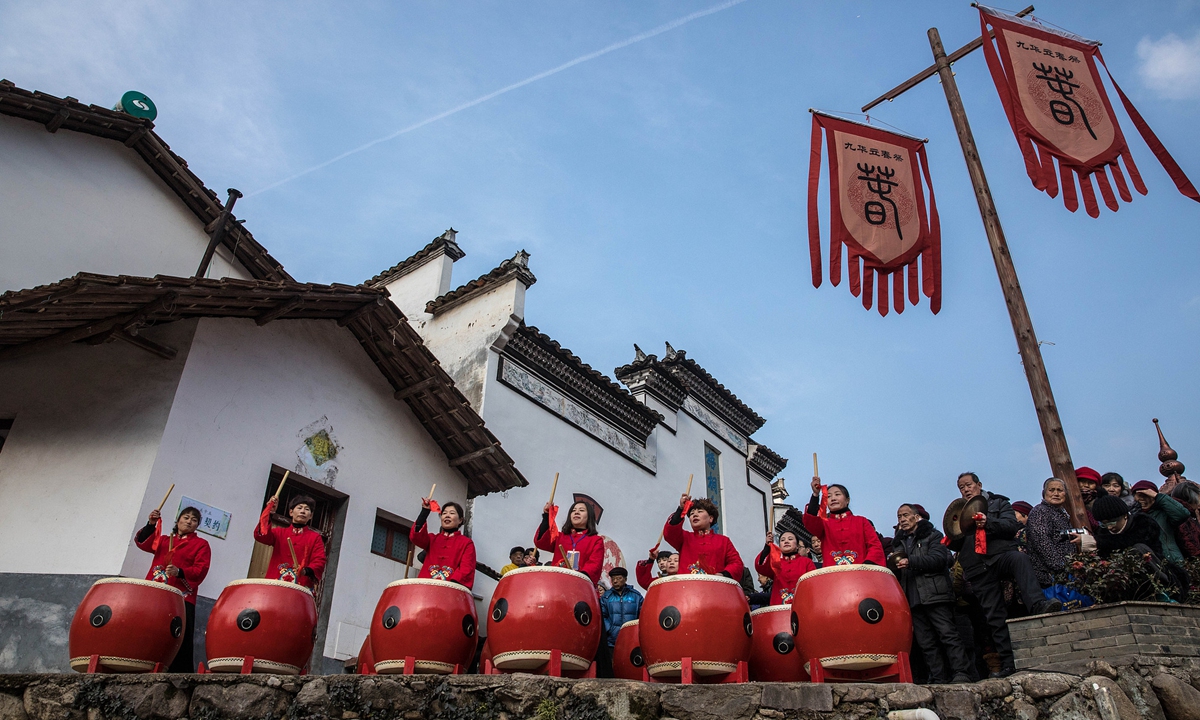
Photo: VCG
The year 2026 marks the 10th anniversary of the successful inscription of the 24 Solar Terms, knowledge in China of time and practices developed through observation of the sun's annual motion, as a UNESCO's Intangible Cultural Heritage of Humanity.Starting from the Beginning of Spring on February 4, an event titled Unveiling China's Spring will be launched to kick off a year-long celebration around the country, featuring activities and practices such as the Ritual for the Beginning of Spring in Zhejiang Province, the "Whipping the Spring Ox" in Neixiang county of Central China's Henan Province, the "Encouraging Farming in Spring" in Suichang, also in Zhejiang Province, and the "Spring Announcement" in Shiqian in Guizhou Province, according to a press conference at the China Agricultural Museum on Tuesday.
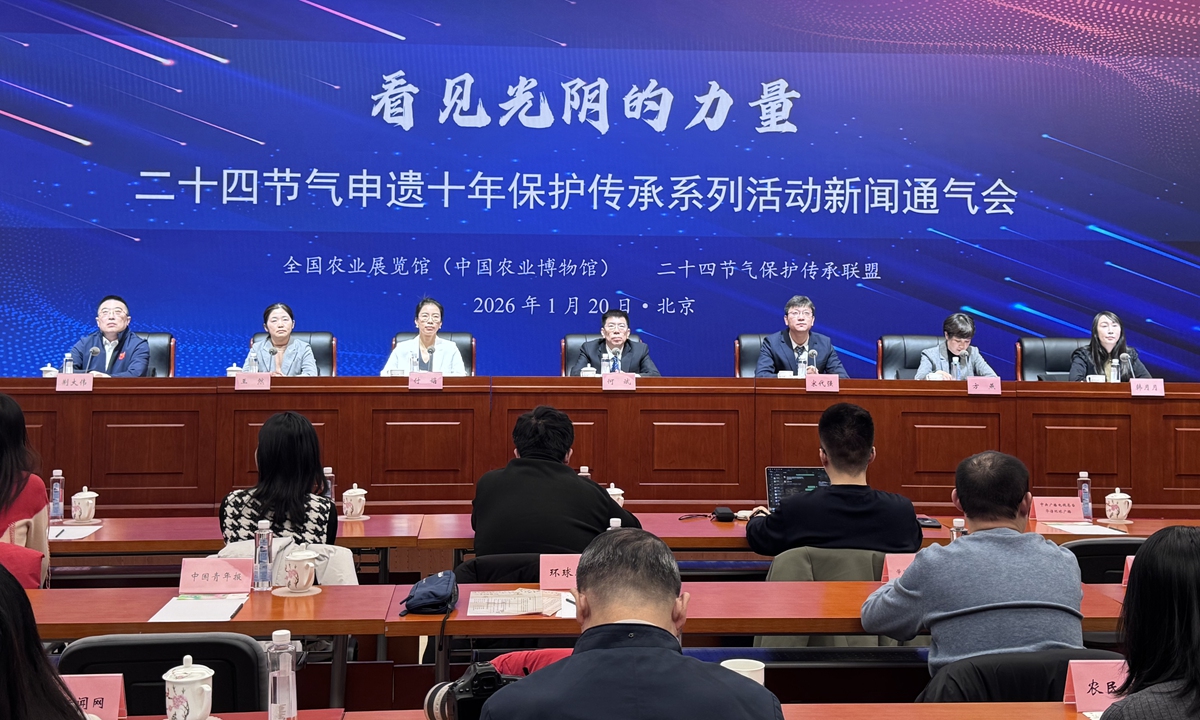
Photo: Xu Liuliu/GT
Fang Yan, head of the publicity department of the Kecheng district in Quzhou, Zhejiang Province, told the Global Times that the Wutong Ancestral Hall is the only well-preserved temple dedicated to the Spring God in China. "The Beginning of Spring Ceremony is not merely a millennium-old folk tradition for the locals, but also a profound dialogue with the land, nature, and the world," Fang said.
The custom of Whipping the Spring Ox is a distinctive activity in China's agricultural civilization. In ancient times, people performed this symbolic ritual to awaken the earth, dispel laziness, and express reverence for the land and seasonal cycles. On the day of the Beginning of Spring, communities would whip a paper-made spring ox, crafted under the guidance of local elders. As the ox broke open, grains and dried fruits hidden inside would scatter to the ground, and people would joyfully scramble to collect them while praying for a bountiful harvest and auspiciousness in the new year.
In Guizhou, a similar wish for abundant harvests is expressed through the folk practice of the Shiqian Spring Announcement. The "Chun Guan" (Spring Official) originated as an official position in the Zhou Dynasty (1046BC-256BC) responsible for agricultural affairs. Later, folk performers emerged. Dressed as Chun Guan, they traveled from village to village to sing and recite poetry. Through their performances, these artists informed peasants of spring's arrival and urged them to prepare for the new season.
The ancient Chinese divided the sun's annual circular motion into 24 segments. Each segment was called a specific "Solar Term." The 24 Solar Terms originated along the Yellow River in China. It starts from the Beginning of Spring and ends with the Greater Cold (usually January 20 or 21).
He Bin, director of the China Agricultural Museum, told the Global Times that the 24 Solar Terms represent the shared heritage of humanity. "Over the past decade, institutions including the Alliance for the Protection and Transmission of the 24 Solar Terms have worked together to establish them as a global cultural emblem," he said.
Over the years, as the lead organization for the safeguarding and transmission of the 24 Solar Terms, the China Agricultural Museum has collaborated with the Chinese Folklore Society, relevant representative communities, and other institutions to plan and implement a series of solid and effective protection and inheritance initiatives. This effort has established a multi-party collaboration mechanism characterized by government leadership, support from specialized institutions, and participation from social forces.
Local governments, such as those in Tiandeng in the Guangxi Zhuang Autonomous Region and Quzhou in Zhejiang Province, have integrated the protection of solar term culture into their local plans. The Gongshu district in Hangzhou, Zhejiang, has established community-based safeguarding mechanisms for solar term culture. Furthermore, the China Agricultural Museum has played a key role in initiating the establishment of the 24 Solar Terms Protection and Transmission Alliance. This alliance is interdisciplinary, cross-sectoral, and trans-regional, and has brought together 98 member units.
Celebration activities for 2026 will be organized around the sequence of the four seasons, said Fu Juan, director of the Agricultural History Research Department at the China Agricultural Museum, in an interview with the Global Times.
Key initiatives include the nationwide campaign "Unveiling China's Spring," a 24 Solar Terms Garden Fair, an international academic symposium on agricultural civilization, and an annual work conference coupled with a decade-review meeting marking the 10th anniversary of the successful UNESCO inscription of the 24 Solar Terms.
These efforts will be carried out through diverse formats such as exhibitions, short video campaigns, online interactions, science popularization and research activities.
The China Agricultural Museum will also launch an online interactive museum titled "Our Solar Terms Memories," encouraging the public to contribute videos, images, texts, and other materials related to the 24 Solar Terms that feature themselves and their families. After approval, these submissions will help form a "Collective Memory Archive of Solar Terms" co-created by the public that aims to integrate this intangible cultural heritage into the fabric of everyday life and ensure its preservation is driven by the people.
RELATED ARTICLES