ARTS / CULTURE & LEISURE
Initiative targets ‘vulgarity’ and ‘money worship’ in micro dramas
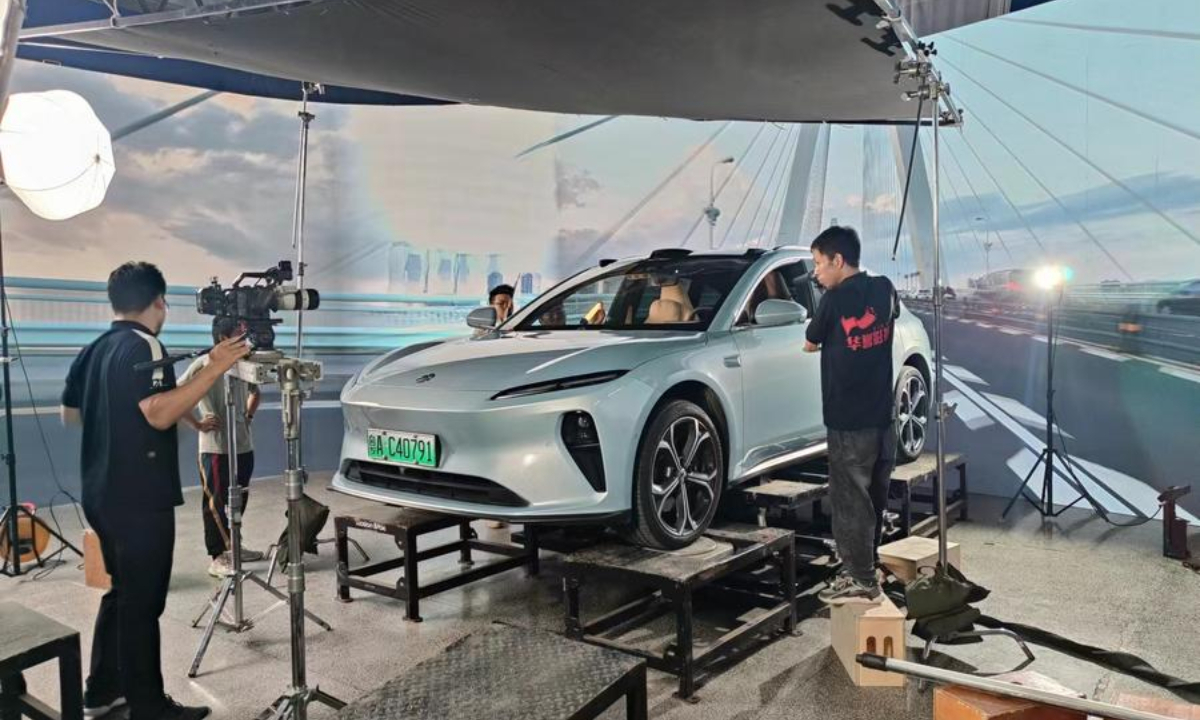
This undated photo shows the filming site of a micro drama at the Shanghai International Short Video Center in Shanghai. Photo: Xinhua
Including calls to reject "vulgar performances" and the "worship of materialism" in micro-short dramas, the China Netcasting Services Association (CNSA) has released an industry initiative aimed at promoting professional ethics among micro-short drama actors.While centered on the "ethics of micro-short drama actors," this new initiative also provides guidance for "shaping ethical practices across the entire industry chain," Jing Chang'an, a researcher and director in the micro-short drama field, told the Global Times.
The initiative underlined that professionals in the micro-drama industry must refuse to participate in productions that "violate social order and good morals" and should avoid resorting to vulgar performances merely for the sake of attracting attention.
The potential for micro-short dramas to spark moral controversy is clear. Recently, a micro-short drama was pulled down from platforms after intense online backlash for featuring plotlines such as "11-year-old girl as a substitute bride," "forced marriage at age 7," and "giving birth at age 15."
Such content "challenges the legal red line of minor protection," lawyer Gao Ling told the Global Times.
Another drama has also sparked moral controversy. To film a scene, the production crew exposed an infant to rain at night for half an hour. Once trending online, the drama has now been taken down.
"To be honest, these morally controversial plots are often directly tied to the script's premise. In a bid to stand out from competitors, many dramas deliberately seek out gray-area topics to develop content and attract traffic," Jing told the Global Times. He also added that "traffic is king" remains "the creed" for many in the micro-short drama industry.
To avoid the drawbacks brought by such a "creed," the newly released initiative also encourages professionals in the industry to resolutely resist trends such as "money worship, materialism, and extreme individualism," while rejecting vulgar performances.
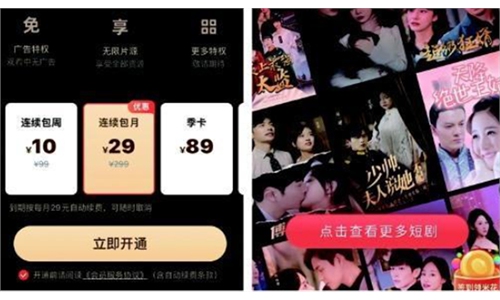
Be it a rich man effortlessly bidding on a diamond necklace worth 100 million yuan ($14.3 million) or another male lead offering a breakup fee of 10 billion yuan, these male characters in micro-short dramas are referred to as bazong (domineering CEOs).
Behind these "domineering CEO" plots "lies a depiction of a twisted value system that prioritizes money and power above all else," Jing told the Global Times. To prevent the public from being misled by extreme materialism, it requires "a consensus among content teams and actors across the industry," he said.
"Actors in particular need to be more conscious about portraying roles with greater social value, hence enriching the depth of micro-drama content," said Jing.
While calling on micro-short drama actors to "reject vulgar performances," the new initiative also encourages them to "meticulously carve out their roles and diligently hone their acting skills." It also supports young actors in taking on leading responsibilities, fostering collaborations across generations, and creating an atmosphere of mutual learning and exchanges.
Meanwhile, the new initiative stipulated that workers within the micro-short drama industry must not "lead or participate in hype and comment manipulation, refrain from deploying internet haters, fabricating false data and inciting fan conflicts, nor maliciously smear their peers."
There are 100,200 micro-short drama enterprises in China, according to a white paper on the industry released by the CNSA in November 2025. By 2025, the total scale of China's micro-short drama market had approached nearly 70 billion yuan, the white paper said. The number of micro-short drama viewers nationwide had reached 696 million as of June 2025, accounting for nearly 70 percent of the total number of internet users, and this market continues to expand.
Against the backdrop of this growing market, China has already introduced regulations in recent years, such as the current initiative, to ensure the industry's healthy growth.
In August 2020, China's National Radio and Television Administration brought online micro-short dramas under its regulatory framework. That same year, it also issued a notice aimed at establishing standards for the content review of micro-dramas within online audiovisual works.
By June 2024, all micro-dramas were subject to tiered classification for review or filing, required to obtain licensing before release, and received specific management guidance on genres such as content targeting middle-aged and elderly audiences, the aforementioned "domineering CEO" themes, AI-altered content, and title review.
"The introduction of these regulations and guidelines is aimed at strengthening guidance for micro-short drama creation at its source. These standards were never meant to be shackles on the diverse development of micro-dramas; on the contrary, they serve to support innovation in this field in the future," Zhang Yiwu, a professor of Chinese language and literature at Peking University, told the Global Times.
RELATED ARTICLES