Giant ship owner starts to cautiously resume navigation, when will the Red Sea route fully reopen?
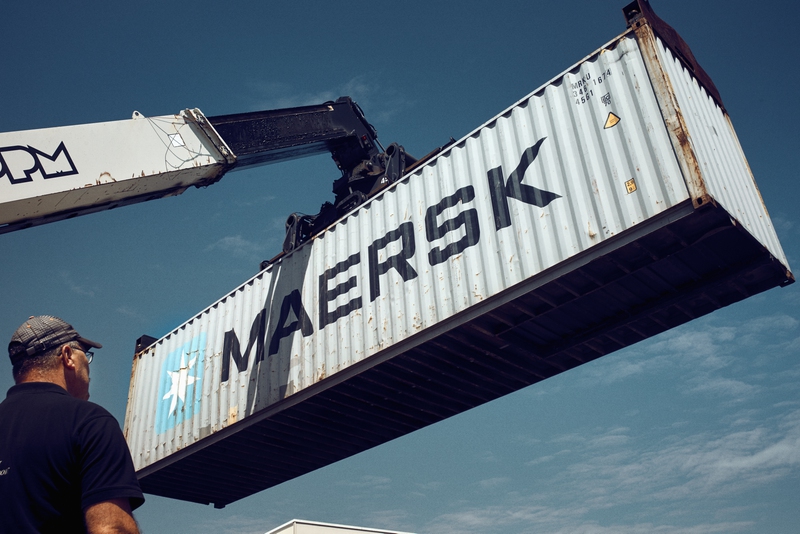
A container with Maersk logo Photo: Courtesy of Maersk
"The maritime shipping industry is finally returning to normal." Bloomberg reported on Tuesday under this headline, saying that the maritime shipping industry has taken a big step toward returning to normal after more than six years of disruption — first from the pandemic, then from Middle East violence and finally from the US' tariff war.
Maersk Group said in a recent announcement that it plans to resume routes through the Suez Canal. Previously, due to security threats faced by commercial vessels, the company had suspended the use of this important channel connecting Europe and Asia since January 2024. The industry generally believes that this move by the industry giant is of significant importance for the recovery of Red Sea shipping. So, how far is the Red Sea route from fully returning to normal? What other factors will influence it?
'A potential turning point'
The Journal of Commerce reported that Maersk's gradual resumption of limited operations in the Red Sea and Suez Canal marks a significant shift for the company after avoiding the route for two years. The Danish shipping giant said that one of its services will resume using the Suez Canal starting January 26, with the first vessel departing from the port of Salalah in Oman. This move indicates Maersk's increasing confidence in the stabilization of the regional situation.
Since the end of 2023, shipping in the Suez Canal has been severely disrupted due to Israel's attacks on Gaza and attacks by Yemen's Houthi rebels on ships in the Red Sea in solidarity with Palestinians in Gaza. Most major shipping companies have detoured around the Cape of Good Hope to avoid the Red Sea, leading to longer global supply chain transportation times and increased costs. Prior to the attacks, the Suez Canal handled approximately 10 percent of global seaborne trade volume and was the most important shipping route between Europe and Asia. If more ships return to this route, it is expected to alleviate current freight rate pressures.
Maersk stated that the first route to resume passage is its MECL service, which connects the Middle East and India with the US East Coast. The company said that it will continue to monitor the security situation in the region very closely.
Maersk said that using the Suez Canal could shorten transportation time by up to a week, thereby improving reliability and reducing costs for customers.
Earlier this month, a Maersk vessel successfully conducted a trial voyage on this route, which occurred after a Gaza ceasefire agreement took effect. Industry analysts believe this move is significant. Maersk has been the most cautious among major shipping companies, so this action could become a turning point for the global shipping industry.
Liu Zhongmin, a professor at the Middle East Studies Institute of Shanghai International Studies University, told the Global Times that Maersk's resumption of Red Sea shipping essentially reflects a restored confidence in the region's security situation to some extent.
Although numerous security risks still exist in the Red Sea region, compared to the period since the outbreak of the latest round of Israeli-Palestinian conflict in 2023, the current security situation in the Red Sea has shown relatively significant improvement. In Liu's view, the gradual recovery of the Red Sea route holds important practical significance for improving the security of international maritime passages and ensuring global supply chain stability.
Li Weijian, a research fellow with the Institute for Foreign Policy Studies of the Shanghai Institutes for International Studies, told the Global Times that Maersk, as one of the shipping giants most cautious about the Red Sea situation, restarting its route has a strong demonstration effect.
If its voyages proceed smoothly in the short term without encountering security fluctuations and risk expectations continue to decrease, it is expected that more shipping companies will follow suit in resuming Red Sea routes, promoting a gradual return to normalcy, Li said.
Currently, global freight forwarders and cargo owners are closely watching the effectiveness of Maersk's voyages, while small and medium-sized shipping companies remain in a wait-and-see mode. The overall industry shows a potential recovery trend of "giants leading, SMEs following," Li added.
Full resumption of navigation?
Experts interviewed by the Global Times believe that although the Red Sea route is stabilizing in the short term, its full recovery still faces multiple uncertainties.
Liu said that multiple geopolitical variables require close attention. The primary factor is the linkage between the Yemen situation and the Israeli-Palestinian conflict. Only with domestic reconciliation in Yemen and effective management of the Israeli-Palestinian conflict can the root cause of Houthi forces exploiting the Israeli-Palestinian issue to disrupt Red Sea security be eliminated.
Also, complex geopolitical games in the Red Sea region continue to ferment. Divergences between Saudi Arabia and the UAE over support for different factions in Yemen exacerbate uncertainties; Israel's public support for Somaliland's independence, attempting to infiltrate the Red Sea region and even planning to establish a base against the Houthis, has caused adverse effects, further destabilizing the security landscape on both sides of the Red Sea, Liu said,
The uncertainty of US Middle East policy is also an important variable. Liu emphasized that whether the international community can build a more legitimate and sustainable multilateral Red Sea security governance mechanism is key to determining whether the route can fully and stably recover.
Li also stated that the potential risks facing the Red Sea route have not been completely eliminated. The primary risk stems from the subsequent resolution process of the Gaza issue. The US proposal to form a committee to jointly manage Gaza is still in preparation, Israel has explicitly expressed dissatisfaction, and the Palestinian side has not clearly agreed. Divergences among parties have not been resolved. If Israel launches large-scale military action in Gaza again, Red Sea shipping security will be impacted once more.
Overall, the Red Sea route is expected to gradually recover in the short term, but the complexity of Middle East geopolitics determines that security risks persist. The full and stable recovery of the route still requires observing the subsequent direction of the regional situation, Li added.
Li Zixin, an assistant research fellow at the China Institute of International Studies, told the Global Times that Maersk's move illustrates the irreplaceability of the Red Sea route and highlights the extreme importance of "critical passages" in current geopolitical games.
Maersk has indeed sent a strong signal, but such a signal must be sustained by the joint efforts of international forces, Li Zixin said.
For example, it requires cooperation among countries in the Red Sea and Gulf of Aden, requires the international community to show stronger willingness to participate in global governance when addressing the Yemen crisis, and to avoid further military actions in the region that could provoke irrational behavior by relevant military-political organizations. Otherwise, the current fragile resumption of navigation could still be interrupted, he added.
Li Zixin stated that the Gaza situation is a major trigger for this round of Red Sea crisis. Although the Gaza situation has temporarily calmed, any new escalation of conflict could lead to targeted spillover in the Red Sea, worsening the shipping environment again.
"Sustained geopolitical stability is the fundamental prerequisite for full resumption of navigation," he said.
RELATED ARTICLES