'Small yet smart' green projects under BRI create new opportunities in Central Asia
From waste to energy
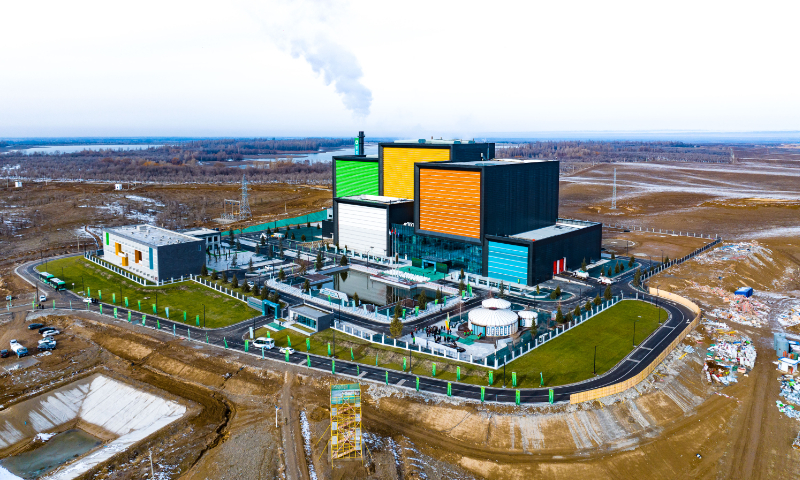
A waste-to-energy incineration project operated by Hunan Junxin Environmental Protection Co (Junxin) in Bishkek, Kyrgyzstan, on December 29, 2025. Photo: Courtesy of Junxin
In Bishkek, the capital of Kyrgyzstan, a steel grab the size of a small room swings slowly over a pit, clamps shut and lifts a dripping load of household trash into the air. Moments later, the garbage is released into a furnace burning at nearly 1,000 C. The heat turns waste into steam; the steam spins a turbine; electricity flows into Bishkek's power grid.
Backed by Chinese investment and built with Chinese technology, the facility has become Central Asia's first waste-to-energy power plant, Hunan Junxin Environmental Protection Co (Junxin), the plant's investor, builder and operator, told the Global Times in a statement on Thursday.
Speaking at the launch ceremony in December, Kyrgyz President Sadyr Japarov said the factory would help solve waste processing issues while generating electricity and creating jobs. He added that the project would significantly improve the environmental conditions in the capital and contribute to the electricity supply for the population.
This is an example of how "small yet smart" green projects under the Belt and Road Initiative (BRI) and undertaken by Chinese companies are quietly delivering environmental and economic benefits across Central Asia.
Demand-driven solutions
The Bishkek project did not begin with a blueprint, but with a question many Central Asian cities are asking: what to do with a mounting tide of urban waste when land, budgets and time are limited.
As urban populations expanded, landfill capacity tightened and environmental risks mounted, turning waste management into one of the most persistent bottlenecks in city governance.
This is precisely where demand-driven cooperation takes shape, and rather than exporting stand-alone equipment, projects are designed around local waste volumes, grid capacity and financing realities, combining incineration technology, power generation and long-term operations, a representative from Junxin told the Global Times.
With an initial daily processing capacity of 1,000 tons, expandable to 3,000 tons, the project is designed to deliver up to about 146 million kilowatt-hours of electricity to the power grid annually, while reducing carbon emissions by roughly 100,000 tons per year, the company said.
"What impressed our partners was not just the technology, but our ability to operate and manage such facilities over the long term," a representative from Junxin said, noting that Kyrgyz officials had visited multiple countries before deciding on the cooperation. "They were looking for a solution that could work locally."
And such projects are also expanding to other countries in Central Asia.
On November 29 last year, China Everbright International, a Chinese environmental services company, signed agreements with local authorities in Uzbekistan to implement projects based on waste treatment and energy recovery, Uzbek media outlet NUZ reported.
Under the agreements, a waste-to-energy project employing thermal waste treatment technology will be rolled out in phases in Uzbekistan's Namangan region, with implementation led by China Everbright International, according to the report.
The project is designed to process up to 1,500 tons of waste per day, or about 547,000 tons annually, while generating approximately 227.5 million kilowatt-hours of electricity each year. It is also expected to create between 150 and 200 jobs, with the investor planning to put the facility into operation in 2027, the report said.
These projects are not simply about exporting equipment; instead, they are driven by local needs and draw on China's experience in waste sorting, waste-to-energy generation and operational management, promoting coordinated upgrades in environmental technologies and governance capacity, Song Wei, a professor at the School of International Relations and Diplomacy at Beijing Foreign Studies University, told the Global Times on Thursday.
Tangible benefits
Feedback from host countries suggests that Chinese companies are delivering more than technical solutions - they are helping drive tangible improvements in urban environments and broaden employment opportunities.
The project in Uzbekistan, for example, is also expected to create between 150 and 200 jobs, with the investor planning to put the facility into operation in 2027, the NUZ report said.
Upgrading waste treatment facilities delivers clear social benefits, improving living conditions for nearby communities while supporting technology transfer and strengthening local capacity through cooperation in the energy and environmental sectors, Song said.
The white paper Carbon Peaking and Carbon Neutrality China's Plans and Solutions, released last year, said that China has built energy cooperation platforms with six regional organizations, namely the Association of Southeast Asian Nations, the League of Arab States, the African Union, Central and Eastern Europe, the Shanghai Cooperation Organization, and the Asia-Pacific Economic Cooperation; established energy partnerships with 34 countries along the Belt and Road; and worked with more than 100 countries and regions on green energy projects.
Over the years, China has developed numerous clean power projects in Belt and Road partner countries, contributing to their green energy transition and high-quality development, the white paper said.
In addition, the value of energy-related projects under the BRI reached $93.9 billion in 2025, the highest level since the initiative was launched and more than double that of 2024, according to a report by Fudan University and Griffith University. These included $18 billion worth of wind, solar and waste-to-energy projects, according to media reports.
"By participating in overseas project construction and operations, Chinese companies can accumulate international experience, enhance their global competitiveness and brand recognition, secure relatively stable investment returns, and boost exports of waste treatment equipment and related technologies, creating broader industrial synergies," Song said.
Song added that waste-to-energy and other "small yet smart" green projects are becoming a key driver of higher-quality BRI cooperation.
These projects reflect a shift from an earlier focus on large infrastructure projects toward a more balanced approach that combines major projects with people-centered initiatives, while placing greater emphasis on green, low-carbon and sustainable development, according to Song.
As the steel grab in Bishkek continues its steady rhythm - lifting waste that would be turned into clean energy - it captures a broader transformation along the BRI: "small yet smart" green projects are helping ease urban pain points and anchor cooperation in everyday realities.
RELATED ARTICLES