SPORT / MISCELLANY
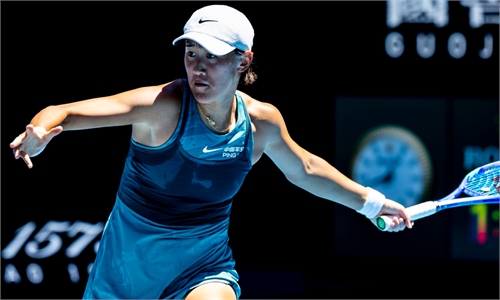
Tennis player Wang Xinyu reaches career-best third round at Australian Open
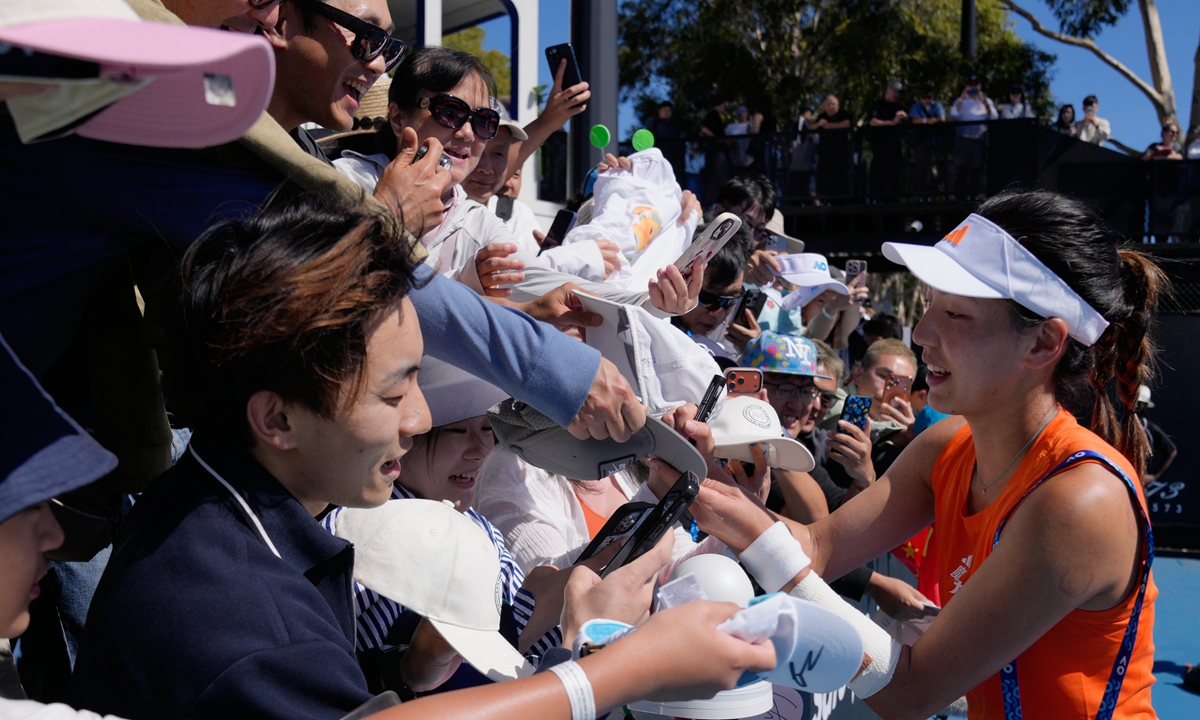
Wang Xinyu signs autographs for fans after defeating Jelena Ostapenko in their second-round match at the Australian Open in Melbourne, Australia on January 22, 2026. Photo: VCG
Chinese female tennis player Wang Xinyu became the only surviving player from the Chinese Tennis Association at the Australian Open after she qualified for the third round by defeating 24th seed Jelena Ostapenko of Latvia 4-6, 6-4, 6-4 on Thursday.The victory marked Wang's first appearance in the last 32 at the Australian Open, meaning that she has now reached the third round or better at all four majors in women's singles.
It also capped a demanding January swing in which Wang has produced wins at every event she played in. She reached the finals at the Auckland Open earlier this month, then claimed a win at the Hobart International before turning her focus to the year's first Grand Slam at Melbourne Park.
The busy schedule tested not only Wang's physical endurance but also her mental approach to the game. For Wang, the significance of qualifying into the last 32 at the Australian Open extends beyond records. In recent seasons, the 24-year-old has often spoken about the pressure she placed on herself when tennis consumed her thoughts entirely.
"I don't treat the matches as my whole life anymore. Over the past few weeks, I really felt the advantage this gave me. Besides tennis, I encourage myself to learn other things such as nutrition and psychology," Wang told reporters.
"It's really important to do things outside tennis, instead of putting tennis in my mind 24 hours a day. Because if you do that, you start thinking, 'I've invested so much, I must do well, I must win.'"
This mental balance was tested in her second-round match, in which Wang, current world No.46, dropped the opening set 4-6 before responding with two 6-4 sets to secure her place in the third round.
Wang acknowledged that the Australian Open has not traditionally been her most comfortable major.
"The courts here are really fast," she said, explaining why her past results in Melbourne had been relatively modest compared with her performances at the other Grand Slams.
Yet she drew confidence from how she handled the match.
"In the first two rounds, the opponents' balls were very flat. At the Australian Open, those are actually very tough opponents," Wang said.
"Even at the start today, I felt there weren't many chances to get into long rallies. I'm really happy that I didn't doubt myself, and when I was behind in the second set, I kept insisting on doing what I thought was right."
Those tweaks will be put to a stern test in the third round, in which Wang will face world No.13 Linda Noskova of the Czech Republic. The two have met once before, with Noskova winning in straight sets in 2025 at the Prague Open.
Noskova's ability to take the ball early and dictate tempo is well suited to Melbourne's conditions, but Wang said her preparation has been designed with such matchups in mind.
She noted that the winter training block included targeted work to raise her own pace and help her cope with opponents who play at a higher speed.
Wang now carries China's singles hopes into the third round.
In the men's singles second round on Thursday, China's Wu Yibing staged a dramatic fightback from two sets down to force a fifth set, but cramps hampered him late and he eventually lost 3-6 in the decider to exit the tournament.
Another Chinese player Shang Juncheng was also eliminated, falling in straight sets after narrowly losing the opening-set tiebreak.
RELATED ARTICLES