Japan PM dissolves lower house for snap election, sparks criticism at home
Experts call it 'high-stakes political gamble' that may pose challenge to regional stability
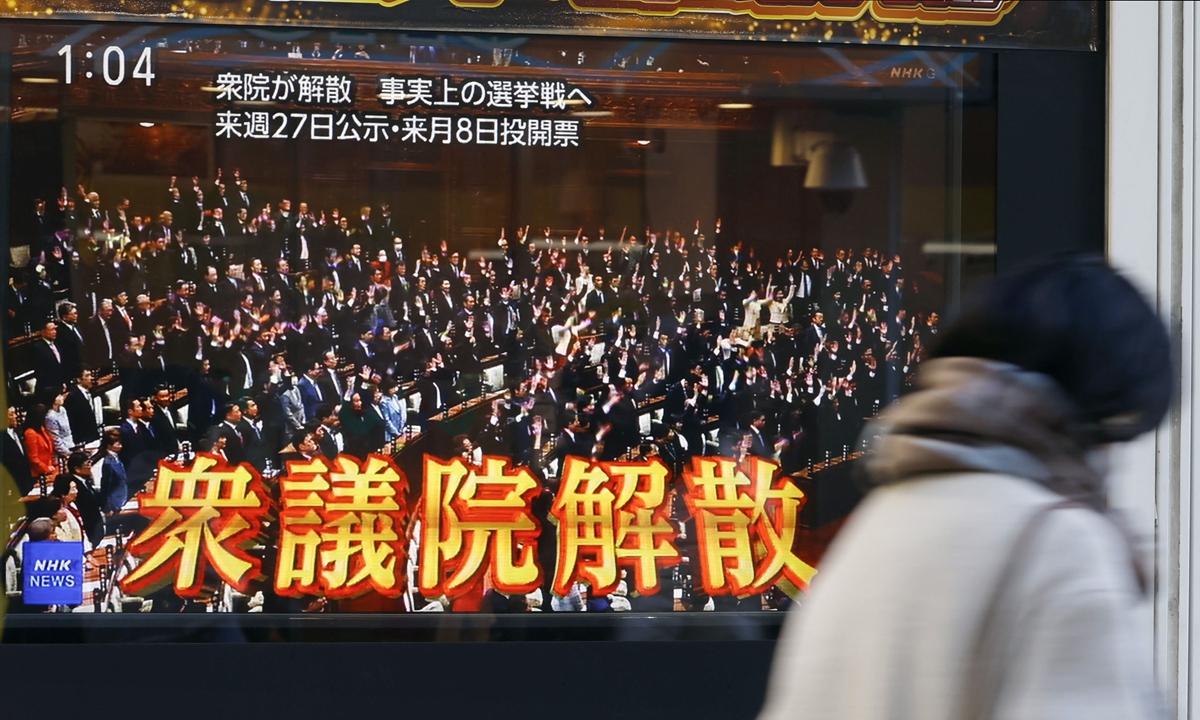
Photo taken on January. 23, 2026, shows a street television reporting news that Japanese Prime Minister Sanae Takaichi dissolved the House of Representatives earlier in the day for a snap general election on February 8. Photo: VCG
Japan's Prime Minister Sanae Takaichi on Friday dissolved the lower house of parliament, paving the way for a snap election on February 8, a move that has sparked criticism within Japan. Some Chinese experts described the decision as "high-stakes political gamble" aimed at reinforcing her leadership and advancing a right-leaning economic and security agenda.
Takaichi sees the February election as a way of gaining the public's mandate for her leadership of the ruling coalition, which consists of her Liberal Democratic Party (LDP) and the Japan Innovation Party (JIP). The two parties joined forces after the departure of Komeito from the ruling coalition after 26 years following the election of the conservative, hawkish Takaichi as LDP president, according to Japan Times.
The report also noted that this is the first time since 1990 that a snap election will take place in February - normally a time when parliament debates the budget for the next fiscal year. The budget bill must be approved in the lower and upper chambers by March 31, the end of the fiscal year, and there are concerns that the election will delay the bill's passage. Prior to the dissolution of the Lower House, the LDP-JIP coalition held a razor-thin majority of 233 seats in the 465-seat chamber.
Takaichi's move is a "high-stakes political gamble", Xiang Haoyu, a research fellow at the China Institute of International Studies, told the Global Times on Friday. He noted Takaichi is betting on "high approval ratings" to win a snap election, attempting to expand her party's majority, and consolidate her grip on power.
But the timing breaks with political convention in Japan and dissolving the lower house at the very start of a regular Diet session - just as deliberations on the 2026 budget are about to begin - is unusual and risks disrupting passage of a budget critical to government operations, economic stability, and people's livelihoods. Such a move puts personal and partisan interests above the national interest, said Xiang.
Former Japanese diplomat Hitoshi Tanaka criticized the move on X on Friday, saying that "they're forcing a third national election in just 1 year and 3 months, creating yet another political vacuum… Reckless fiscal policy combined with hardline anti-China rhetoric is plunging the Japanese economy into a serious crisis. I have absolutely no desire to vote for a Liberal Democratic Party that so shamelessly and arrogantly follows such a leader who completely disregards the people."
Takaichi's move has also drawn criticism in recent days. In a report on Friday, Tokyo Shimbun said that the decision has plunged the country into an "extremely short election campaign", with the official campaigning starting from January 27 and voting and ballot counting set for February 8. The paper also cited LDP election and political adviser Akira Kume as saying, "If I were to give it a name, I would call it a 'mysterious election.' I think many voters are puzzled and wondering why the dissolution was necessary."
The Asahi Shimbun said on Friday that "the 16-day period from dissolution to voting marks the shortest election cycle in Japan's post-war history" and the move has drawn sharp criticism from opposition parties, who call it a "self-serving dissolution to evade Diet deliberations."
"At a time when there is so much that needs to be done about rising prices, I see absolutely no justification for dissolving the Lower House," said Yoshihiko Noda, co-leader of the newly formed Centrist Reform Alliance.
Uncertainty looms
In a report on Friday, the Japan Times said the February 8 election will also be the first electoral test for the Centrist Reform Alliance, a party hastily formed by the Constitutional Democratic Party of Japan and Komeito. Up for grabs are 289 district seats and 176 proportional representation seats, the latter of which are distributed by a party among its representatives depending on the number of votes it secures.
The newly formed "Centrist Reform Alliance" quickly put forward a proposal to cut the consumption tax on food. Co-leader Yoshihiko Noda said he aims to "create a swell of centrist momentum." Many involved said "the outcome remains impossible to predict until the very end" as a tense and closely fought election campaign gets underway, according to media reports.
Xiang noted that Takaichi also pushed through a snap dissolution to undercut the opposition while the Centrist Reform Alliance is still taking shape. The alliance's emergence, he said, reflects growing unease over Takaichi's hard-right trajectory and marks a tentative realignment among moderate political forces in Japan seeking to check Japan's rightward drift.
Lü Chao, a professor at the Liaoning Academy of Social Sciences, said that Japan's broader rightward drift has set China and the wider Asia-Pacific on alert. Persistent signs of militarism and historical revisionism are unlikely to fade and could resurface when conditions allow, posing risks not only to Japanese society but to regional stability.
RELATED ARTICLES