ARTS / CULTURE & LEISURE
China-Egypt project unearths first 'sacred lake' in history
Discoveries ‘crowning achievement’ of joint team
By Li Yuche and Published: Jan 25, 2026 09:22 PM

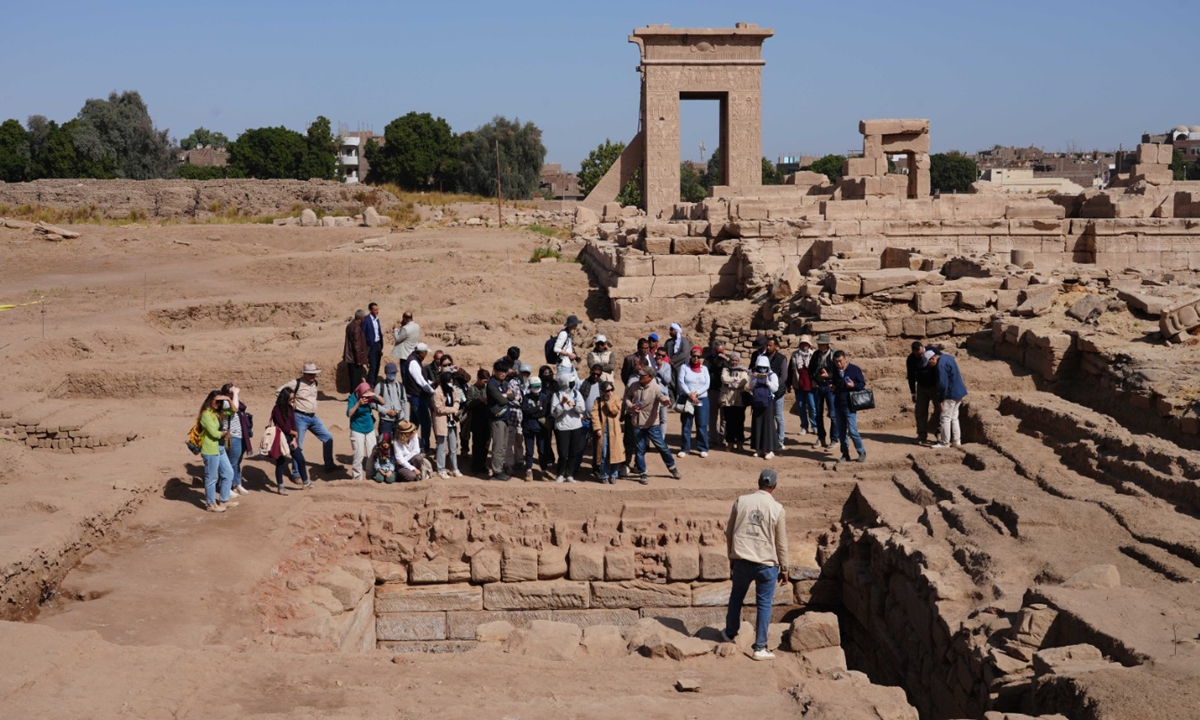
Photo: Courtesy of the China-Egypt joint archaeological team
Including a newly discovered "sacred lake," several archaeological developments have recently been made by a China-Egypt joint team around the Montu Temple site in the Karnak Temple Complex in Luxor, Egypt.The joint team has cleared and unearthed the architectural remains of a sacred lake. In Egyptian history, a "sacred lake" is not "an ordinary body of water" but rather "an artificial water system strongly connected to rituals," Qu Liang, an expert in ancient sacrificial rites, told the Global Times. Covering an area of over 50 square meters, the newly discovered sacred lake is a well-structured and well-preserved ancient man-made reservoir.
It lies west of the Maat Temple within the Montu Temple enclosure. The scared lake was found to have been dedicated to Goddess Maat. Praised for her goodness, Maat was the personification of truth, justice and harmony.
The sacred lake has an entrance built of mud bricks, reused sandstone, and sandstone stairs along the eastern wall. Stairs built along the eastern wall "lead down to the lake bed, likely used by ancient priests to collect water," said Hend Aly, the project's Egyptian member and also the inspector at the Montu Temple.
The upper edges of the lake, particularly the southern wall, were reinforced using red bricks, mud bricks, and sandstone. Notably, a sandstone block incorporated into the stairs - likely originating from the ancient gate of the Maat Temple dating to the 25th Dynasty - was repurposed here. This original gate was later replaced by a new sandstone structure during the 30th Dynasty.
"The sacred lake had been repaired several times, dating from the 30th Dynasty to the Roman Period," Jia Xiaobing, co-director of the project, told the Global Times. However, he also said, "The foundation of the structure cannot be reached by the excavation due to the water table." Jia is also the director of the world archaeological research office at the Institute of Archaeology of the Chinese Academy of Social Sciences.
While noting the newly found scared lake had "been previously undocumented," Jia told the Global Times that it "had a rectangular design and is approximately 6.5 by 6 meters in size."
"It can be distinguished from the sacred lake to the west of the Montu Temple mentioned for the first time by the French Egyptologist A. Varille in the 1940s," Jia remarked.
The two sacred lakes were in a unique configuration, standing side by side to the north and south within the Karnak enclosure walls. The one found in 2026 was therefore labeled "Southern scared lake."
The discovery of the twin sacred lakes within the same temple precinct is "the first discovery of its kind in the history of Egyptian archaeology, filling a key academic void in Egypt's archaeological history," Jia said.
In addition to architectural remains, the China-Egypt team also unearthed dozens of cow jawbone remains and some reused blocks related to the king and the Divine Adoratrice of Amun from the Late Period (747BC-332BC), a powerful female priestess in ancient Egypt. Subsequently, these reused blocks will provide crucial materials for determining the initial construction period of the sacred lake.
At another spot of the site, the "Osirian chapel" area, the China-Egypt team found three chapels dedicated to the god Osiris. The chapel is a ritual construction dedicated to "Osiris," one of the most important Egyptian gods, representing fertility, agriculture, and the afterlife. Dozens of the god's statuettes of different sizes and materials were also discovered at the spot, alongside several fragments related to the Divine Adoratrice.
Despite the progress, Jia told the Global Times that work continues. Next, the team will excavate the Northern sacred lake. He also noted that the Chinese team will take greater responsibility in upcoming tasks like "inscription analysis and 3D modelling."
Aly told the Xinhua News Agency that the new discoveries "are something rare that is the crowning achievement stemming from the hard work of the joint mission after eight years."
China-Egypt archaeological work at the Montu Temple commenced in 2018. The team has now completed eight excavations at the site to date.
RELATED ARTICLES