ARTS / CULTURE & LEISURE
Real-life ‘Zootopia’ re-emerges in many Chinese cities
Cohabitating with wildlife
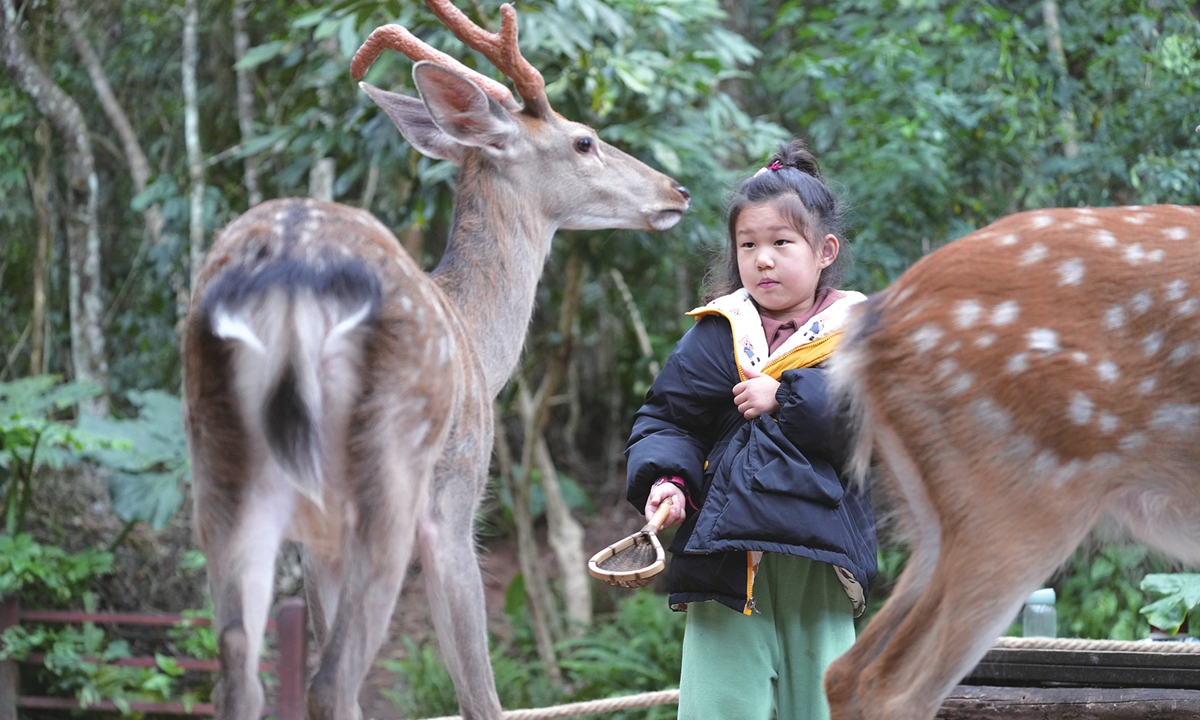
A girl gets up close to sika deer at a park in Pu'er, Southwest China's Yunnan Province.
On the edge of a grassy patch in an old Shanghai residential compound around 10 pm, a raccoon dog pokes its head out from a hole at the base of a wall, skirts past a row of trash bins, and then slips, clearly well-practiced, into the depths of a greenbelt."It comes out at about this time nearly every day," Li Qi, a Shanghai resident, told the Global Times.
"At first it would avoid people. Later it stopped being afraid, but still ignores us."
According to figures previously compiled by Xinhua News Agency, raccoon dog activity has been recorded in more than 300 residential compounds across Shanghai, with the population estimated at around 5,000.
These numbers sketch out the basic picture of raccoon dogs settling into the city. But the trend is not unique to Shanghai.
In recent years, urban residents have found themselves encountering wild animals with growing frequency. In Nanjing, East China's Jiangsu Province, some residents now habitually steer clear of green spaces where wild boars are often spotted, and in other Chinese cities, birds have taken up long-term residence under the beams and eaves of public buildings.
"It's not that there was a sudden surge at a particular moment," Li said. "You just got to realize that you seem to keep running into animals you wouldn't normally expect to see in the city."
Never went far
What is unfolding in Chinese cities today is less a sudden return than a gradual reappearance - one that links the growing frequency of encounters to deeper ecological shifts.
Li Ziyao, a biologist with a focus on urban ecology, told the Global Times that raccoon dogs are classified as a nationally protected wildlife species under second-class protection in China. Nocturnal by nature, medium-sized, somewhere between a raccoon and a dog and highly adaptable, they tend to live in groups.
"Holes at the base of walls, abandoned pipes, and concealed greenbelts can all serve as habitats," Li said.
"As urban environmental conditions continue to improve, they have gradually settled into city spaces."
According to Li, the presence of wild animals in cities is a sign that urban ecosystems are becoming more complete.
"When pollinating insects, small mammals and birds are able to form relatively stable activity chains in urban areas, it suggests that a city is no longer just a space defined solely by human activity."
Compared with the wild, cities offer fewer natural predators and more stable food sources. Whether it's raccoon dogs in Shanghai, wild boars in Nanjing, or badgers in Qingdao, Shandong Province, these are not invasive species, nor have they migrated from faraway places, according to CCTV News.
Li added that observations these years show a clear decline in these animals' wariness of humans, resulting in what is increasingly a state of mutual non-interference.
"The gradual shift is quietly reshaping how urban ecosystems function from within," Li noted.
Needed boundaries
In day-to-day encounters, many residents have developed a set of practical, almost instinctive judgments. "As long as people don't approach or disturb them, the animals usually choose to avoid humans," a Beijing-based official working in urban ecological management surnamed Ma told the Global Times.
Based on field records, Ma said cases of wild animals actively attacking people are extremely rare now. "Problems tend to arise when there is too much human interference."
From a behavioral perspective, Ma explained that most wild animals that enter urban areas retain an instinctive wariness of humans. Observations and related studies show that even when people make loud noises or obvious movements, these animals will retreat. However, the likelihood of conflict increases when they encounter cats, dogs, or other animals of similar size.
"There's actually a very simple set of principles for coexisting with wildlife in cities: Don't panic, don't touch, don't feed, and don't harm," Ma said.
In practice, he added, feeding is by far the most difficult issue to manage.
"Once fixed feeding spots form, animals change their movement patterns, and the distance needed between people and wildlife for safety is easily broken."
Zhang Mingxiang, a professor at the School of Ecology and Nature Conservation at Beijing Forestry University, told the Global Times that the growing presence of wild animals in cities is pushing urban management toward a new phase.
"Rather than relying primarily on removal or containment, cities are being challenged to adopt approaches centered on scientific coexistence, with wildlife movement and habitat restoration increasingly considered within urban planning," he said.
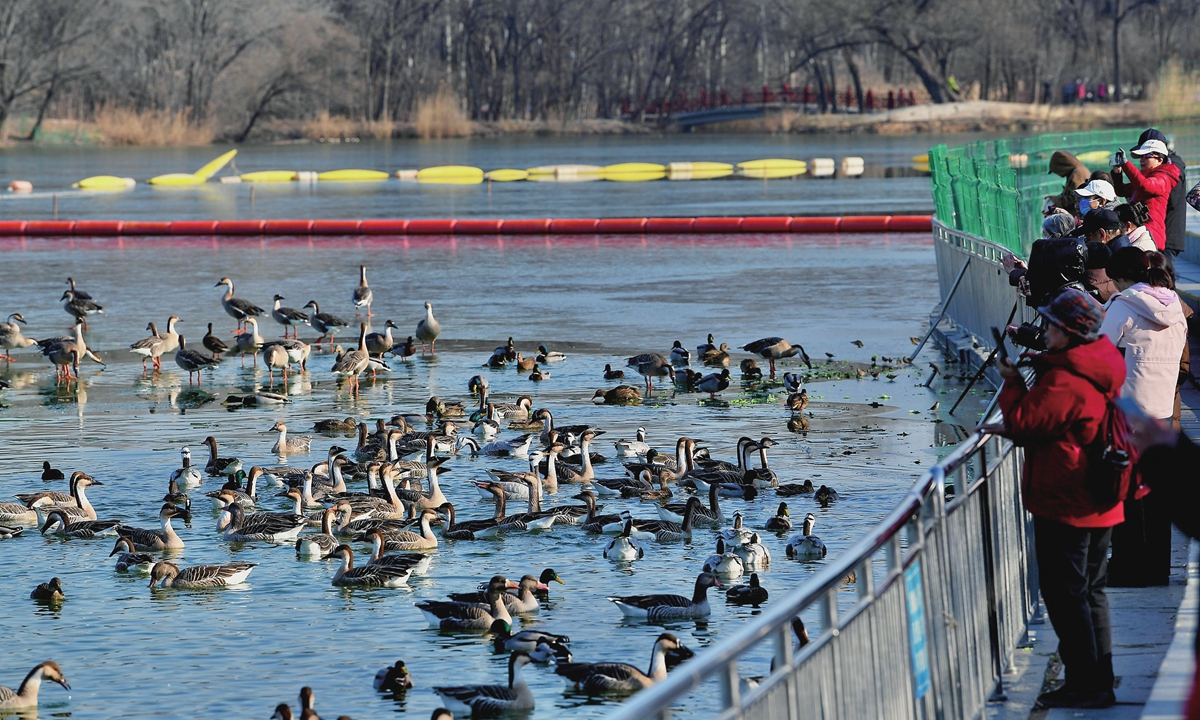
A flock of geese swim on the wetland lake at the Olympic Forest Park in Beijing on December 9, 2025, attracting visitors and photography enthusiasts. Photos: VCG
Ways to goPublic behavior can be a critical factor in whether coexistence can continue unimpeded.
According to Zhang, while some cities have begun establishing observation networks, expanding public education, and experimenting with more ecological forms of green space design, some gaps remain in clearly defining responsibilities, aligning long-term ecological planning, and reshaping everyday human behavior.
"Progress is most likely to come through gradual, preventive measures," he said.
"These include introducing clearer spatial zoning in areas where wildlife activity is frequent, expanding ecological corridors, and improving on-site guidance to reduce unnecessary contact between people and animals. There is value in new community-based roles," Zhang said. "Ultimately, the goal is not to eliminate encounters, but to reduce risk before conflicts emerge, protecting human safety while allowing urban ecosystems to function more smoothly."
Shanghai, for example, has begun responding to this reality with more refined measures.
The city has conducted four rounds of raccoon dog population surveys. Based on extensive questionnaires and field observations, a series of targeted recommendations have been proposed, including stricter controls on feeding and waste management, as well as better protection of private courtyards and balconies to reduce unnecessary disruption to residents.
Today, animals have already reclaimed the margins of urban life, and in these seemingly minor, everyday adjustments, the relationship between people and nature is quietly being recalibrated.
RELATED ARTICLES