ARTS / BOOKS
Read good books, read wisely: China's new regulations nurture inclusive reading for all
Read good books, read wisely
By Published: Jan 26, 2026 11:08 PM

Editor's Note:
Reading is an important avenue for humans to acquire knowledge, expand wisdom and cultivate virtues. It enlightens us and helps us aim high and stand upright.
As China's first national regulations to promote public reading are set to take effect on February 1, the country is entering a new phase for its national reading initiative. The regulations explicitly call for improving reading services for different groups and advancing reading equity through institutional guarantees.
The Global Times is launching a special series to show how reading is changing people's lives. This first installment will focus on how the regulations are breaking down barriers to reading for everyone.
The 38-year-old Jiangxi native lives with severe visual and other physical disabilities as cerebral palsy limits her mobility and eyesight, but such hardships have never blocked her path to reading.
"Reading is my way of walking. It opens a window to the world when my body limits my steps," Wu told the Global Times.
Wu's experience embodies the spirit of China's first national regulations to promote public reading which are set to take effect on February 1. A cornerstone for building a "nation of lifelong readers," they mandate improved services for disadvantaged groups, including persons with disabilities and the elderly, ensuring literary nourishment is accessible to all.
Power of reading
Wu's bond with the Jiangxi Provincial Library began years ago, when the library was still in its old building. She participated in a speech contest held by the library, writing and delivering a speech. She is drawn to Chinese classics like poetry. Now, she visits the Braille room two or three times a week to read, or to sit quietly for a lecture, letting the words flow into her heart.
A borrowed book titled Bright Black Eyes once gave her strength. Its message has stayed with her: One can have visual barriers, yet possess an inner world that is bright and open.
At the library, Wu is more than a reader, she is also a volunteer storyteller. In the library's recording studio, she found another door had opened for her. Guided by the supportive staff, she began recording audiobooks for children. "Poetry is a treasure of our culture, our shared spiritual wealth," she said. Her passion inspired a poetry group made up of her friends with disabilities, who later joined a local poetry society.
"We encourage each other and progress together," Wu said, noting that national reading is spreading across professions, from Liu Shili, a construction worker who has been celebrated for reading, to Wang Jibing, a food deliveryman who has made a name for himself with his poetry.
"They have a light in their eyes. Though we've never met, I feel a connection," Wu said.
The reading regulations' mandate for improved services for persons with disabilities encourages the publication of accessible formats and the establishment of inclusive facilities.
Audio, large-print, Braille, electronic publications and barrier-free reading facilities… Wu has benefited deeply from these provisions: librarians recommend books to her via WeChat and deliver them to her home. She also received a "Sunshine Reader" device, which converts text to audio and offers a wealth of classics, English learning resources, and accessible films. "It's a treasure trove, and the resources keep expanding," she said.
Silver-haired pursuits
The culture of inclusion fostered by the regulations extends across ages. Article 38 of the regulations specifically highlights services for elderly persons, encouraging age-appropriate content and activities that have become a principle brought to life in the lecture halls of Beijing's libraries.
In the Capital Library of China, 62-year-old retired engineer Teng Lijing takes notes on a talk about Beijing's historical architecture. For Teng, these lectures, followed by deep dives into related books, have redefined her retirement.
As a Beijinger, Teng spent her career in precision automotive research, but she has always hidden a passion for the humanities and social sciences. Retirement finally gave this passion room to flourish. "Lectures open the door to culture, and reading helps me dig deeper," she said.
Teng sees this as actively fulfilling the regulations' call to "read good books, and read wisely."
Her rigorous approach, which includes researching speakers and preparing questions, has impressed scholars and built a community of like-minded friends. They discuss topics, visit exhibitions and spread the joy of reading.
Reading is "emotional medicine" for Teng's silver years, and a "spiritual window" broadening her horizons. Faced with grief over lost loved ones and the health concerns of peers, immersing herself in books and culture gives her a haven. "I have no time for sorrow. My life is filled with what I love, and my heart is full," she said.
This culture of lifelong learning resonates widely. A 2025 reading report from the Hubei Provincial Library shows a post-1990 reader topped the library's borrowing list with 1,925 books, marking his third consecutive year in the top 10.
The list included readers of all ages, with interests ranging from literature to health. Whether for in-depth study or leisure, reading offers a fulfilling, peaceful retreat.
Mao Yajun, director of the Capital Library of China, told the Global Times that the national reading regulations safeguard more than just increased book counts or reading rates, it aims for a deeper state of social civilization.
"Reading preserves a city's unique cultural bloodline. Through exploring local documents, sharing urban stories, and nurturing local writers, reading preserves historical memories and strengthens one's cultural identity," Mao said.
From Wu Siyu's fingertips in Jiangxi to Teng Lijing's notebook in Beijing, individual stories of empowerment are increasingly supported by China's national framework.
Ma Yongqiang, chairman of the Gansu Provincial Literary Critics Association, told the Global Times that the regulations elevate reading to a crucial position for building a cultural powerhouse and preserving cultural heritage. This helps all walks of life, public welfare and the market, as well as the government and society, to understand reading from the perspective of national development and the inheritance of the nation's cultural genes.
Reading is an important avenue for humans to acquire knowledge, expand wisdom and cultivate virtues. It enlightens us and helps us aim high and stand upright.
As China's first national regulations to promote public reading are set to take effect on February 1, the country is entering a new phase for its national reading initiative. The regulations explicitly call for improving reading services for different groups and advancing reading equity through institutional guarantees.
The Global Times is launching a special series to show how reading is changing people's lives. This first installment will focus on how the regulations are breaking down barriers to reading for everyone.
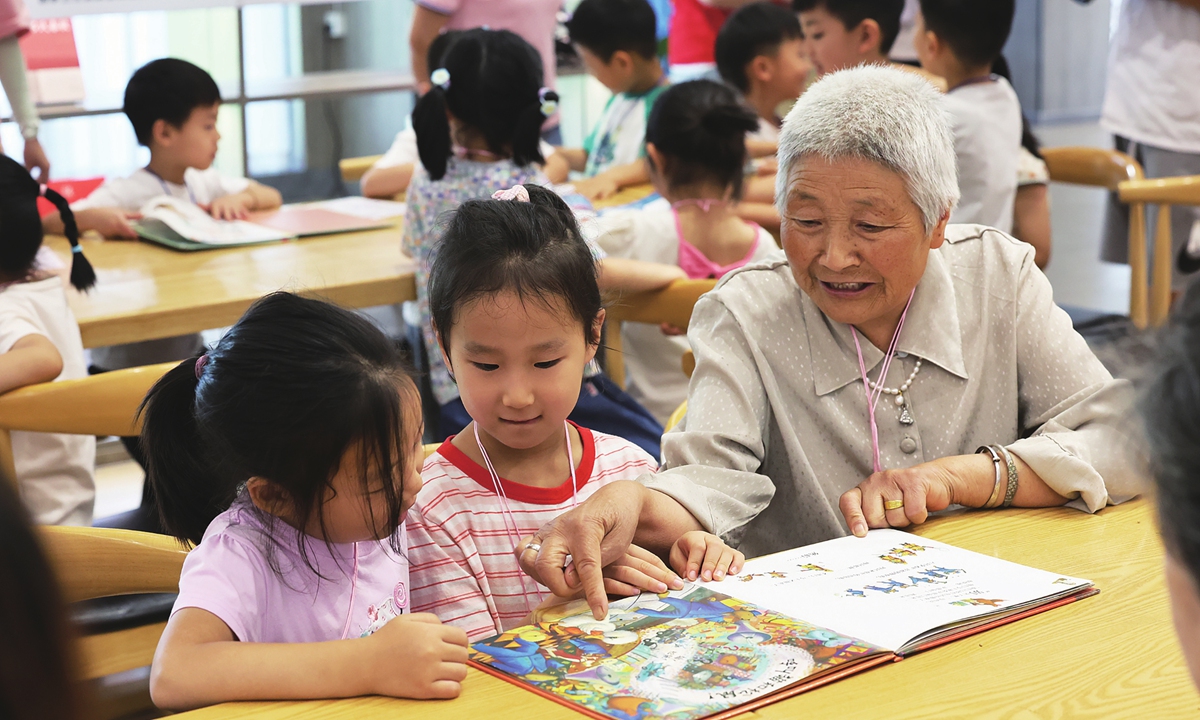
Children and an elderly lady enjoy reading together at a book club meeting in Wuhu, East China's Anhui Province on June 6, 2025. Photo: VCG
Winter sunlight filters through the windows of the Braille Reading Room at the Jiangxi Provincial Library, settling gently on Wu Siyu's fingers. Her hands, slightly unsteady due to cerebral palsy, glide tenderly yet intently over the raised dots of a Braille book, as a librarian's soft voice checks in on her.The 38-year-old Jiangxi native lives with severe visual and other physical disabilities as cerebral palsy limits her mobility and eyesight, but such hardships have never blocked her path to reading.
"Reading is my way of walking. It opens a window to the world when my body limits my steps," Wu told the Global Times.
Wu's experience embodies the spirit of China's first national regulations to promote public reading which are set to take effect on February 1. A cornerstone for building a "nation of lifelong readers," they mandate improved services for disadvantaged groups, including persons with disabilities and the elderly, ensuring literary nourishment is accessible to all.
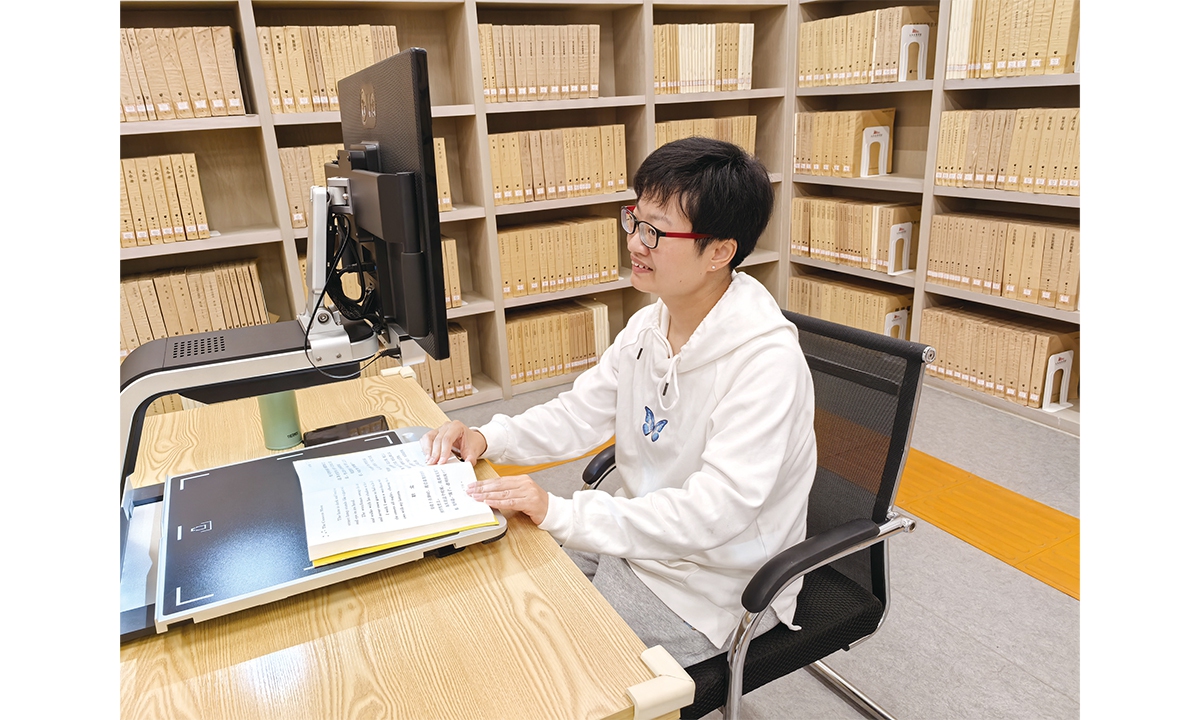
Wu Siyu, a visually impaired reader, read books with the assistance of an electronic video magnifier at the Jiangxi Library on June 20, 2025. Photo: Courtesy of Wu
Power of reading
Wu's bond with the Jiangxi Provincial Library began years ago, when the library was still in its old building. She participated in a speech contest held by the library, writing and delivering a speech. She is drawn to Chinese classics like poetry. Now, she visits the Braille room two or three times a week to read, or to sit quietly for a lecture, letting the words flow into her heart.
A borrowed book titled Bright Black Eyes once gave her strength. Its message has stayed with her: One can have visual barriers, yet possess an inner world that is bright and open.
At the library, Wu is more than a reader, she is also a volunteer storyteller. In the library's recording studio, she found another door had opened for her. Guided by the supportive staff, she began recording audiobooks for children. "Poetry is a treasure of our culture, our shared spiritual wealth," she said. Her passion inspired a poetry group made up of her friends with disabilities, who later joined a local poetry society.
"We encourage each other and progress together," Wu said, noting that national reading is spreading across professions, from Liu Shili, a construction worker who has been celebrated for reading, to Wang Jibing, a food deliveryman who has made a name for himself with his poetry.
"They have a light in their eyes. Though we've never met, I feel a connection," Wu said.
The reading regulations' mandate for improved services for persons with disabilities encourages the publication of accessible formats and the establishment of inclusive facilities.
Audio, large-print, Braille, electronic publications and barrier-free reading facilities… Wu has benefited deeply from these provisions: librarians recommend books to her via WeChat and deliver them to her home. She also received a "Sunshine Reader" device, which converts text to audio and offers a wealth of classics, English learning resources, and accessible films. "It's a treasure trove, and the resources keep expanding," she said.
Silver-haired pursuits
The culture of inclusion fostered by the regulations extends across ages. Article 38 of the regulations specifically highlights services for elderly persons, encouraging age-appropriate content and activities that have become a principle brought to life in the lecture halls of Beijing's libraries.
In the Capital Library of China, 62-year-old retired engineer Teng Lijing takes notes on a talk about Beijing's historical architecture. For Teng, these lectures, followed by deep dives into related books, have redefined her retirement.
As a Beijinger, Teng spent her career in precision automotive research, but she has always hidden a passion for the humanities and social sciences. Retirement finally gave this passion room to flourish. "Lectures open the door to culture, and reading helps me dig deeper," she said.
Teng sees this as actively fulfilling the regulations' call to "read good books, and read wisely."
Her rigorous approach, which includes researching speakers and preparing questions, has impressed scholars and built a community of like-minded friends. They discuss topics, visit exhibitions and spread the joy of reading.
Reading is "emotional medicine" for Teng's silver years, and a "spiritual window" broadening her horizons. Faced with grief over lost loved ones and the health concerns of peers, immersing herself in books and culture gives her a haven. "I have no time for sorrow. My life is filled with what I love, and my heart is full," she said.
This culture of lifelong learning resonates widely. A 2025 reading report from the Hubei Provincial Library shows a post-1990 reader topped the library's borrowing list with 1,925 books, marking his third consecutive year in the top 10.
The list included readers of all ages, with interests ranging from literature to health. Whether for in-depth study or leisure, reading offers a fulfilling, peaceful retreat.
Mao Yajun, director of the Capital Library of China, told the Global Times that the national reading regulations safeguard more than just increased book counts or reading rates, it aims for a deeper state of social civilization.
"Reading preserves a city's unique cultural bloodline. Through exploring local documents, sharing urban stories, and nurturing local writers, reading preserves historical memories and strengthens one's cultural identity," Mao said.
From Wu Siyu's fingertips in Jiangxi to Teng Lijing's notebook in Beijing, individual stories of empowerment are increasingly supported by China's national framework.
Ma Yongqiang, chairman of the Gansu Provincial Literary Critics Association, told the Global Times that the regulations elevate reading to a crucial position for building a cultural powerhouse and preserving cultural heritage. This helps all walks of life, public welfare and the market, as well as the government and society, to understand reading from the perspective of national development and the inheritance of the nation's cultural genes.
RELATED ARTICLES