ARTS / CULTURE & LEISURE
Dim sum hometown establishes morning tea standard to safeguard heritage and culture
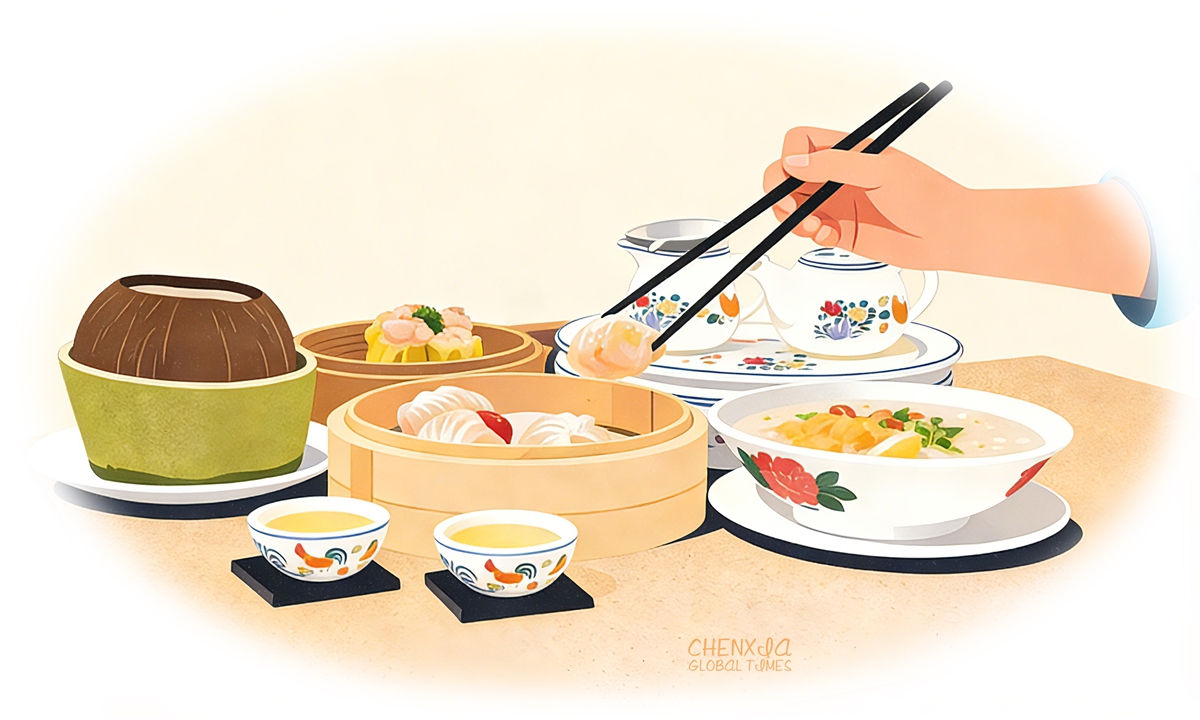
Illustration: Chen Xia/GT
Just as spicy hotpot is to Sichuan and hulatang (spicy soup) is to Henan, zao cha (morning tea) is the culinary soul of Guangzhou, South China's Guangdong Province.Recently, a set of new regulations governing Guangzhou morning tea culture has been adopted at the 47th Session of the Standing Committee of Guangzhou Municipal People's Congress. The regulations call for the classification of morning tea into "traditional" and "non-traditional" categories for targeted protection and they also emphasize that its inheritance should incorporate initiatives such as digital preservation and talent development.
While the enactment of the regulations grants the local morning tea routine legislative importance, it also raises a question: Why does zao cha deserve such high regard and protection in Guangzhou?
The answer to this question lies in the tradition's cultural and social connotations, which extend far beyond the palate experience alone.
Originating from the Qing Dynasty (1644-1911), the tradition has developed its defining soul of "Yizhong Liangjian" - one pot of tea and two dim sum (bite-sized snack) dishes - through generations of everyday practice. The "tea" typically refers to Pu'er and chrysanthemum tea, while the most popular dim sum dishes among diners include shrimp dumplings, Guangdong-style rice noodle rolls and egg tarts.
Be it young dinners or senior eaters, zao cha serves not just to satisfy their stomach, but helps them express an attitude toward life. "Like some people enjoy working at a cafe, I prefer our morning tea houses. It's my way of slowing down, and it reflects the unhurried attitude toward life that we embrace here," Liao Li, a 34-year-old journalist and Guangzhou local, told the Global Times.
The "unhurried lifestyle" embodied by zao cha has made this culinary tradition an integral part of urban life shared by residents. The new regulations, then, aim not merely to protect the dishes, but to safeguard the city's collective cultural memory.
This is why they call to preserve the "in-person and handcrafted" nature of the tradition. Because only authentic flavors can deepen people's cultural memory, especially today, when quick, convenient pre-made dishes are rapidly taking over dining tables.
Beyond tea and dishes, scattered tea houses across the city can draw people of different backgrounds to one place. It indirectly reshapes how people interact. In other words, a morning tea house can serve as a social living room, weaving closer bonds among neighbors, families and strangers alike.
"We are both retired, so joining our old pals at the tea house is our daily 'job' now," Liao Guangming, a 67-year-old retired teacher living in Guangzhou's Liwan district, told the Global Times.
Real human connections give tea houses social importance, but such importance can only be amplified when restaurants operate with transparency and standardization. To address this, the new regulations also encourage measures such as "clear pricing" and "standardizing tea seating fees" to foster a healthier consumer environment.
In 2022, the Guangzhou morning tea was included in the eighth batch of provincial-level intangible cultural heritage (ICH) representative projects of Guangdong Province.
This ICH title elevates the making techniques of tea and dim sum into the most tangible and protected core of zao cha culture. Details such as the elasticity of rice noodle sheets, the precise weight of each shrimp dumpling, and the exact ratio of ingredients in steamed barbecued pork buns… these minutiae constitute the very originality of zao cha.
Maintaining originality is key. That is the reason why the regulations have highlighted that restaurant owners can only label their servings under "the traditional type" if the food's "time from production to consumption generally does not exceed 24 hours."
On the one hand, this "traditional type" of morning tea cannot be replicated by pre-made foods. On the other hand, it demands more experienced makers, and these culinary masters are often advanced in age.
Hence, the crux of inheriting the culture lies in cultivating more practitioners. This has also been underlined by the new regulations, which prioritize talent development.
A most encouraging aspect of this approach is its potential to attract young people to the cause. Perhaps one day, these young zao cha masters will create innovative flavors while also carrying the culture to a far wider world.
Throughout history, Guangzhou has been a city of commerce, embracing exchanges with the world. Its iconic zao cha is therefore not only the city's calling card but also a representative Chinese culinary treasure going global.
Be it in Chinatown in the UK or in countries across the Americas - from Panama to the US and Canada - zao cha culture has long become a global phenomenon. It evokes nostalgia among overseas Chinese while bridging cross-cultural friendship among people.
While the new regulations address the domestic morning tea market, they also lay the foundation for the global development of the culinary culture. That is to enable it to reach the world with a credible image, rather than being perceived merely as a foreign cuisine without roots.
The author is a reporter with the Global Times. life@gloaltimes.com.cn
RELATED ARTICLES