China to advance three international technological innovation centers in Beijing, Shanghai and Greater Bay Area in 2026
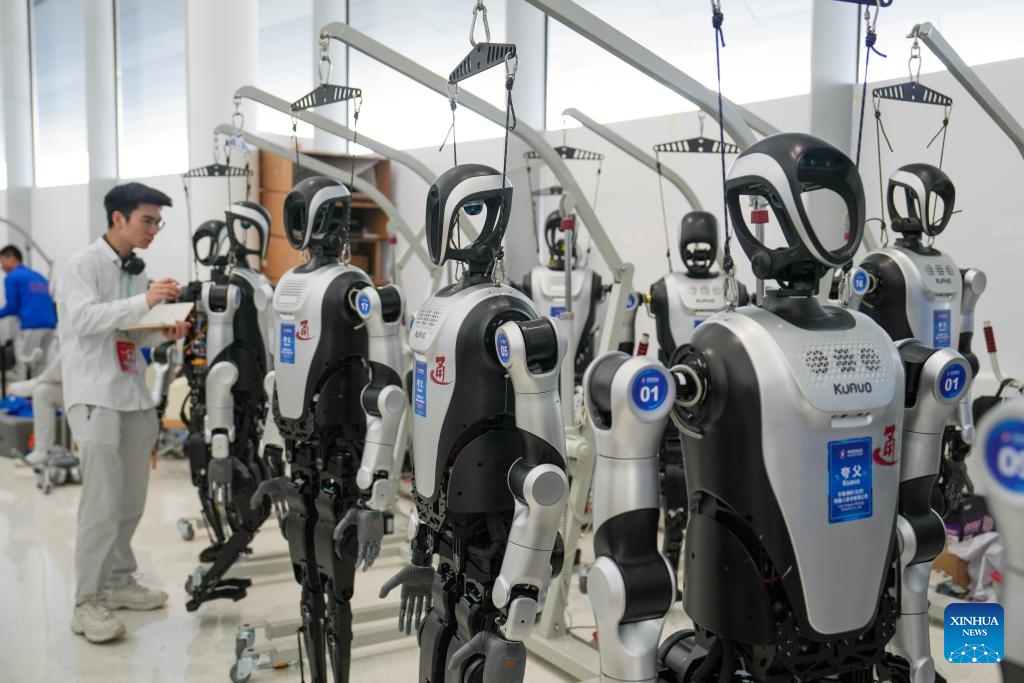
A machinist debugs humanoid robots at Zhongguancun International Innovation Center, venue for the 2025 Zhongguancun Forum (ZGC Forum) Annual Conference, in Beijing, capital of China, March 27, 2025. Themed "New Quality Productive Forces and Global Technology Cooperation," this year's annual conference of the forum showcases the latest technologies and products on humanoid robots. (Photo: Xinhua)
China will move to advance the high-level development of its three international technological innovation centers in 2026, alongside stronger efforts to boost original innovation and achieve breakthroughs in key core technologies, according to a national science and technology conference held from Monday to Tuesday.
The conference, convened by the Ministry of Science and Technology, stressed that China will accelerate the building of regional science and technology innovation centers, fostering innovation-driven growth poles that can better support high-quality regional development, Xinhua News Agency reported on Tuesday.
China's three international technological innovation centers include Beijing (Beijing-Tianjin-Hebei region), Shanghai (Yangtze River Delta), and the Guangdong-Hong Kong-Macao Greater Bay Area (GBA).
The two-day conference said that China's regional innovation layout became more optimized in 2025, with the development of the three innovation centers entering a new stage, marking one of the year's key achievements in the country's science and technology innovation, according to Xinhua.
Other advancements in 2025 included coordinated progress in building China's national strategic scientific and technological capabilities, with fresh gains in the construction of national laboratories, stronger cultivation of leading technology enterprises, and deeper reform and innovation at national research institutes and high-level research universities.
Minister of Science and Technology Yin Hejun said that the 15th Five-Year Plan period (2026-30) will be a critical phase for achieving high-level sci-tech self-reliance and building China into a science and technology powerhouse.
Priority should be given to original and leading-edge breakthroughs, alongside stronger innovation deployment across all fields and along the entire innovation chain, to ensure the effective implementation of major tasks for building a strong sci-tech nation, he said.
Yin further called for faster organization and implementation of major science and technology projects, stronger system-level capabilities of national strategic scientific forces to tackle key challenges, deeper integration of scientific and technological innovation with industrial innovation, and higher-level international cooperation in science and technology.
Recent international and domestic assessments also point to China's rising position in the global innovation landscape. According to the International Science and Technology Innovation Center Index 2025 released by Tsinghua University in November last year, Chinese innovation cities continued to strengthen their advantages globally.
Among the world's top 10 cities or metropolitan areas, Beijing ranked among the top three for four consecutive years, the GBA climbed to fourth place from sixth, and Shanghai ranked 10th.
Global Times
RELATED ARTICLES