'Donald, enough!' Der Spiegel's latest cover highlights Europe's growing frustration as transatlantic tensions rise: Chinese expert
By and Published: Jan 28, 2026 07:54 PM


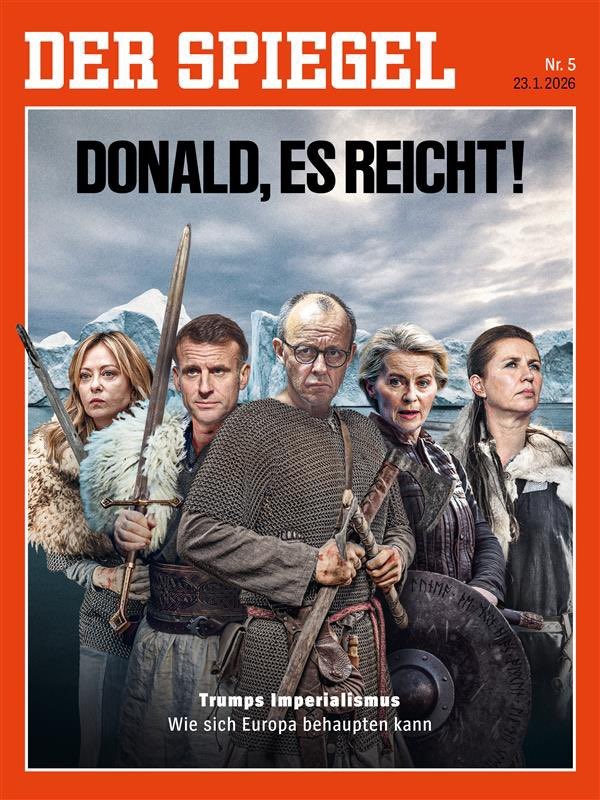
Screenshot of Germany's Der Spiegel magazine cover
The latest cover of Germany's Der Spiegel magazine, headlined "Donald, Enough!", features five European leaders dressed in hunting attire against the backdrop of Greenland's glaciers. The cover design reflects growing frustration in Europe over mounting pressure from Washington, a Chinese expert said. The expert noted that transatlantic relations have entered a critical period marked by increasing friction and uncertainty, and that while the EU is aware of the importance of strategic autonomy, achieving it will require time and greater unity.
The cover features five European leaders, with German Chancellor Friedrich Merz at the center, flanked by French President Emmanuel Macron, European Commission President Ursula von der Leyen, Italian Prime Minister Giorgia Meloni, and Danish Prime Minister Mette Frederiksen. All are dressed in hunting attire, holding weapons, against the backdrop of Greenland's glaciers.
Framing US President Donald Trump's actions as "imperialism," the cover questions how Europe can defend its own interests. In its in-depth analysis titled "Donald, Enough! What Europe Must Do to Push Back Against Trump's Hunger for Power," Der Spiegel said that the drama surrounding the temporarily shelved annexation of Greenland has exposed Europe's vulnerability, while stressing that the European Union possesses ample tools to resist Trump's coercive tactics.
The article reviews the US' recent escalating pressure on the EU over Greenland and notes that Trump has repeatedly stated his desire to incorporate the island into the US, even though it belongs to Denmark, a close US ally and a founding member of NATO.
The article also said that Trump clearly intends to turn Europe into a US backyard—a colony he can dominate politically and carve up at will. If Europeans fail to push back decisively against this plan, they risk becoming vassals of the US.
As one of Germany's most influential mainstream outlets, Der Spiegel often reflects prevailing European perspectives and has maintained a critical stance toward transatlantic relations under the Trump administration. Its recent cover and accompanying analysis highlight a growing sense of frustration among European elites over escalating tensions with the US, Zhao Junjie, a senior research fellow at the Institute of European Studies at the Chinese Academy of Social Sciences, told the Global Times on Wednesday.
Trump's first year back in office has left Europe deeply disillusioned, with many viewing Washington as treating the continent less as a valued partner than as a tool of renewed American imperial ambition. This unease and resentment are now being widely echoed across European media discourse, said the expert.
The article of the Der Spiegel also warns that Europe's dependence on the US in defense, technology, finance, and trade has left it dangerously vulnerable. It noted that for Europe, Trump's presidency is both "a shock and an opportunity" and it starkly exposes how dependent the old continent has become on the US over the past decades. Europeans do not produce modern fighter jets capable of matching America's fifth-generation stealth aircraft. They lack credit card companies and AI firms that can even come close to competing with their US counterparts. Nor do they possess an effective, shared nuclear deterrent.
In the section on what the EU should do, the article notes that Europe should standardize its weapons, demonstrate its instruments of leverage—particularly in the financial arena—and develop its own AI technology.
The EU should still be strong enough to take its fate into its own hands. It simply has to be willing to do so—and must avoid sabotaging itself, said the article, noting that this requires abandoning the illusion that the US under Trump remains a partner, painful as that may be, especially in light of Ukraine, according to the article.
Zhao noted that the transatlantic relationship appears to be approaching a critical inflection point—verging on strategic decoupling and heightened confrontation. Trust has eroded sharply, and rivalry is becoming more pronounced.
The prime ministers of Denmark and Greenland met German Chancellor Friedrich Merz in Berlin on Tuesday, and will travel to Paris on Wednesday to shore up support over US President Donald Trump's push to take over the Arctic island, according to Reuters.
The US demand for control of Greenland has shaken transatlantic relations and accelerated European efforts to reduce dependence on the United States, even as Trump last week withdrew tariff threats and ruled out taking Greenland by force, per Reuters.
In a report on Tuesday, The Guardian said that "Trump's attempted Greenland grab has driven a wedge between the US president and some of his ideological allies in Europe, as previously unstinting enthusiasm and admiration collides with one of the far right's key tenets: national sovereignty."
It also noted that polling published on Tuesday by the Paris-based European affairs debate platform Le Grand Continent suggested that between 18 percent and 25 percent of far-right voters in France, Germany, Italy and Spain consider Trump as an "enemy of Europe."
Europe is fully aware of the importance of strategic autonomy, but it is unlikely to achieve it overnight; true independence requires time and the removal of structural obstacles, Zhao said. He noted that even as Europe moves toward greater autonomy, forces favoring close alignment with Washington are likely to persist and impede that process.
Achieving genuine autonomy, the expert added, will require stronger unity and political resolve across the bloc.
Der Spiegel's cover has drawn attention online, with some netizens reposting the image and sharing their views, while others criticizing the EU for its lack of unity in the face of pressure from the US.
Carl Bildt, a Swedish politician and diplomat who previously served as Sweden's prime minister and foreign minister, wrote on X that the political fallout from the dramas in Davos would be substantial. He noted that the magazine portrays the EU as "ready to resist."
RELATED ARTICLES