Exclusive: Renowned Japanese group criticizes Takaichi's dissolution of lower house as against public opinion, expects 'a stern verdict' on the administration in election
By and Xing Xiaojing Published: Jan 29, 2026 10:15 PM

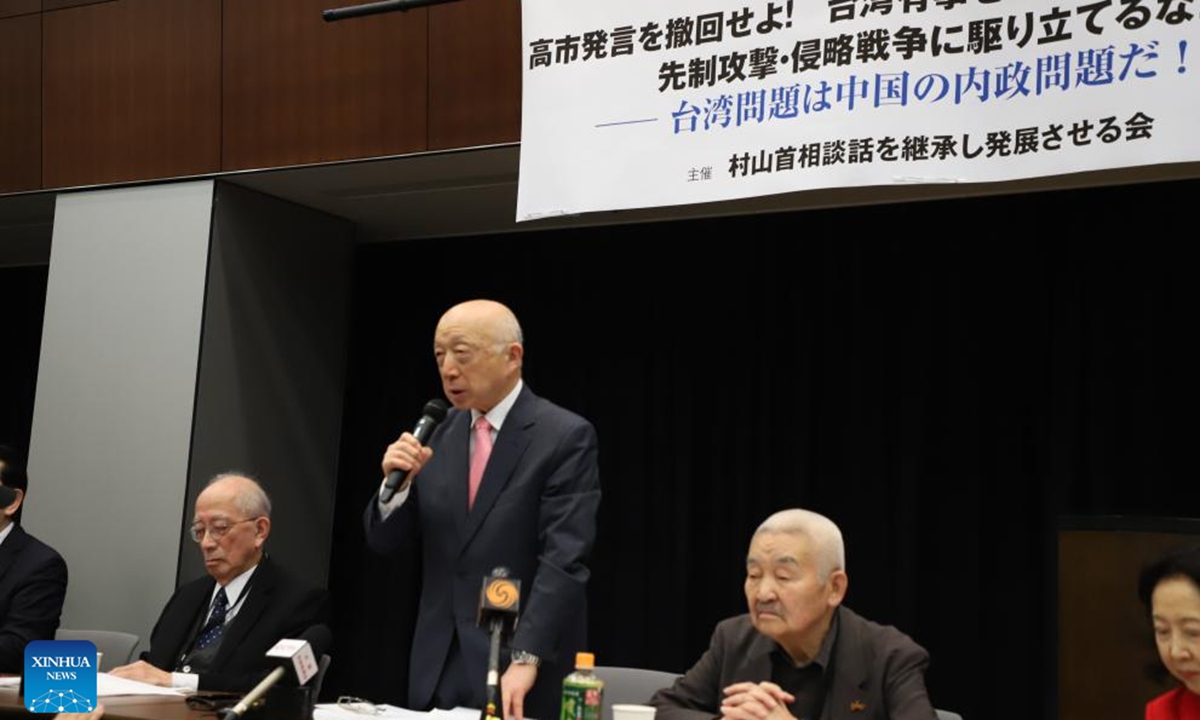
Takakage Fujita, the secretary-general of the Association for Inheriting and Propagating the Murayama Statement, reads out a statement demanding Takaichi withdraw her comments at a press conference in Tokyo, Japan, December 8, 2025. Photo: Xinhua
Japanese Prime Minister Sanae Takaichi's initiation of a snap election campaign for the House of Representatives on Tuesday — described by Japanese media as "an unusually early election at an unusual time" — has continuously drawn domestic criticism. In an exclusive interview with the Global Times on Thursday, Takakage Fujita, secretary-general of the Association for Inheriting and Propagating the Murayama Statement, described the dissolution of the lower house and the election as "against public opinion." He believes that the move aims to consolidate the ruling foundation of the "anti-China, ultra-right " Takaichi administration and advance its path toward becoming a military power.
On Tuesday, campaigning began for the Japanese lower house election, set to take place on February 8, after Takaichi dissolved the lower house on January 23.
Some Japanese media have noted that besides the weak position of the ruling party, factors behind the house dissolution and election also included strained China-Japan relations following her Taiwan-related provocative remarks. Commenting on this, Fujita told the Global Times on Thursday that the Takaichi cabinet has been seized by the ultra-right and pro-Taiwan independence factions of the Liberal Democratic Party (LDP).
Fujita believed Takaichi administration attempts to achieve three major goals if they can win this election.
"First, to realize a large-scale military expansion in preparation for a potential conflict with China; second, to unite the coalition partner Japan Innovation Party (JIP) and other right-wing parties including Sanseito party, the Democratic Party for the People and the Conservative Party to enact the anti-spy law, a modern version of the Peace Preservation Law; third, to revise the Three Non-Nuclear Principles and fully lift the ban on weapons exports. Furthermore, taking these moves as a breakthrough, the Takaichi administration is pushing forward ultra-reactionary politics that suppresses public opinion and democracy on all issues, with the ulterior motive of revising the pacifist Constitution," Fujita said.
At present, the election situation is still hard to predict, Xiang Haoyu, a distinguished research fellow at the China Institute of International Studies, told the Global Times on Thursday.
But if the LDP can secure 233 seats alone in the end, or if the ruling coalition can win 244 seats to form a stable majority, then Takaichi's ruling position will become more solid and stronger; moreover, there will be no major national political elections in Japan for the next two and a half years, and she may also take this opportunity to establish a long-term administration, Xiang warned.
In this case, Xiang cautioned, Takaichi will be far more likely to forcefully advance her controversial agendas mentioned by Fujita, and the resistance she faces in Japanese political circles and society will be relatively small. The expert warned that once Japan's remilitarization process accelerates, it will inevitably produce spillover effects on regional security.
"This dissolution goes against public opinion," Fujita said, noting the dissolution for an election has suppressed parliamentary questioning into major suspicious issues involving prime minister Takaichi herself, such as political funding and the controversial Unification Church ties, and also delayed and even abandoned measures to address the soaring prices that have plagued the Japanese people.
Regarding timing of Takaichi's dissolution of the lower house for a snap election, Asahi Shimbun reported on January 19 that a factor is deteriorated relations with China following Takaichi's Taiwan-related claims.
As Takaichi's erroneous remarks on Taiwan continue to escalate tensions, the Association for Inheriting and Propagating the Murayama Statement held an assembly in Tokyo on Thursday, attended by former senior Japanese officials as well as prominent Japanese scholars, university professors and lawyers. The assembly demanded that Takaichi retract her Taiwan-related remarks and stressed that it will "never allow Japan to launch another war of aggression against China."
One of the guests at the assembly was former Japanese Prime Minister Yukio Hatoyama, who criticized Takaichi's erroneous remarks for damaging China-Japan relations. He stated, "She cannot be allowed to continue serving as prime minister," and reminded voters to take this into account when casting their ballots in the House of Representatives election, Kyodo News reported on Thursday.
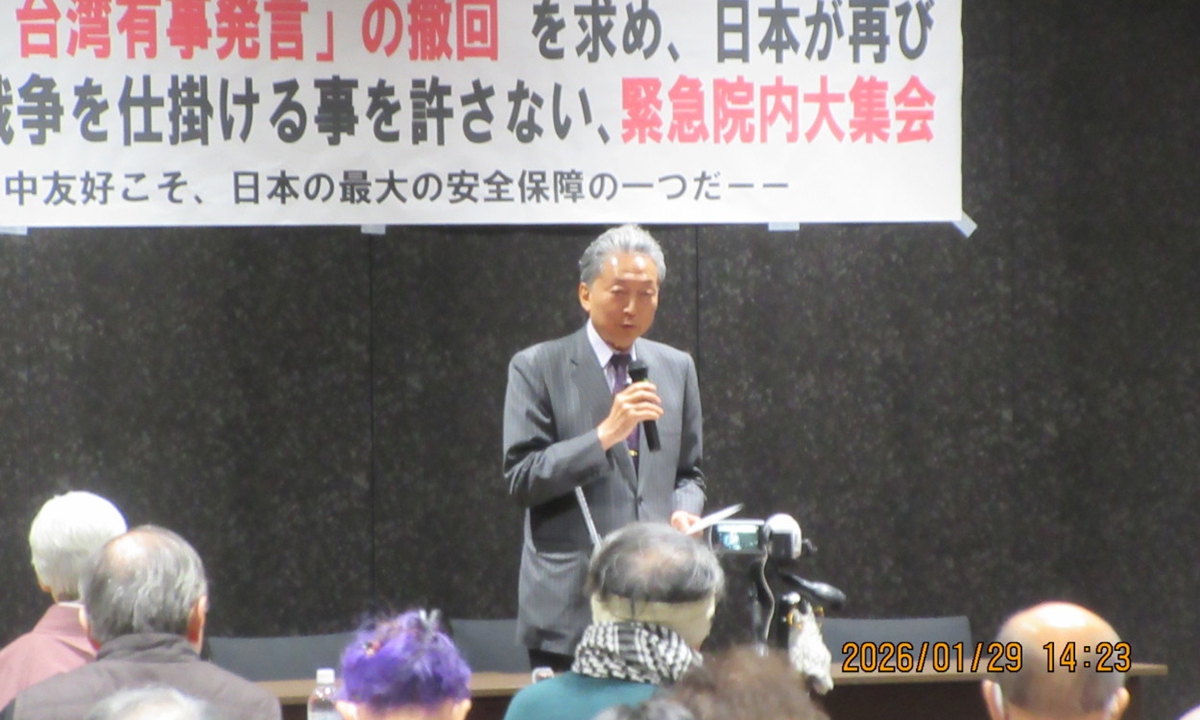
Former Japanese prime minister Yukio Hatoyama attends an assembly in Tokyo held by the Association for Inheriting and Propagating the Murayama Statement on January 29, 2026 to demand that Japanese Prime Ministers Sanae Takaichi retract her Taiwan-related remarks. Photo: Courtesy of Takakage Fujita, secretary-general of the association
Faced with the Takaichi administration—described by Fujita as "anti-China and ultra-right"—Fujita expressed his expectation for "a stern verdict" on the administration in this election, stating that "this is crucial for the future peaceful development of Japan and Asia."
To battle the conservative ruling camp, the Constitutional Democratic Party (CDP) of Japan and the Komeito party, a former longtime LDP ally, on January 15 has formed the Centrist Reform Alliance, the largest opposition force, for the election campaign, according to Kyodo News.
"This is undoubtedly a major and noteworthy development in Japanese political circles, signifying that moderate and pragmatic forces opposed to ultra-rightism have begun to gather," Fujita commented. Although it is difficult to accurately predict the outcome of this election, if the new alliance can carry out its election cooperation smoothly, it is likely to deliver a blow to the ultra-right coalition, Fujita noted.
RELATED ARTICLES