Trump reportedly mulls strikes on Iran amid rising tensions; intl community urges restraint as gold, oil prices soar
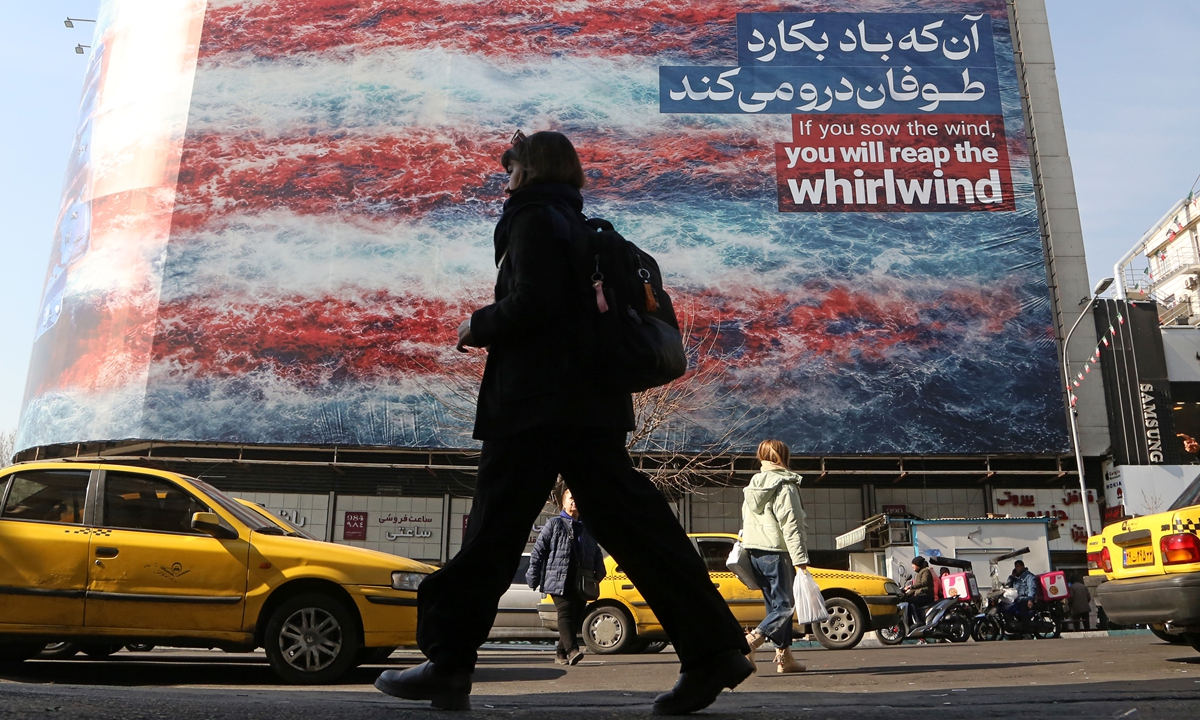
People walk past an anti-American wall poster that reads 'If you sow the wind, you will reap the whirlwind.' following a possible US intervention against Iran on January 28, 2026 in Tehran, Iran. Photo: VCG
In the past 24 hours, the risk of military conflict erupting in the Middle East, particularly around Iran, has spiked dramatically. Media reports on Thursday indicate that US President Donald Trump is weighing military options against Iran, including targeted strikes on Iranian security forces and leaders, while simultaneously deploying additional military forces to the Middle East.
Facing intensifying pressure from Washington, Iranian officials have issued stern warnings of tit-for-tat retaliation. Meanwhile, regional countries have voiced deep concerns over the looming threat of military conflict. China has also emphasized that military adventurism would only push the entire region into an unpredictable and catastrophic abyss.
As tensions continue to escalate, global gold and oil markets have responded with sharp price surges, reflecting growing market anxiety over the deepening crisis.
Surging risks of conflict
Citing sources, the Reuters reported on Thursday that US President Donald Trump is weighing options against Iran that include targeted strikes on security forces and leaders to inspire protesters, even as Israeli and Arab officials said air power alone would not topple the current regime.
Two US sources familiar with the discussions said Trump wanted to create conditions for "regime change" after a crackdown crushed a nationwide protest movement earlier this month, killing thousands of people, according to the Reuters.
According to the BBC on Thursday, a US Navy drone has been operating over the Gulf near the coast of Iran since the early hours of this morning, citing FlightRadar24 tracking data.
The US already has between 30,000 and 40,000 troops in the region, with forces including five air wings — command units comprised of about 70 aircraft — across as many countries and five warships, including two destroyers, along with air defense systems, the Financial Times (FT) said.
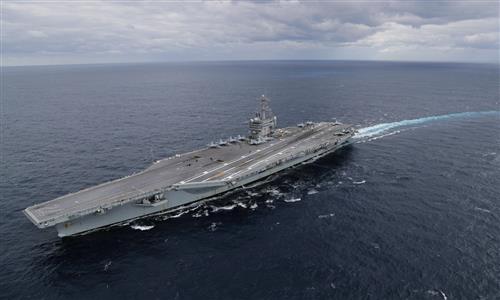
A massive armada, headed by the Aircraft Carrier Abraham Lincoln and larger than that sent to Venezuela, is heading to Iran, Trump said in a Truth Social post on Wednesday.
Ali Shamkhani, a senior advisor to Iran's Supreme Leader Ali Khamenei, warned that "any military action by the US from any source and at any level will be considered the start of war, and its response will be immediate, all-out, and unprecedented," the Xinhua News Agency reported on Thursday.
Shamkhani stressed that Iran's response will target "the aggressor, the heart of Tel Aviv, and all of the aggressor's supporters," per Xinhua.
According to AP reporter Jon Gambrell's X post, Iran issued a warning to ships at sea Thursday that it planned to run a drill next week that would include live firing in the Strait of Hormuz.
A day earlier, Iran's foreign minister Abbas Araghchi said on Wednesday that the Iranian armed forces are ready to "immediately and powerfully" respond to any possible attack by the US, per the Al Jazeera.
BBC laid out seven possible scenarios about "what could happen if the US strikes Iran", such as targeted and surgical strikes with regime change, or a scenario where the regime survives but moderates its policies.
Washington has steadily intensified its deterrence against Tehran, combining heightened pressure through public opinion and cognitive warfare with parallel military movements and deployments. Iran, for its part, has responded on both the rhetorical and military fronts. Against this backdrop, the likelihood of a US-Iran conflict has continued to rise, Liu Zhongmin, a professor at the Middle East Studies Institute of Shanghai International Studies University, told the Global Times on Thursday.
At the same time, both sides face real constraints, the expert continued. For the US, even as the risk of using force against Iran increases, key, unavoidable questions remain: how to fight, how far to go, how long an operation might last, and whether it would achieve the desired outcomes, Liu noted.
For Iran, the core objective is to avoid conflict in order to ease mounting internal and external pressures, yet under sustained US pressure, it has little choice but to raise the intensity of its responses in step with the escalation of deterrence, he added.
"Bellicose US rhetoric leaves Iranians feeling directly threatened," Al Jazeera's Tehran-based reporter Ali Hashem said on Thursday. "If diplomacy fails, war is probably going to be the outcome."
Global concerns
Amid an already volatile global landscape, the escalation of tensions surrounding Iran and Middle East has sparked more global concerns.
Fu Cong, the Chinese envoy to the UN, said at a UN Security Council high-level debate on the Middle East on Wednesday local time that any military adventurism would only push the region into an unpredictable abyss.
China calls on all parties to abide by the purposes and principles of the UN Charter, opposes interference in other countries' internal affairs, and opposes the use or threat of force in international relations, Fu said.
China hopes that the US and other relevant parties will heed the calls of the international community and regional countries, do more to promote peace and stability in the Middle East, and avoid escalating tensions or fanning the flames, the Chinese envoy added.
Russian President Vladimir Putin on Thursday told his UAE counterpart, Mohamed bin Zayed Al Nahyan, that Moscow is closely monitoring the situation in Iran, and he wants to discuss it with him in Kremlin talks, Al Jazeera reported.
Senior officials from Pakistan and India also talked with Iranian officials.
Some regional countries have also voiced concerns over the growing war risks. Turkey is weighing contingency plans along its border if the US attacks neighboring Iran, a senior official who requested anonymity told AFP on Thursday.
Regional states — including Saudi Arabia, Qatar, Oman and Egypt — have urged Washington not to strike Iran, worried they would be prime targets for retaliation, the Gulf News reported on Thursday.
Saudi Crown Prince Mohammed bin Salman has reportedly told Iran's president that Riyadh would not allow its airspace or territory to be used for attacks on Tehran, per the Gulf News.
Gold, oil prices hit high
Gold prices have set a new record amid US threats of military action against Iran and the weakness of the US dollar, Al Jazeera reported.
Bullion surged past $5,500 an ounce on Thursday, extending an extraordinary rally that has seen the precious metal gain more than 20 percent in value since the start of the year, the media report said.
Brent oil futures prices jumped on Thursday, hitting a four-month high on rising concerns about a possible US military attack on Iran, OPEC's fourth-largest producer with output of 3.2 million barrels per day, Reuters reported on Thursday.
"The immediate (market) concern ... is the collateral damage done if Iran takes a swing at its neighbors or possibly even more tellingly, it closes the Strait of Hormuz to the 20 million barrels per day of oil that navigates it," said PVM analyst John Evans, per Reuters.
The oil market is monitoring whether the unrest in Iran and possible military intervention by the US could lead to a disruption of crude supplies in the region, CNBC reported.
Ali Vaez, Iran project director at International Crisis Group, said on Thursday that a US war with Iran will have the potential to spill over into other countries in the region, the Al Jazeera reported.
"If we end up in a conflict that escalates and spills over to the rest of the region, it is hard to imagine that the Iranians would not target these facilities, which are nearby," he said, "if the US started a war that eventually toppled Iran's government, "then you will have a failed state of 92 million right next door with the possibility of spillover, of radicalism, of refugees, of instability, which again is not a pretty prospect for Iran's neighbors in the Gulf."
RELATED ARTICLES