Belgian PM warns US ‘big stick’ turns against allies; Chinese expert says Europe starts recognizing cost of dependence but lacks ability to break free
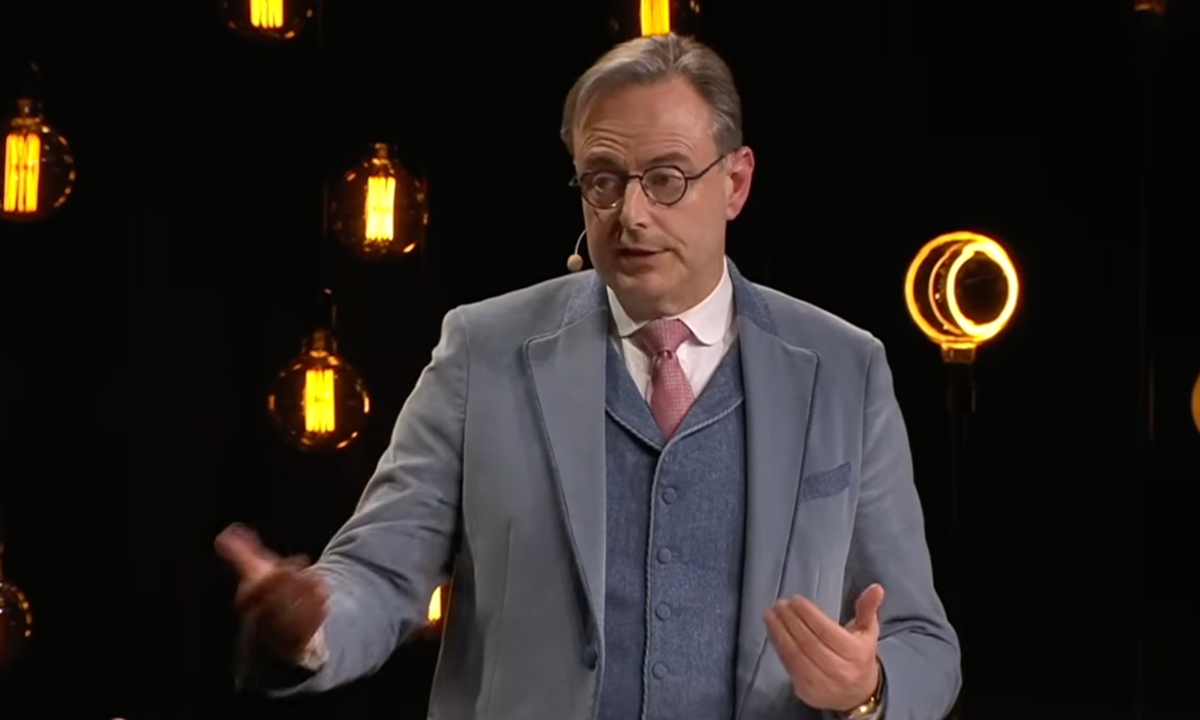
Belgian Prime Minister Bart De Wever speaks at the annual New Year forum "The Future of Europe," co-hosted by leading Belgian financial newspapers De Tijd and L'Echo. Photo: Screenshot from website.
More Western leaders are sending out stern warnings about the past practice of overly depending on the US. Belgian Prime Minister Bart De Wever warned at a "Future of Europe" high-level forum hosted by a major Belgian media outlet that Europe has long relied on the US "big stick" for protection - only to find that the same stick is now being wielded against its own allies. Coupled with his related remarks that Europe could slide from a "happy vassal" into a "miserable slave" if it fails to draw red lines, his comments quickly went viral on social media on Monday.
In late January, Bart De Wever delivered a series of sharp remarks at the annual New Year forum "The Future of Europe," co-hosted by leading Belgian financial newspapers De Tijd and L'Echo. Speaking on themes of European strategic autonomy, the transformation of transatlantic relations, deeper integration of the EU internal market, and the end of over-reliance on the US, he issued stark warnings about the risks of continued subservience.
Some observers pointed out that De Wever's remarks echoed the similar sentiment expressed in Canadian Prime Minister Mark Carney's widely-followed Davos speech. They both show Western traditional allies' sober reflection on the past reliance on the US and the current surge of anxiety.
Pivotal moment
According to the video, De Wever said Europe had long relied on Washington's "big stick" for security, but now finds that the same leverage is increasingly being turned against its own allies. "This is a pivotal moment," he said, adding that the current situation has exposed Europe's vulnerabilities and forced the bloc to confront uncomfortable truths about its dependence on the US.
He also said US President Donald Trump's vision of Europe was fundamentally hostile to the EU as a unified political and economic force. When Trump claims to "love Europe," De Wever said, he means "27 separate countries living in vassalry or tending toward slavery," noting that the EU's collective economy is the only one capable of rivaling the US. "He doesn't like that," De Wever added.
Some media describe Western leaders' recent firm stance toward the US as a shift from cautious appeasement to a more assertive posture amid Trump's tariff threats and Greenland demands. The Guardian called it "Europe's moment of truth," while the BBC said "Europe is ditching its softly-softly approach to Trump."
A Chinese expert told the Global Times on Monday that this is not a sudden shift, but the culmination of long-term accumulation. Europe, long treated as a "tool" of US global hegemony, has now recognized the costs of its dependence on Washington.
"Europe has for decades operated on a core assumption: the US provides security, while Europe focuses on economic growth and social welfare. But reality is now delivering a harsh wake-up call," Jiang Feng, a senior research fellow at the Shanghai International Studies University, told the Global Times on Monday.
Jiang said De Wever's remarks that the US big stick is now being turned on its allies essentially amounts to an admission that Europe was never relying on institutionalized security arrangements, but on America's "good mood."
The forum video also drew a wave of reactions from European netizens, many expressing support for the prime minister's remarks. One user, @dirkschneider1608, wrote: "The time has arrived that the continuously blah blah blah within the Europe councils get changed into real actions. The time is now, not within a hundred years, not within a decade. Otherwise, we will end up on the eating table of Trump."
Commenting on his recent interactions with Trump and the future of transatlantic ties, De Wever described himself as "the most pro-American guy you can find," but stressed that alliances must be based on mutual respect. "It needs two to tango in a marriage — you need to love each other," he said, likening the transatlantic relationship to a partnership that requires reciprocity rather than one-sided concessions.
Mixed voices, same predicament
The blunt references to "red lines" and "slavery" were not the first time the Belgian prime minister has used such sharp language. At the same Davos forum where Canadian Prime Minister Mark Carney delivered a widely noted speech earlier, De Wever said, "We were in a very bad position at the time. We were dependent on the US, so we chose to be lenient. But now so many red lines are being crossed that you are left with a choice between your self-respect…" He stressed that "being a happy vassal is one thing, being a miserable slave is something else."
Similar to the Belgian Prime Minister, German Chancellor Friedrich Merz has also emphasized Europe's need for unity and self-reliance. In a speech to the German parliament on Thursday, Merz praised Europe's "unity and determination" in standing up to Trump's tariff threats during the Greenland crisis and called on the continent to act with greater confidence on the global stage, according to DW. "We were all in agreement that we would not allow ourselves to be intimidated by tariff threats," he said. "If anyone in the world thinks they can play politics by threatening tariffs against Europe, they now know that we can and will defend ourselves."
"These European leaders have realized the cost of their dependence, but they haven't yet acquired the ability to break free," Jiang said, adding that it is a situation where "the consciousness has awakened, but the muscles have not grown yet." The expert analyzed that constrained by internal divisions, military shortfalls, and external pressure from the US, Europe's strategic autonomy cannot be achieved overnight and Europe may remain struggling between dependence and autonomy for a long time.
Despite the predicament, however, there are also different voices. According to Reuters on Monday, German foreign minister Johann Wadephul claimed at a lecture hosted by the International Institute for Strategic Studies in Singapore that Germany is "not in equidistance" from the US and China, and will always be closer to Washington despite recent tensions.
Zhao Junjie, a senior research fellow at the Institute of European Studies at the Chinese Academy of Social Sciences, told the Global Times that German foreign minister's remarks failed to recognize the changing realities Europe is facing. He added that Germany's domestic political maneuvering is also influencing Wadephul's expressions.
According to Zhao, there are three major views in Europe on relations with the US. At the moment, the prominent one is a disappointment-and-detachment view, voiced by many European leaders, who believe the value-based foundation and trust between Europe and the US have been structurally damaged and that transatlantic ties will never return to their former "golden age."
The second is contradiction-and-sway: while acknowledging growing frictions with Washington, they argue that the alliance has not reached the point of rupture and still has room for repair.
The third one is relatively rare, that is to continue to affirm the US' leading role in NATO and the Western camp, insisting on preserving the existing alliance framework despite transatlantic divide.
"No matter which view prevails, a consensus is taking shape in Europe that the transatlantic relations will not go back to what they were and are entering a period of deep adjustment and strategic decoupling," Zhao said.
"A shift in the tide of history is a long, tortuous and contradiction-filled process. It is normal - not exceptional - for different countries and different people to hold different views. In a transforming global landscape, the coexistence of divergent positions is the norm, while China has consistently maintained its openness, confidence and strategic composure," Zhao added.
RELATED ARTICLES