ARTS / CULTURE & LEISURE
Behind millennia-old ritual: Whipping Spring-ox, embracing nature’s harmony in China
Behind millennia-old ritual
By Published: Feb 04, 2026 12:20 AM

Editor's Note:
"The spring rain heralds spring's clear and bright days, summer's fullness arrives with the heat in waves..." This folk rhyme serves as a key to unlocking the spiritual world of the Chinese people.
In 2016, "The Twenty-Four Solar Terms, knowledge in China of time and practices developed through observation of the sun's annual motion" was inscribed on UNESCO's Representative List of the Intangible Cultural Heritage of Humanity.
The ancient Chinese divided the sun's annual circular motion into 24 segments. Each segment was called a specific Solar Term, starting from the Beginning of Spring and ending with Greater Cold.
From the rhythm of labor aligned with nature to the wisdom of seasonal dishes, the 24 Solar Terms have shaped a philosophy of "harmony between humans and nature" and a way of life unique to Chinese culture.
The Global Times presents the series The Markings of Time, which follows cultural inheritors across China to explore local traditions and humanistic sentiments tied to each solar term. Here is the first in the series, the Beginning of Spring.
"The spring rain heralds spring's clear and bright days, summer's fullness arrives with the heat in waves..." This folk rhyme serves as a key to unlocking the spiritual world of the Chinese people.
In 2016, "The Twenty-Four Solar Terms, knowledge in China of time and practices developed through observation of the sun's annual motion" was inscribed on UNESCO's Representative List of the Intangible Cultural Heritage of Humanity.
The ancient Chinese divided the sun's annual circular motion into 24 segments. Each segment was called a specific Solar Term, starting from the Beginning of Spring and ending with Greater Cold.
From the rhythm of labor aligned with nature to the wisdom of seasonal dishes, the 24 Solar Terms have shaped a philosophy of "harmony between humans and nature" and a way of life unique to Chinese culture.
The Global Times presents the series The Markings of Time, which follows cultural inheritors across China to explore local traditions and humanistic sentiments tied to each solar term. Here is the first in the series, the Beginning of Spring.
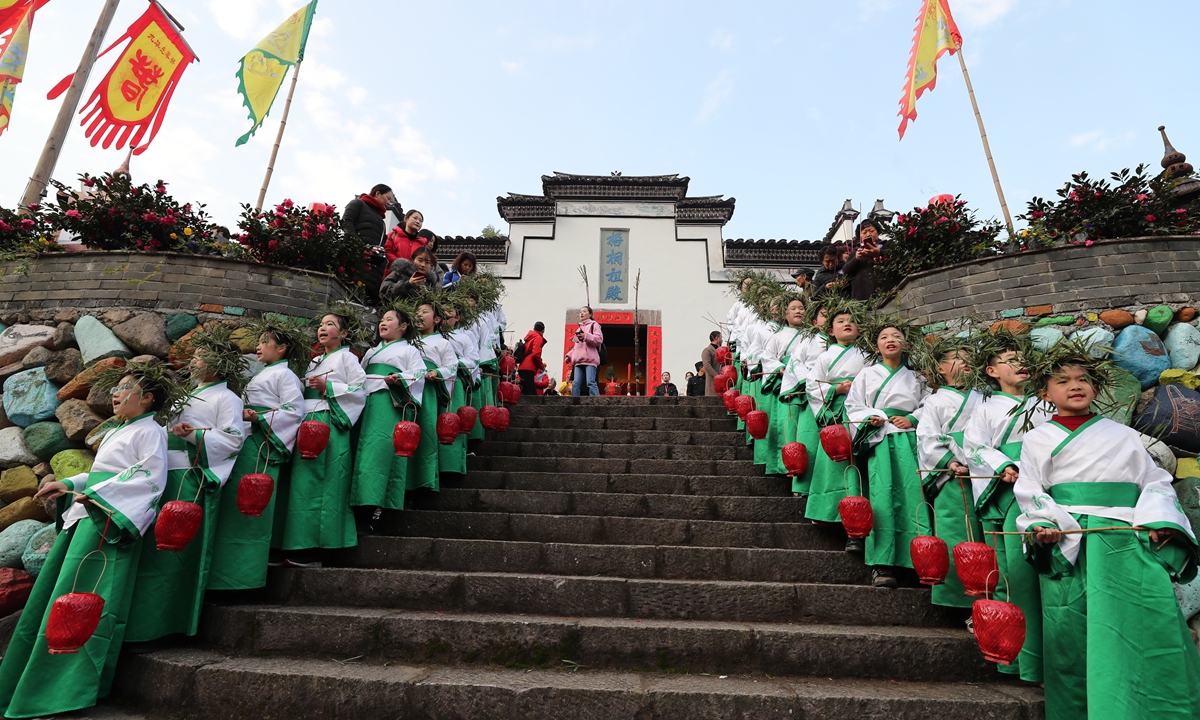
Twenty-four youthful "spring greeters" dressed in traditional white and green attire, willow wreaths and oil-paper lanterns in hand take part in the Ritual of the Beginning of the Spring in Jiuhua, East China's Zhejiang Province. Photo: Courtesy of Wu Haigen
Every year on the day of the solar term Beginning of Spring, the annual Ritual for the Beginning of Spring would unfold at the Wutong Ancestral Hall in Jiuhua town, East China's Zhejiang Province.
At 9:58 am, Wu Haigen, the representative inheritor of this intangible cultural heritage and chief officiant, delivered the ceremonial address at the 2025 event. Before the hall, 24 youthful "spring greeters" - dressed in traditional white and green attire, willow wreaths crowning their heads, and oil-paper lanterns in hand - recited classics such as "Spring Dawn" and "Ode to the Willow" to welcome the season.
"Oh! There's a foreign child in the spring-welcoming procession this year!" At the procession's head, a young foreign face drew delighted attention: 9-year-old Lorenzo from Colombia. Confidently reciting four classical Chinese poems with a bright smile, he charmed the villagers, who exclaimed, "This kid's Chinese is truly amazing!"
Lorenzo Restrepo, known locally as Lei Bo, arrived in China with his parents three years earlier. He now speaks fluent Chinese and can recite 11 classical poems.
Inherit tradition
Including a foreign child as a "spring-greeting envoy" marked a historic first for this 3,000-year-old ceremony. In 2016, the Ritual for the Beginning of Spring in Jiuhua - along with other elements of China's 24 Solar Terms - was inscribed on UNESCO's list, becoming Quzhou's inaugural world intangible cultural heritage entry. "In recent years, this folk tradition has grown increasingly international," Wu told the Global Times. Now preparing for the 2026 ceremony (to be held on Wednesday), he noted that foreign visitors flock to the event each year. He first met Lorenzo's family at the 2024 ritual, after which they forged a lasting cross-cultural friendship.
"Having a child from Colombia as our spring-greeting envoy better demonstrates that our Beginning of Spring ceremony is a heritage that belongs to all humanity," Wu said.
As the majestic "Spring Welcoming Chant" echoed through the Wutong Ancestral Hall, spring seemed to awaken. This hall is China's only fully preserved ancestral temple dedicated to Gou Mang, the Spring God. Its deity statue - carved from a massive phoenix tree root and revered locally as the "Wutong Old Buddha" - is enshrined within.
The main hall, a Qing Dynasty (1644-1911) structure, features a grand wooden opera stage that is over 100 square meters in size and adorned with intricate Huizhou-style carvings, making it a remarkably well-preserved ancient performance space. Following the worship rite came the highlight: "Spring-Ox Whipping," the ceremony's most distinctive spectacle. "A whip to the spring ox, and the earth returns to spring."
True to millennia-old custom, the procession moved to the fields. Amid the herdsmen's "Spring Whipping and Chanting Song," a respected village elder - clad in a straw raincoat - led his plough ox, festooned with red silk, in the "first plowing." Seeds sown into the furrows completed the "first cultivation" of the new season.
Beginning of solar terms
Wu and the villagers spent a full decade restoring the ritual's complete form - gathering elders' oral accounts and consulting ancient texts to reconstruct its sequence: welcoming, worshiping, and whipping the spring ox. "When I was young, I repaired computers in Hangzhou," Wu recalled. "In 2011, when the ritual gained national intangible cultural heritage status, I returned home to dedicate myself to researching Beginning of Spring culture."
As older generations passed away, the ceremony had faded, with few participants remaining. "Someone had to pass on our hometown's traditions," Wu said. "I felt these customs needed documentation and preservation."
In 2021, the Beginning of Spring Culture Exhibition Hall - a rural museum incorporating holographic fans and digital scrolls - opened its doors. A long digital scroll, titled Jiuhua Spring Scenery, blends solar term culture with folk elements, while an interactive "Spring-Ox Whipping" performance welcomes the participation of visitors.
While safeguarding the ritual's core, Wu has infused it with fresh vitality: open auditions for the spring-welcoming team, interactive additions like the "Spring Worship Cheer Song" and "Spring Ox Whipping Cheer Song," and new elements such as planting spring trees, scattering blessed soil, praying for blessings, and distributing blessing packets - all heightening engagement and experiential appeal.
The museum has drawn a steady stream of visitors to Miaoyuan village, Jiuhua. Recent years have seen the rise of themed study tours centered on the ceremony, cultural creative products, and homestay services, harmoniously merging heritage preservation with rural revitalization.
The Beginning of Spring Ritual helps more people appreciate these folk traditions. Above all, it reminds us of the ancient wisdom: Follow nature's rhythms to foster harmony between humans and the natural world. Wu said he expects this agricultural culture and timeless insight will endure for generations.
At 9:58 am, Wu Haigen, the representative inheritor of this intangible cultural heritage and chief officiant, delivered the ceremonial address at the 2025 event. Before the hall, 24 youthful "spring greeters" - dressed in traditional white and green attire, willow wreaths crowning their heads, and oil-paper lanterns in hand - recited classics such as "Spring Dawn" and "Ode to the Willow" to welcome the season.
"Oh! There's a foreign child in the spring-welcoming procession this year!" At the procession's head, a young foreign face drew delighted attention: 9-year-old Lorenzo from Colombia. Confidently reciting four classical Chinese poems with a bright smile, he charmed the villagers, who exclaimed, "This kid's Chinese is truly amazing!"
Lorenzo Restrepo, known locally as Lei Bo, arrived in China with his parents three years earlier. He now speaks fluent Chinese and can recite 11 classical poems.
Inherit tradition
Including a foreign child as a "spring-greeting envoy" marked a historic first for this 3,000-year-old ceremony. In 2016, the Ritual for the Beginning of Spring in Jiuhua - along with other elements of China's 24 Solar Terms - was inscribed on UNESCO's list, becoming Quzhou's inaugural world intangible cultural heritage entry. "In recent years, this folk tradition has grown increasingly international," Wu told the Global Times. Now preparing for the 2026 ceremony (to be held on Wednesday), he noted that foreign visitors flock to the event each year. He first met Lorenzo's family at the 2024 ritual, after which they forged a lasting cross-cultural friendship.
"Having a child from Colombia as our spring-greeting envoy better demonstrates that our Beginning of Spring ceremony is a heritage that belongs to all humanity," Wu said.
As the majestic "Spring Welcoming Chant" echoed through the Wutong Ancestral Hall, spring seemed to awaken. This hall is China's only fully preserved ancestral temple dedicated to Gou Mang, the Spring God. Its deity statue - carved from a massive phoenix tree root and revered locally as the "Wutong Old Buddha" - is enshrined within.
The main hall, a Qing Dynasty (1644-1911) structure, features a grand wooden opera stage that is over 100 square meters in size and adorned with intricate Huizhou-style carvings, making it a remarkably well-preserved ancient performance space. Following the worship rite came the highlight: "Spring-Ox Whipping," the ceremony's most distinctive spectacle. "A whip to the spring ox, and the earth returns to spring."
True to millennia-old custom, the procession moved to the fields. Amid the herdsmen's "Spring Whipping and Chanting Song," a respected village elder - clad in a straw raincoat - led his plough ox, festooned with red silk, in the "first plowing." Seeds sown into the furrows completed the "first cultivation" of the new season.
Beginning of solar terms
Wu and the villagers spent a full decade restoring the ritual's complete form - gathering elders' oral accounts and consulting ancient texts to reconstruct its sequence: welcoming, worshiping, and whipping the spring ox. "When I was young, I repaired computers in Hangzhou," Wu recalled. "In 2011, when the ritual gained national intangible cultural heritage status, I returned home to dedicate myself to researching Beginning of Spring culture."
As older generations passed away, the ceremony had faded, with few participants remaining. "Someone had to pass on our hometown's traditions," Wu said. "I felt these customs needed documentation and preservation."
In 2021, the Beginning of Spring Culture Exhibition Hall - a rural museum incorporating holographic fans and digital scrolls - opened its doors. A long digital scroll, titled Jiuhua Spring Scenery, blends solar term culture with folk elements, while an interactive "Spring-Ox Whipping" performance welcomes the participation of visitors.
While safeguarding the ritual's core, Wu has infused it with fresh vitality: open auditions for the spring-welcoming team, interactive additions like the "Spring Worship Cheer Song" and "Spring Ox Whipping Cheer Song," and new elements such as planting spring trees, scattering blessed soil, praying for blessings, and distributing blessing packets - all heightening engagement and experiential appeal.
The museum has drawn a steady stream of visitors to Miaoyuan village, Jiuhua. Recent years have seen the rise of themed study tours centered on the ceremony, cultural creative products, and homestay services, harmoniously merging heritage preservation with rural revitalization.
The Beginning of Spring Ritual helps more people appreciate these folk traditions. Above all, it reminds us of the ancient wisdom: Follow nature's rhythms to foster harmony between humans and the natural world. Wu said he expects this agricultural culture and timeless insight will endure for generations.
RELATED ARTICLES