BRASIL 247 / MORE
BYD advances local production in Brazil and targets market leadership
Chinese automaker plans to reach 50% local content at Bahia plant and aims to become the country's largest carmaker by 2030
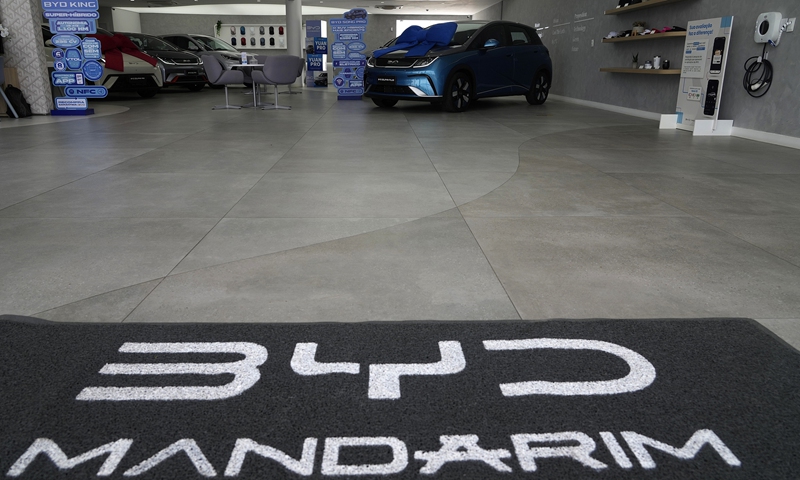
File photo: BYD vehicles are for sale in a dealership in Camacari, Bahia state, Brazil, on March 7, 2025. Photo: CFP
By Brasil 247 - The Chinese automaker BYD is accelerating the localization of its vehicle production in Brazil, seeking to include 50% local content in cars manufactured at its factory in Camaçari, in the state of Bahia, as part of a broader strategy to consolidate its presence and challenge established players in the Brazilian automotive market.
According to an interview given this week to Reuters by Alexandre Baldy, BYD's senior vice president in Brazil, the company is moving as fast as possible to transition to a local supply chain. The goal, he said, is to become the largest automaker in Brazil by sales volume by 2030, in a market where concerns have been raised by domestic manufacturers and labor groups about the rapid growth of imported vehicles.
BYD aims to reach 50% local content in vehicles produced in Brazil by January 1, 2027. Baldy stressed that maintaining the current pace of expansion is essential to achieving that target. "We arrived here at a very fast speed, a speed we need to maintain to reach this goal," he said. The executive also highlighted that Brazil is currently BYD's largest market outside China.
The company ended January as the fifth-largest brand in Brazil in terms of sales, with a 6.03% share of passenger car and light commercial vehicle registrations, surpassing Toyota. One year earlier, BYD held a 4.12% market share and ranked ninth, according to data from Fenabrave, the national association of vehicle dealers.
Since October, BYD has produced around 25,000 vehicles at the Camaçari factory, which occupies more than four million square meters on a site previously used by Ford before the US automaker ceased manufacturing operations in Brazil. The city has even renamed a nearby avenue, replacing the name Henry Ford with BYD, symbolizing the industrial transition underway.
From imports to exports
Increasing local content will also allow BYD to begin exporting vehicles from Brazil to neighboring Mercosur countries as early as this year, Baldy said. This shift comes amid criticism from parts of the local industry and labor unions, which argue that the company has relied heavily on imports while benefiting from temporarily reduced tariffs.
Baldy responded by saying that BYD is accelerating local production and reaffirmed the company's commitment to generating up to 20,000 direct and indirect jobs in Brazil. At present, vehicles are assembled in Camaçari from semi-knocked-down (SKD) imported units, a model that benefited from an import tax exemption that has recently expired.
The company plans to request an additional quota to extend the tax exemption until midyear. Baldy described the SKD approach as "a transitional regime" and emphasized the need for full local manufacturing.
Facilities for stamping, welding and painting at the Camaçari plant are close to completion, according to Baldy. This expansion is part of BYD's first phase of investment in Brazil, totaling 5.5 billion reais, which aims to increase annual production capacity to 300,000 vehicles, up from an estimated 150,000 units by the end of this year.
(Reported by Brasil 247 on Feb 5, 2026)
