ARTS / CULTURE & LEISURE
With tea and coffee, Pu’er becomes a hot tourist destination rich in heritages
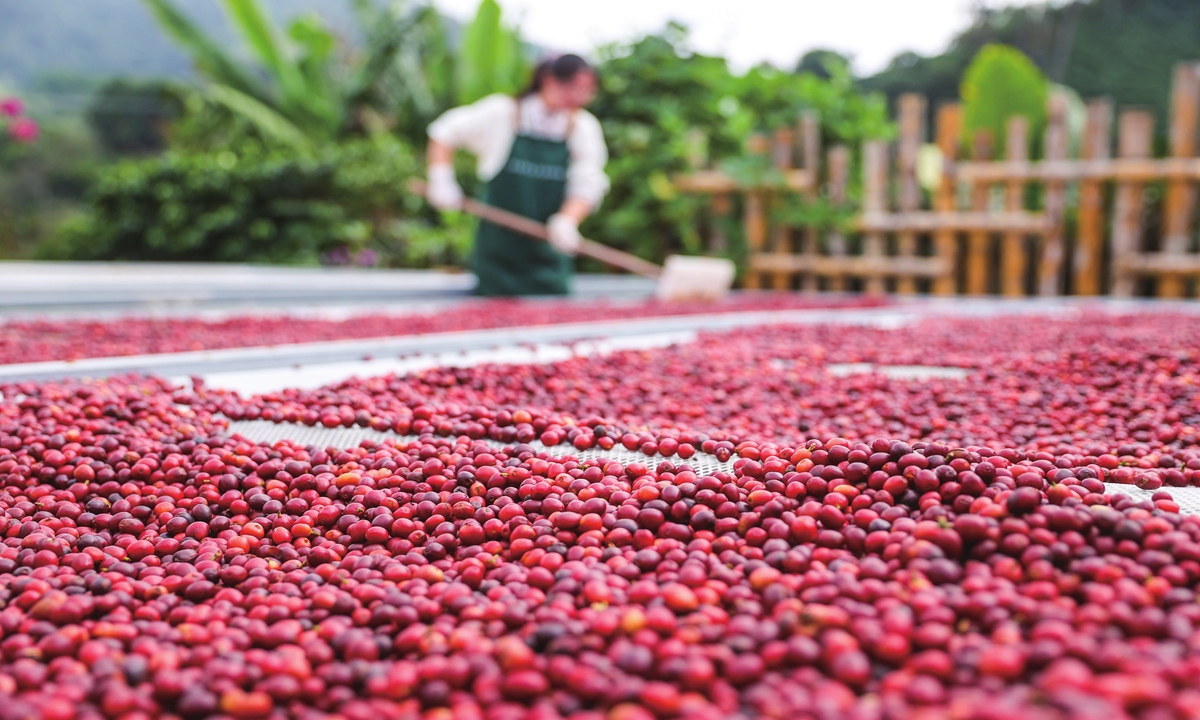
A worker dries coffee cherries in Pu'er. Photo: VCG
Fifty-six-year-old Diao Faxing is a native of Pu'er in Southwest China's Yunnan Province. In his everyday life, tea and coffee are "as essential as breathing," he told the Global Times. A cup of coffee in the morning keeps him energized, while in the evening, after dinner, he enjoys a pot of "Bingdao," a type of Pu'er tea with his family or friends. "Only with that [by completing the routine] can I sleep tight."
A daily cup of tea and coffee may not help everyone "sleep tight" like Diao, but including him and many locals, this routine is simply the most common part of their lives. Locals often describe such a lifestyle as "tea in the left hand, and coffee in the right." Behind this lies a connection to the area's world-renowned tea heritage and its status as the largest coffee-growing region in China.
'A form of life'
In Pu'er, the coexistence of tea and coffee reveals itself in trivialized daily observations. The most telling small touch can be found when a tourist checks into a local hotel and discovers the room thoughtfully stocked not with generic tea bags and instant coffee, but with authentic local Pu'er tea bags and carefully crafted pour-over coffee bags sourced directly from this region.
Pu'er tea is believed to have originated in the Shang (c.1600BC-1046BC) and Zhou (1046BC-256BC) dynasties. It is divided into two categories: the "raw Pu'er" and the "ripe Pu'er." Tea soup colors of the raw and the ripe ones appear pale yellow and deep amber red, respectively.
While it is typically encountered in its classic compressed tea cake form, travelers may also find tasting packs representing different varieties of Pu'er tea in hotels.
Each kind offers a subtly distinctive tasting experience. "Bingdao" is renowned for its natural, crystal-clear sweetness, while "Lao Banzhang" is famous for its mellow bitterness that transforms into a lingering sweet aftertaste. Tasting and sharing Pu'er tea serves as the locals' way to socialize and build friendships. And the Pu'er tea itself stands as a world heritage that proudly represents the region.
Around a three-hour drive from the city center of Pu'er, one will arrive at Jingmai Mountain. In 2023, the Cultural Landscape of Old Tea Forests of Jingmai Mountain was inscribed on the UNESCO World Heritage List.
Walking into the tea forest, one feels humble amid the vast greenery. The hospitable locals might offer you a cup of locally sourced "Jingmai" Pu'er tea, which is renowned as the most fragrant Pu'er tea. But the tea alone does not define the site's World Heritage status; the local's unique human-nature ecosystem is the heritage's soul.
Apart from five ancient tea forest areas, there are also nine traditional villages. Local tea grower Tang Lixin told the Global Times that they have an "understory tea planting model,'' in which tea trees grow naturally in forests, and villages are built adjacent to the tea forests with farmlands encircling the periphery. This vertical land-use system allows natural resources to circulate and regenerate sustainably.
"To us, Pu'er tea is not merely a crop, but a form of life, something that we exist in mutual dependence with," Tang remarked.
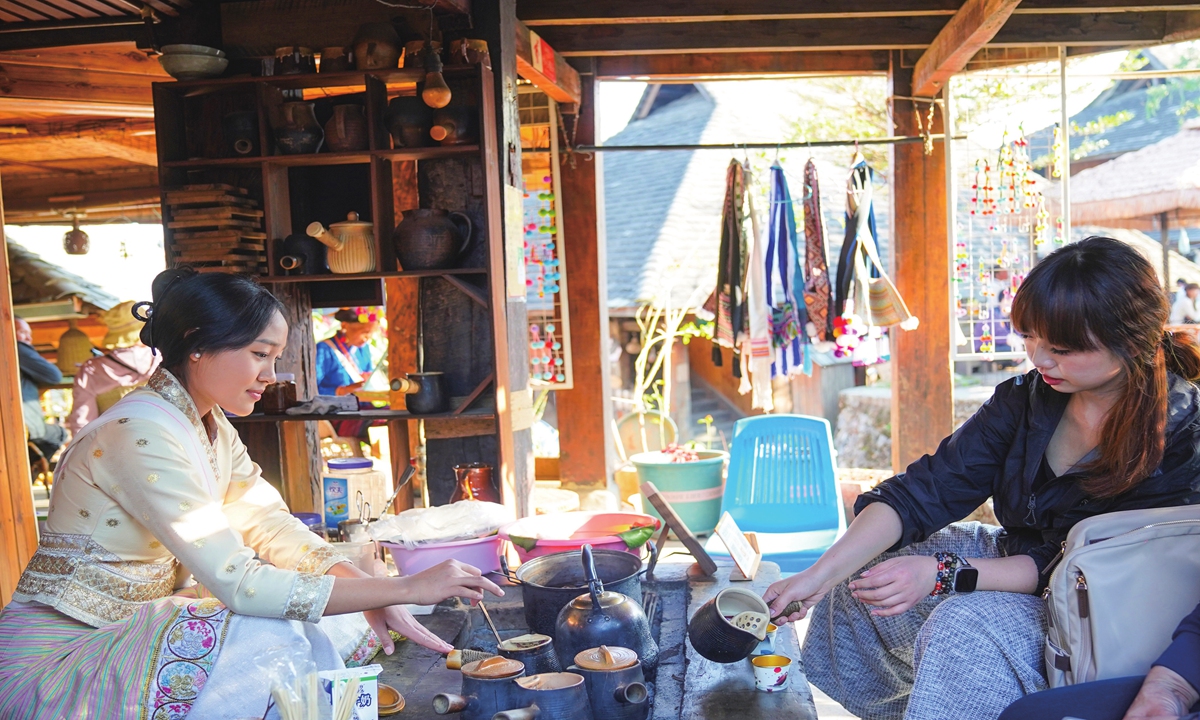
A tourist experiences local tea culture in Pu'er on January 30, 2026. Photo: VCG
Fusion of cultures
The practice of nature-human dependence, Tang noted, has been passed down through generations of Pu'er people, including young locals who are innovating based the traditional tea culture.
In a small drink shop in downtown Pu'er, one can find the "red and green yuanyang" beverages that blend the raw and ripe types of Pu'er teas with locally sourced coffee. Such a remix also showcases another iconic product of Pu'er coffee.
So far, Pu'er is the largest coffee-producing region in China by cultivation area, with the current planting area covering 679,000 mu (approximately 45,267 hectares).
Scattered around the local area are numerous coffee fields. Unlike traditional farming, which relies heavily on manual cultivation, coffee cultivation in Pu'er has embraced intelligent management. For instance, a coffee field in Ning'er county has integrated a drip irrigation system with smart sensors to create a comprehensive setup. This system utilizes big data for monitoring and regulation, establishing an intelligent model for seedling cultivation.
On the one hand, these areas supply beans to large domestic and international brands like Starbucks and Luckin Coffee. On the other hand, they place a greater emphasis on integrating coffee, a crop with foreign cultural roots into regional characteristics.
Inspired by the local Yunnan dietary custom of eating fried insects, a cafe in Pu'er's Simao district has launched "Grasshopper Latte" and "Bamboo Worm Americano." While the concept might seem intimidating at first glance, the first sip reveals an explosion of coffee and savory protein aromas in the mouth. "Since I've already come all this way, I want to try the most authentic local coffee. This is my way of remembering the city," Zhong Xinyi, a tourist from Zhanjiang, South China's Guangdong Province, told the Global Times.
Letting coffee define Pu'er has also become a strategy for its cultural and tourism development. Inspired by the region's unique wildlife resources, the Elephant Coffee Plantation in Pu'er has successfully integrated the coffee experience with observations of wild Asian elephants, creating a novel tourist attraction.
Meanwhile, in the local villages that used to host mainly the elderly, an increasing number of young people from other regions are moving in to start their own coffee businesses.
Once an artist who lived in Chengdu, Sichuan Province, young coffee shop owner Zhang Fan is one of them.
He rents a traditional stilted house from local ethnic Dai villagers and runs a cafe together with them. "When I first arrived, the villagers saw me as an outsider. But now, my coffee shop has become a living room shared by the whole village and tourists," Zhang told the Global Times.
RELATED ARTICLES