SPORT / MISCELLANY
Veterans lead charge in halfpipe qualifier
Chinese snowboarder Liu Jiayu taken off field after scary fall
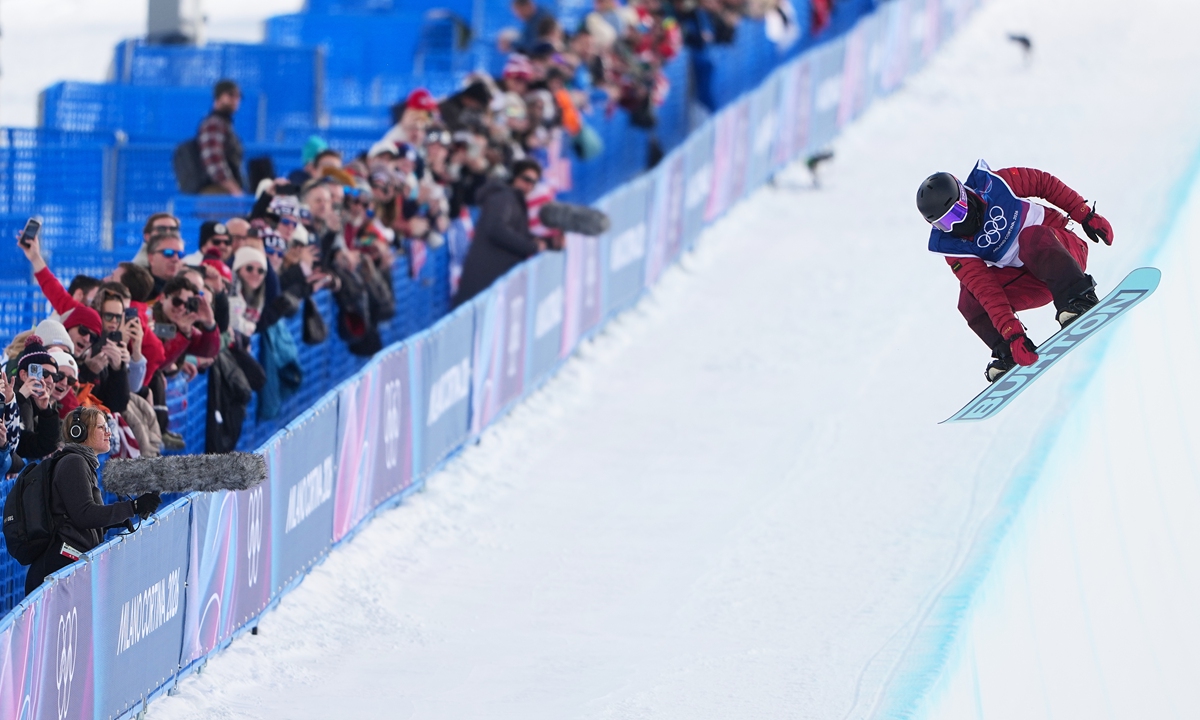
China's Cai Xuetong competes during the women's snowboarding halfpipe qualification event at the 2026 Winter Olympics in Livigno, Italy, on February 11, 2026. Photo: VCG
Five-time Olympian Cai Xuetong will lead teammate Wu Shaotong to compete in the women's snowboard halfpipe final after finishing the qualification round in the top 12 at the Milan Cortina Winter Olympic Games on Wednesday.
At Livigno Snow Park, the veteran athlete competed with Chinese five-time Olympian Liu Jiayu and teammate Yang Lu, as the Chinese quartet eyed qualifying for the final.
Ultimately Cai finished in fifth place with a best run of 83.00 points, with Wu in 12th place with 75.25 points. They will aim for a podium finish in the finals, which are scheduled to start on Thursday.
Chinese fans were troubled when Liu, a silver medalist in the discipline at Pyeongchang 2018, crashed into the pipe at the bottom of her second run and being stretchered off the course.
"My heart aches. I genuinely feel sorry for her. She has old injuries; her ankles aren't in great shape. So when she fell, I was really worried her old injury might get worse," 24-year-old Yang told reporters after finishing her qualification in 19th place with 42.50 points.
"It's tough [but] it didn't really impact me that much. When I stood at the starting line, I just wanted to enjoy being at this venue. Nothing else really affected me, although my heart breaks for her."
Initial reports suggest that Liu suffered a head impact but is currently conscious, according to the Xinhua News Agency.
As iconic figures in China's snowboard halfpipe event, Cai and Liu's fifth Olympic journey is itself a legend.
The 32-year-old Cai, since her debut at the Vancouver Winter Olympics, steadily climbed from 23rd place to fourth at the Beijing Winter Olympics.
"I want to see where my limit in the sport is," Cai was quoted as saying by Migu sports.
Cai, a consistent performer with three World Championship gold medals, has been a cornerstone of the team, as her technical precision and amplitude have set benchmarks.
The two veterans' perseverance spanning nearly 20 years has witnessed the entire evolution of China's snowboarding, from its beginnings to becoming a powerhouse. Many young Chinese athletes look up to them.
The halfpipe, a 22-foot-high U-shaped structure, demands a blend of height, rotation, and style. The max score is 100.
Defending champion Chloe Kim of the US dominated with her first attempt, scoring 90.25 points. Japan's Sara Shimizu followed closely at 87.50, while US snowboarder Maddie Mastro claimed third with 86.00.
The day also brought additional highlights for Chinese athletes.
In the Nordic combined, which merges ski jumping and cross-country skiing, Chinese athlete Zhao Jiawen achieved 31st place in the Gundersen normal hill/10km event. Teammate Zhao Zihe finished in 36th place.
Starting with a solid jump of 110.2 points, Jiawen clocked 36:56.2 in the 10km ski, improving on his 43rd finish at Beijing 2022.
In the ski jumping mixed team finals, the Chinese quartet consisting of Zeng Ping, Song Qiwu, Liu Qi and Jiawen finished in eighth place, a result that marked the best-ever finish for China in the discipline at any Winter Olympics.
Ski jumping, historically dominated by European nations with decades of infrastructure and cultural traditions, presents steep challenges for China due to late starts and limited foundational resources. Back at Beijing 2022, China finished 10th in the mixed team qualification round and failed to advance to the finals.
On the ice in Milan, Chinese figure skater Jin Boyang delivered a poised and technically solid performance in the men's short program.
Competing in his third Olympic Games, the 28-year-old veteran showcased his enduring skill set against a field of rising stars and established champions.
Skating to "Fought and Lost" by Sam Ryder featuring Brian May in a program that has evolved significantly over the season, Jin executed a clean quadruple toe loop, a triple Axel, and a triple Lutz-triple toe loop combination, earning high marks for his jumping prowess.
His spins and step sequence demonstrated maturity and control, though some judges noted room for improvement in artistic expression.
With a technical elements score of 47.79 and program components of 38.76, Jin tallied 86.55 points overall, securing 13th place and comfortably advancing to the free skate among the top 24 qualifiers.
Despite facing injuries and form fluctuations in recent years, including a challenging period post-Beijing 2022, Jin appeared relaxed and focused on the Olympic ice.
His short program built on a strong showing in the earlier team event, where he scored 84.15 points and placed seventh in the men's segment, contributing valuable points to China's squad.
Following the competition, Jin reflected candidly on his journey and current form.
"I've worked hard to stay steady, and I wish this kind of form had come earlier in my career," he admitted, acknowledging the ups and downs that have defined his path from a teenage prodigy to a seasoned Olympian.
Yet, his optimism shone through as he looked ahead to the free skate on Thursday.
"Now I aim for another perfect performance in the free skate," Jin said, before emphasizing his enjoyment of the moment.
"I felt very relaxed on the rink, which allowed me to fully devote myself to the performance. I am really enjoying my third Winter Olympics," he said.
RELATED ARTICLES