SPORT / MISCELLANY
Speed skater Ning scores bronze medal
Performance a perfect answer to self, says Chinese flag bearer
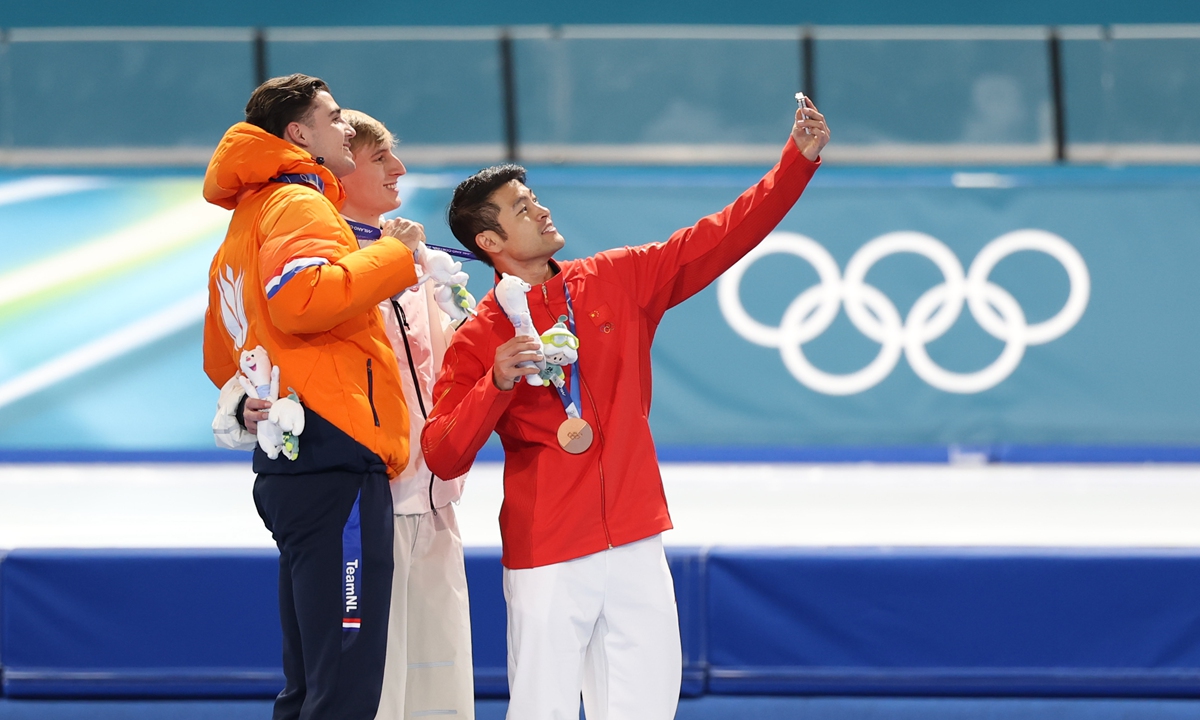
Bronze medallist Ning Zhongyan (right) of China takes a selfie with gold medallist Jordan Stolz (center) and silver medallist Jenning de Boo after the speed skating men's 1,000m final at the 2026 Winter Olympic Games on February 11, 2026. Photo: Chen Tao/GT
China's speed skater Ning Zhongyan claimed a third medal for China at the Milano-Cortina 2026 Winter Olympics by securing a bronze medal in the men's 1,000m speed skating final.Ning, who served as one of China's flag bearers at the opening ceremony, clocked a time of 1:07.34, his best low-altitude performance of the season.
Ning finished 1.06 seconds behind gold medalist Jordan Stolz of the US, who set a new Olympic record of 1:06.28. Silver went to Dutch skater Jenning de Boo with 1:06.78, 0.50 seconds off Stolz's pace.
This podium finish not only delivered China's first medal on ice at these Games but also compensated for Ning's regrettable fifth-place result in the same event at Beijing 2022.
Ning, a 27-year-old sprint specialist from Heilongjiang Province, previously earned silver in the team sprint at the 2020 and 2025 World Single Distances Championships and bronze in the 1,000m at the 2024 edition.
At Beijing 2022, he placed fifth in the 1,000m and seventh in the 1,500m, experiences that fueled his determination for Milano-Cortina.
"I really enjoyed today's race. This is my second Olympic Winter Games, and it was completely different from my first one [Beijing 2022]. I was truly very excited today," he noted.
"This bronze medal means a lot to me. At the Beijing Olympics, I carried so much pressure and did not perform to my true level. So to win this today shows that my efforts over the past four years have paid off. It is a perfect answer - to myself."
The men's final race, however, was not without controversy, as Chinese skater Lian Ziwen was disqualified following an incident in the 11th pairing against Dutch world champion Joep Wennemars.
During a lane change after a turn, Lian, skating in the inner lane, clipped Wennemars' skate, causing the Dutchman to stumble and lose momentum. Officials ruled that Lian had impeded Wennemars, who has the right of way as the outer-lane skater during exchanges. Lian said the collision was unintentional.
Wennemars reacted furiously by taking a swipe at Lian after the race. The Dutch athlete was given a warning for his unsportsmanlike behavior. While Wennemars was granted a re-skate alone, he clocked 1:07.58 in his second attempt, finishing fifth overall.
Wennemars' re-stake also sent Ning nervous.
"I was so nervous - terrified, even - when I know he's going tore-skate… If he went faster, I would be fourth. I did not want that - but there was nothing I could do," said Ning.
The mishap drew parallels to past Olympic dramas in speed skating, where lane changes can make or break races, and highlighted the fine margins in a sport where splits of a second determine outcomes.
Shifting to the snow-covered slopes of Livigno, China's snowboarders made their mark in the men's halfpipe qualifications.
Wang Ziyang advanced to the finals by securing 10th place overall, showcasing consistent runs that earned him a spot among the top 12 qualifiers.
The 22-year-old from Northwest China's Xinjiang Uygur Autonomous Region demonstrated his growing prowess in a field dominated by international stars.
Wang's qualification builds on his Olympic debut at Beijing 2022 and positions him as a contender in Friday's final, in which tricks like switch backside double corks could propel him higher.
Making his Winter Olympic debut was 17-year-old Ren Chongshuo, the youngest athlete in China's 126-athlete delegation.
Ren finished 20th in the qualifications, missing the cut for the final but gaining valuable experience in his first major Games appearance.
Born in 2009, Ren represents the next generation of Chinese snowboarders, a sport that China has invested heavily in since hosting Beijing 2022.
RELATED ARTICLES