ARTS / CULTURE & LEISURE
Tradition of sharing food, conversation, laughter as a family my favorite part of Spring Festival: Greek envoy
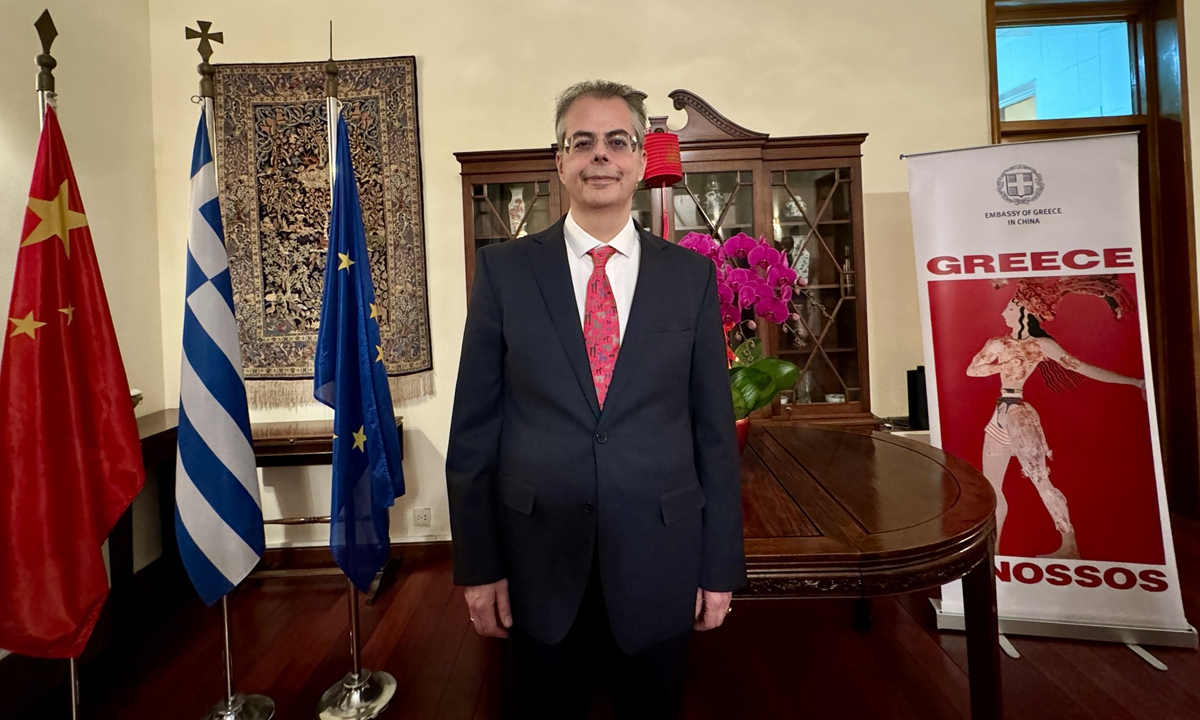
Ambassador of Greece to China Evgenios Kalpyris Photo: Dong Feng/GT
On the occasion of the upcoming Spring Festival, I would like to extend my best wishes to all Chinese people.Considering that in a few days we will be celebrating the Year of the Horse, I can't help but reflect on the values the horse stands for in both Greek and Chinese cultures, as a symbol of strength, authority, beauty and vitality, among other things.
In ancient Greece, the horse carried an exceptional importance, both materially and symbolically, as an indicator of social status. Several names used by Geek aristocracy incorporated the element hippo- (horse), such as Philippos ("lover of horses"). Horses also had a crucial role in warfare - it was the Trojan Horse that led Greeks to victory in Troy, as Homer narrates in the Iliad.
Moreover, the horse has always been present in every form of Greek art - one of the most famous examples are the horsemen on the sculpted frieze of the Parthenon. In Greek mythology, these animals were often associated with gods and supernatural forces: Poseidon was able to create horses from the sea, while Pegasus, the immortal winged horse, symbolized transcendence, linking the human and the divine worlds.
Another intriguing aspect of horse symbolism in Greek mythology is the Centaur, a creature that possesses the upper body of a human and the lower body of a horse. This duality exemplifies the internal struggle between the "rational" (human) and the "passionate/animal" (horse) aspects of existence. In Plato's philosophical work, the myth of the chariot of the soul vividly illustrates this divide with a charioteer guiding two horses - a noble white one and a wild black one - each symbolizing different facets of the human psyche.
Additionally, horseshoes have become enduring symbols of luck and good fortune, treasured in Greece, as well as in many cultures around the world.
These themes resonate with Chinese mythology as well. Figures like "Tianma," the "Heavenly Horse," and "Longma," the "Dragon Horse," reveal that, in both Greek and Chinese cultures, horses symbolize order, power, and the harmonious connection between heaven and earth.
This holiday however, is not only about reflecting upon the past, but also about enjoying the present. In that respect, I would also like to share with you one of my favorite Spring Festival traditions, which is gathering with my family for the New Year's Eve reunion dinner - a meal that's about so much more than just food. It's a time when everyone, no matter how busy life gets, comes home to be together under one roof.
After dinner, we make special dumplings, which are eaten right as the clock strikes 12, symbolizing good luck and a fresh start for the new year. This tradition of sharing food, conversation, and laughter as a family is my favorite part of the Spring Festival.
Global Times
RELATED ARTICLES