Spring Festival travel surges as cross-regional trips continue to rise
Backed by enhanced rail-air capacity, greater domestic deployment and intelligent transport systems
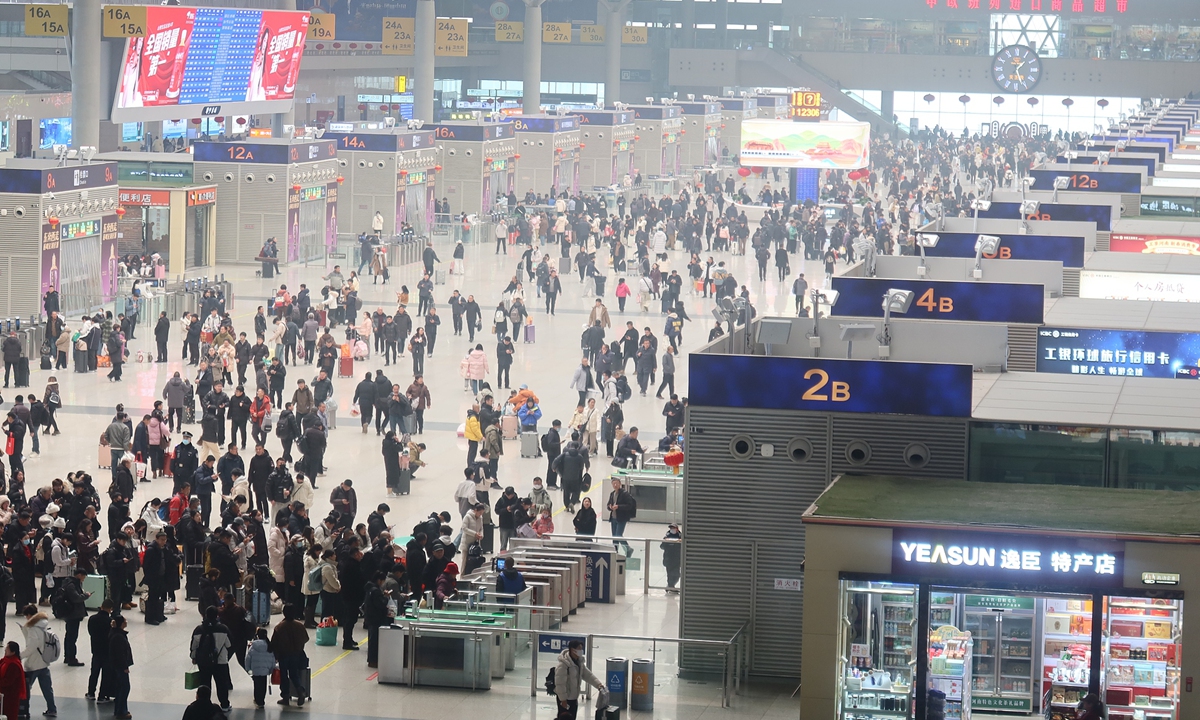
Passengers have their tickets checked before boarding at Zhengzhou East Railway Station in Zhengzhou, Central China's Henan Province on January 29, 2026. Photo: VCG
China's cross-regional passenger trips are expected to exceed 285 million on February 13, the 12th day of the Spring Festival travel rush, also known as chunyun, rising 4.5 percent from a year earlier, the Ministry of Transport (MOT) said, as reported by China Central Television (CCTV) on Friday. The figure extends a multi-day upward trend.
Analysts said the sustained travel surge is a vivid readout of China's economic vitality, made possible by hard capacity - expanding rail and air networks, homegrown aircraft deployments, upgraded charging infrastructure and smarter travel services that can absorb massive flows efficiently.
According to CCTV, railway passenger trips are expected to edge up 0.5 percent day-on-day, while road travel - the dominant component - will increase 4.9 percent from a year earlier. Waterway transport will grow 6.5 percent year-on-year and civil aviation passenger volume will reach 2.46 million trips, up 3.4 percent.
The 2026 travel season runs from February 2 to March 13. Total cross-regional trips during the 40-day period are projected to reach 9.5 billion, equivalent to nearly seven journeys per person nationwide and another record high, according to earlier MOT data.
Often described as the world's largest annual human migration, the Spring Festival travel season not only reflects transport capacity and technological progress but also serves as a barometer of consumption vitality and social trends. Analysts noted the nine-day holiday this year has further stimulated travel demand.
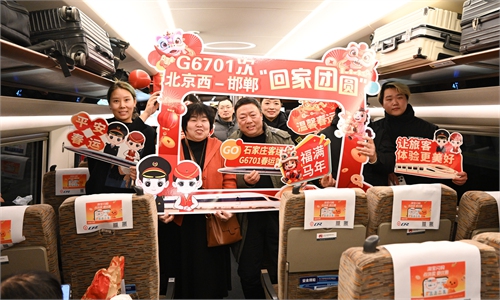
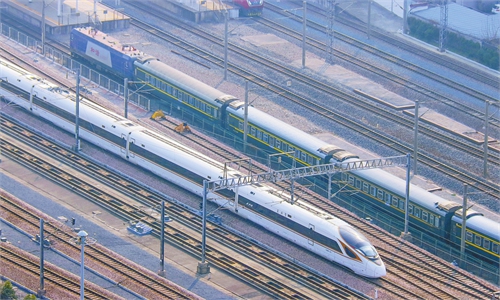
Behind the surge in movement lies expanding transport capacity. CCTV reported that 22 new high-speed railway lines totaling 3,109 kilometers opened ahead of the season, with more than 50 passenger stations entering Spring Festival service for the first time.
Peak days may see more than 14,000 passenger trains in operation and about 19,400 flights handled daily, highlighting the scale and coordination capability of China's transport network in accommodating massive flows, the report noted.
China State Railway Group announced on December 27 that the country's operational high-speed rail mileage has surpassed 50,000 kilometers - exceeding the combined total of all other countries and ranking first globally, reinforcing the capacity foundation that supports massive holiday mobility.
"Chunyun is a phenomenon unique to China, with hundreds of millions of people traveling within a short, highly concentrated period before the Spring Festival. The scale and time sensitivity of this movement highlight not only China's transport capacity, but also its strong ability in social organization, inter-governmental coordination and overall governance," Bian Yongzu, executive deputy editor-in-chief of Modernization of Management magazine, told the Global Times on Friday.
Further supporting the surge, air transport capacity is expanding, with the Civil Aviation Administration of China expecting passenger volume during the travel season to go up about 5.3 percent year-on-year, reaching a record high. China's domestically developed large passenger aircraft C919 is also playing an increasing role in the holiday transport network.
During the 2026 festival season, China Eastern Airlines' 14 C919 aircraft will operate more than 50 flights per day on average, up 52.6 percent year-on-year, according to a company statement sent to the Global Times.
China Southern Airlines said that its C919 and C909 aircraft flights since the start of the travel rush on February 2 rose 49.1 percent year-on-year, carrying 60.3 percent more passengers. Air China will deploy all nine of its C919 aircraft, with total passenger flights planned to rise 10.1 percent year-on-year, the Global Times learned from the company.
Road travel growth also reflects changes in vehicle structure. Daily traffic of new-energy vehicles on expressways is expected to approach 9.5 million during the holiday, CCTV reported. To ease charging concerns, regions nationwide have upgraded charging networks.
By the end of 2025, China had more than 20 million electric-vehicle charging facilities, including 71,500 charging points at highway service areas, of which 20,000 were added in 2025 alone.
Meanwhile, digital technologies are also reshaping travel efficiency. Facial recognition boarding, electronic tickets and automated baggage handling at railway stations and airports have shortened waiting times and reduced congestion, making journeys faster and more convenient.
Bian noted that changes in travel patterns reflect broader economic upgrading. Faster and more comfortable trips via high-speed rail and aviation underscore improved infrastructure and rising living standards.
Policy support is also helping activate holiday consumption. At the start of the year, the Ministry of Commerce and two other departments allocated the first batch of 62.5 billion yuan ($8.7 billion) in national subsidy funds to local authorities. The ministry said it will guide regions to expand subsidy distribution and ensure consumers can access benefits in accordance with policy requirements.
Rising mobility, improving infrastructure and supportive consumption policies indicate that the festival travel rush has become more than a seasonal phenomenon - it reflects the underlying strength of China's real economy and the resilience of domestic demand, the expert said.
RELATED ARTICLES