ARTS / CULTURE & LEISURE
Trotting through 5,000 years: Horse in cultural heritage, a symbol of China's eternal spirit of vitality and progress



Renowned Yuan Dynasty painter Zhao Mengfu's painting "Bathing Horses" Photo: VCG
The Year of the Horse in 2026 celebrates a zodiac symbol of vitality, passion and relentless progress in Chinese culture. The idiom "the horse gallops without stopping" captures the spirit of forging ahead tirelessly, echoed in Spring Festival blessings like "may success come as swiftly as a horse gallops."As a spiritual totem spanning over 5,000 years of Chinese civilization, the horse carries profound symbolism, illuminating Chinese thought and emotion.
Therefore, stories and images associated with the horse run through the long history of Chinese civilization. From bronze ware and classic paintings to literary idioms, the image of the horse shines like brilliant stars, illuminating the sky of human thought and emotion.
Imprint of civilization
Relics are tangible footprints of civilization, and horses in national treasures have given this spiritual totem a tangible charm. From the Warring States Period (475BC-221BC) to the Yuan Dynasty (1279-1368), horse-themed relics mirror the profound Chinese culture and history.
When speaking of the deep connection between horses and Chinese civilization, one cannot overlook King Mu of Zhou's legendary Eight Steeds (Ba Jun). These eight magnificent horses were said to gallop thousands of miles a day, carrying the king on his westward journey to the Kunlun Mountains, where he met with the Queen Mother of the West (Xiwangmu), creating a fantastical tale woven into Chinese mythology.
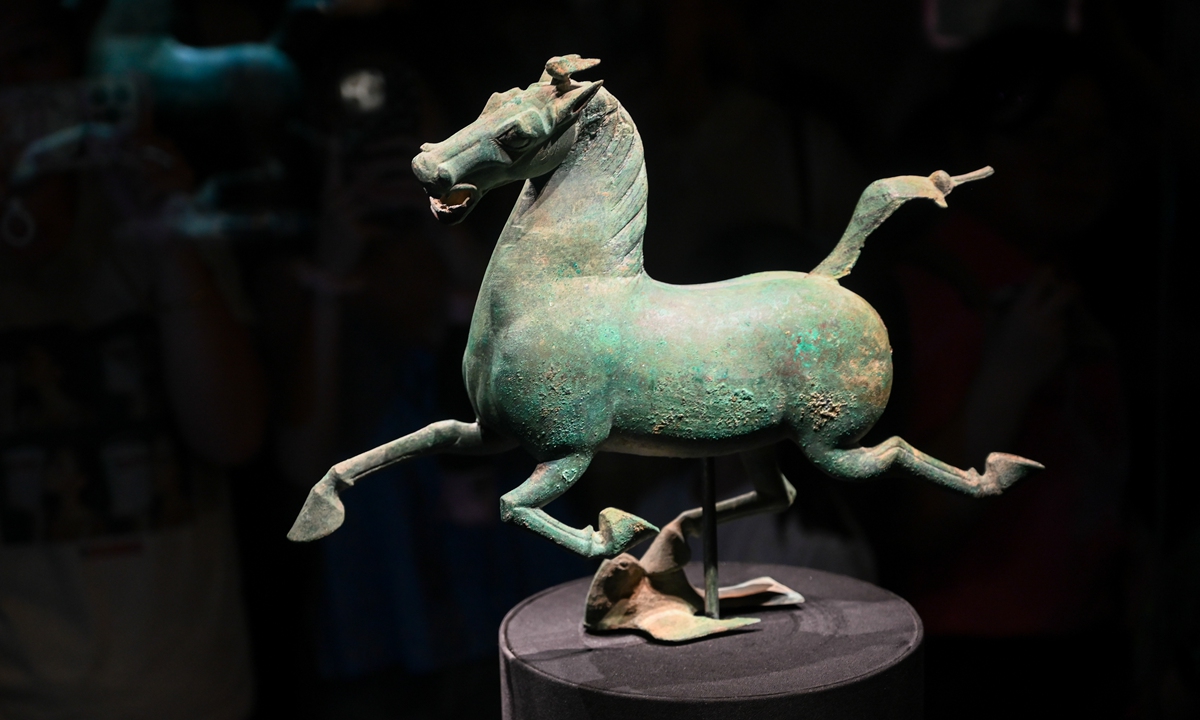
An ancient bronze horse statue at Gansu Provincial Museum in Lanzhou, Northwest China's Gansu Province Photo: VCG
Yet among all these treasures, one stands out as a timeless icon that bridges ancient craftsmanship and modern popularity, which is popularly known as "Bronze Galloping Horse Treading on a Flying Swallow," dating back to the Eastern Han Dynasty (25-220). The bronze horse statue was unearthed in the 1960s from the Leitai Tomb of the Eastern Han Dynasty in Wuwei city, Northwest China's Gansu Province."Artifacts featuring horses were quite common in the Han Dynasty (206BC-AD220)… But this is the only one that uses a horse stepping on a flying bird to show its speed," Ban Rui, director of the Gansu Provincial Museum, told the Global Times with pride.
The 34.5cm-tall bronze horse's "same-side gait" is no flaw, but a trained "contralateral step" of fine horses in the Hexi Corridor, a key artery of the ancient Silk Road, bred from Western and local breeds in the Han Dynasty to suit the Silk Road's long rides.
This intrinsic connection to national destiny and military achievements naturally established the horse as a symbol of success, strength and responsibility, laying a solid historical foundation for its elevation to a totemic symbol.
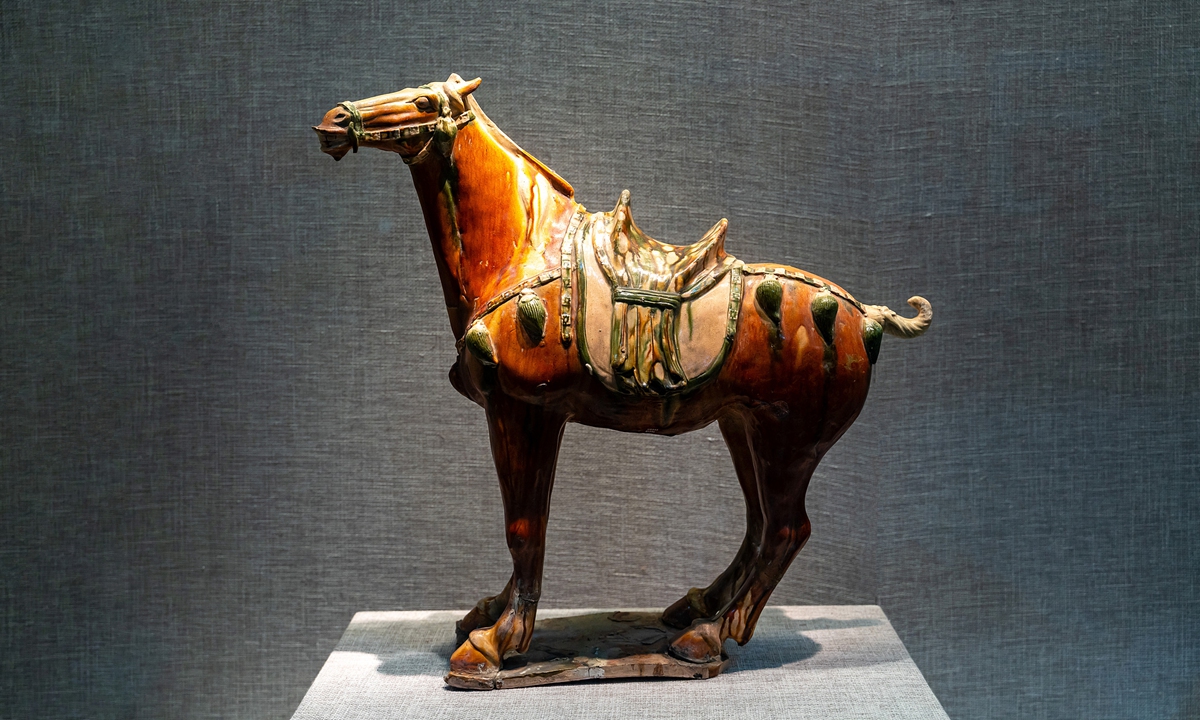
A tri-color horse statue from the Tang Dynasty at Luoyang Museum, Central China's Henan Province Photo: VCG
Spirit of the dragon-horseIt was the infusion of Confucian thought and its philosophical elevation that truly transformed the horse from a "meritorious servant" into a "spiritual totem." Under the influence of the Confucian concept of "comparison with virtues," people began to project the horse's admirable qualities - such as perseverance, loyalty, bravery and humility - onto the moral benchmarks expected of a noble character.
The millennia-old phase "The spirit of the dragon-horse" further elevates the horse's spiritual significance to the level of national character. The dragon, as a totem of the Chinese nation, represents authority, nobility and power; the horse symbolizes bravery, wisdom and loyalty. The spirit embodies the perfect integration of strength and wisdom, as well as a spirit of relentless progress.
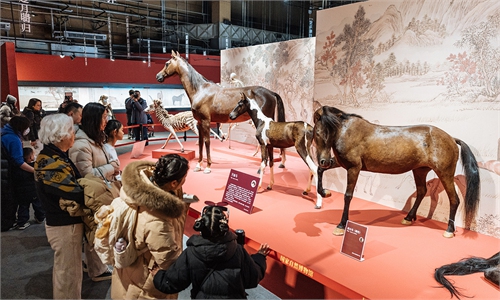
Within the halls of museums, in classical paintings and calligraphy, horses are depicted galloping or standing serene - each posture imbued with distinct cultural nuance.
Ying Jinfei, Director of the Zhejiang Art Museum, has a profound fondness for the horse, both as a creator and an art professional. He told the Global Times that he particularly admires horses from the Northern Dynasties period, which is why his prints and derivative silk scarves often feature depictions of horses from that era.
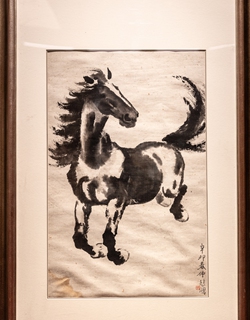
Chinese painter Xu Beihong's painting "The Galloping Horse" Photo: Li Hao/GT
In Chinese painter Xu Beihong's depiction of "The Galloping Horse," the brushwork is bold and fluid, capturing a steed with its head raised high, tail aloft and all four hooves off the ground, full of dynamism and strength.
Globally, horses hold similar reverence: Greek Olympic equestrian events, the Norse Sleipnir traversing worlds, Indian sun god Surya's seven steeds, and French artist Jacques-Louis David's "Napoleon Crossing the Alps."
East or West, the horse inspires an uplifting pursuit of enterprise and vigor. Through relics, myths, philosophy and art, the horse gallops across millennia as a timeless emblem of Chinese civilization's enduring spirit.
RELATED ARTICLES