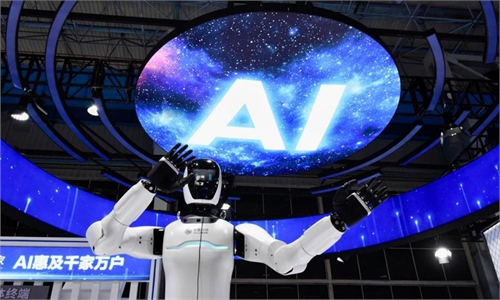
India hosts AI summit, expert says it aims to join global AI boom
By Published: Feb 17, 2026 04:07 PM
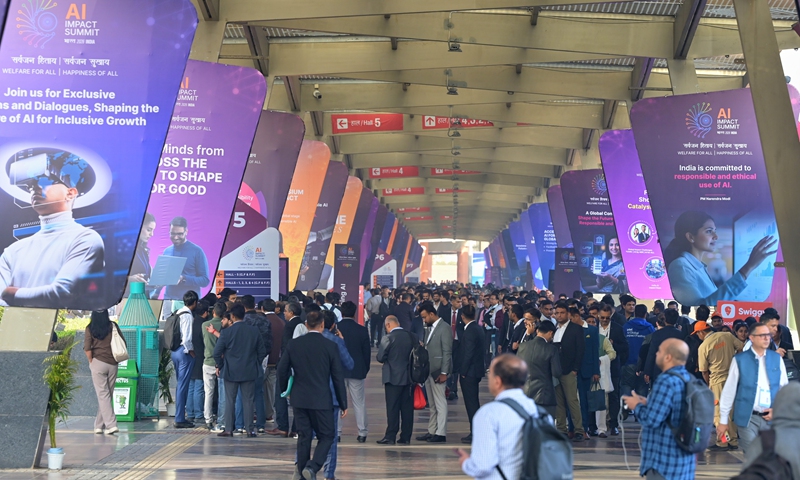
The AI Impact Summit 2026 is held on February 16, 2026 in New Delhi, India. Photo: VCG
India is hosting an artificial intelligence summit this week, bringing together heads of state and tech executives to deliberate on key issues. Indian Prime Minister Narendra Modi inaugurated the five-day AI Impact Summit on Monday, which aims to declare a "shared roadmap for global AI governance and collaboration," NDTV reported.
The annual summit is the fourth of its kind, with previous meetings being held in France, South Korea and the UK.
Modi took to X on Monday ahead of the summit and said: "The AI Impact Summit will enrich global discourse on diverse aspects of AI, such as innovation, collaboration, responsible use and more."
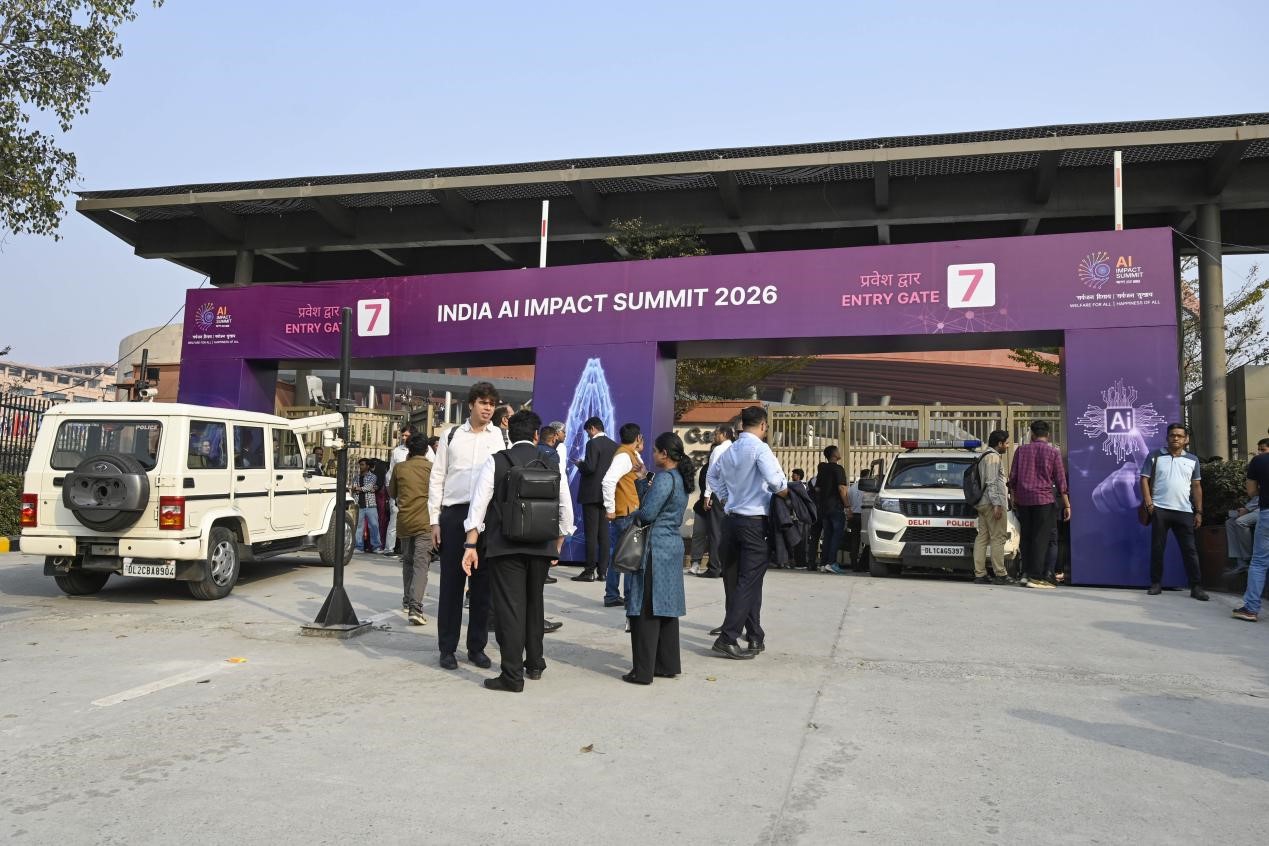
Delegates arrive for AI Impact Summit 2026 on February 16, 2026 in New Delhi, India. Photo: VCG
The expo is attended by 20 heads of state, 60 ministers, and 500 global AI leaders, bringing together global technology firms, startups, academia institutions, Union Ministries, state governments, and international partners, the Xinhua News Agency reported. Google Chief Executive Sundar Pichai, Qualcomm CEO Cristiano Amon, OpenAI CEO Sam Altman, Microsoft President Brad Smith and AMI Labs Executive Chairman Yann LeCun are reportedly among them.
Indian officials are positioning this event, which runs until February 20, as a platform to amplify the voices of developing nations in global AI governance. It marks the first time the event is being held in the developing world, Reuter's reported.
According to an official statement, the AI summit was anchored in the three core pillars of "People, Planet and Progress." It was driven by seven thematic working groups covering AI for Economic Growth and Social Good, Democratization of AI Resources, Inclusion for Social Empowerment, Safe and Trusted AI, Human Capital, Science, and Resilience, Innovation and Efficiency.
As India races to narrow the artificial intelligence gap with the United States and China, it is planning a vast new "data city" to power digital growth on a large scale, AFP reported.
Liu Wei, director of the Human-Machine Interaction and Cognitive Engineering Laboratory at Beijing University of Posts and Telecommunications, told the Global Times on Tuesday that the summit demonstrates India's efforts and momentum in actively participating in the global AI boom competition, marking a step in challenging the long-standing dominance in AI by developed countries.
The BBC reported on Tuesday that at last year's AI Action Summit, as it was then known, "an ugly power struggle broke out" among some Western countries over who should be in charge. The various Western powers jostled for pole position in Paris, and US vice president JD Vance delivered a blistering speech in which he said America's place at the top of the pack was non-negotiable, according to the report.
Liu further noted that India's initiative to host this AI summit reflects its determination to join the global AI boom. It wants to leverage its demographic dividend - with a population exceeding 1.4 billion and over 1 billion internet users - to become a significant player in the global AI scene besides China and the United States in the future, Liu said.
According to the scholar, India aims to leverage AI to enhance its status as a major power and consolidate its image as a "leader of the Global South" following the G20 summit. The expert also warned that India's data governance remains chaotic and its AI policies lack stability.
Despite India's ambitious plans for large-scale digital infrastructure development and its grand vision for innovation, the country still faces a long road ahead in artificial intelligence advancement. "While India has laid out impressive blueprints, challenges in foundational research, computing resources, talent depth, and ecosystem maturity mean that realizing its full AI potential will require sustained effort and international collaboration," Liu noted.
RELATED ARTICLES