BRASIL 247 / MORE
Brazilian president calls for UN-led global AI governance at India's Artificial Intelligence summit
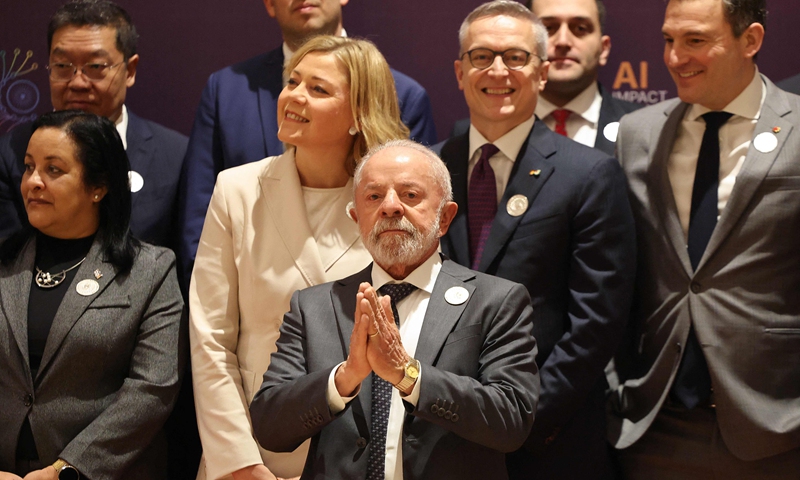
Brazil's President Luiz Inacio Lula da Silva (C) gestures as he prepares to pose for a group photo while attending the AI Impact Summit in New Delhi on February 19, 2026. Photo: CFP
By Brasil 247 - Artificial intelligence is boosting productivity and public services worldwide, but it is also intensifying disputes over power, data and sovereignty, Brazil's President Luiz Inácio Lula da Silva said Thursday in New Delhi, where he delivered a speech at the Indian government's AI Impact Summit, the first edition held in the Global South, according to Brasil 247.
Lula framed the debate as a turning point for the international system, arguing that technology is moving faster than diplomacy. "Our societies find themselves at a crossroads. The Fourth Industrial Revolution is advancing rapidly while multilateralism is dangerously retreating," he said, adding that this makes international rules for AI urgent and strategic.
He emphasized what he described as the "dual" nature of high-impact innovation, saying AI can expand collective well-being or cast shadows over humanity's future. In his speech, Lula listed potential benefits for industrial productivity, public services, medicine, and food and energy security. But he also warned that the same tools can be used for destructive ends, citing autonomous weapons, hate speech, disinformation, child pornography, femicide, violence against women and girls, and the precarization of work.
Lula argued that manipulated or AI-generated false content can distort elections and threaten democracy. He rejected the idea that algorithms are neutral mathematical codes, saying they are part of a broader power structure. Without collective action, he said, AI will deepen historic inequalities.
A central point of the address was the concentration of computing capacity, infrastructure and capital in the hands of a small number of countries and corporations. Lula said data produced by citizens, companies and public institutions are being appropriated by a few conglomerates without equivalent returns in value and income in the territories where that information originates.
Lula linked the regulation of Big Tech to protecting human rights online, ensuring information integrity and defending creative industries. He said the prevailing business model relies on the exploitation of personal data, the erosion of privacy and the monetization of sensationalist content that amplifies political radicalization.
Turning to Brazil's domestic agenda, he noted that Congress is debating policies to attract investment in data centers and to establish an AI regulatory framework. He also cited the launch of the Brazilian Artificial Intelligence Plan in 2025, presented as a strategy to modernize public services and stimulate jobs and income.
On the international front, Lula referred to initiatives across different forums, including BRICS, the Global Partnership on AI created in the G7 context, and China's proposal to create an international organization for AI cooperation focused on developing countries. Still, he argued that none of these initiatives replace the universal role of the United Nations in building what he called a truly multilateral, inclusive and development-oriented AI governance.
He also mentioned the Global Digital Compact approved in 2024 in New York and highlighted the creation of the Independent International Scientific Panel on Artificial Intelligence as a relevant step toward a global scientific body on the issue.
(Reported by Brasil 247 on Feb 19, 2026)
