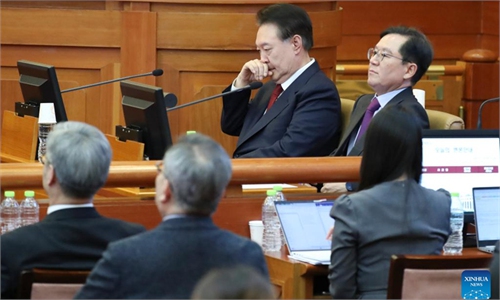
S.Korea's ex-president Yoon sentenced to life in prison on insurrection; expert calls it harshest realistically enforceable penalty
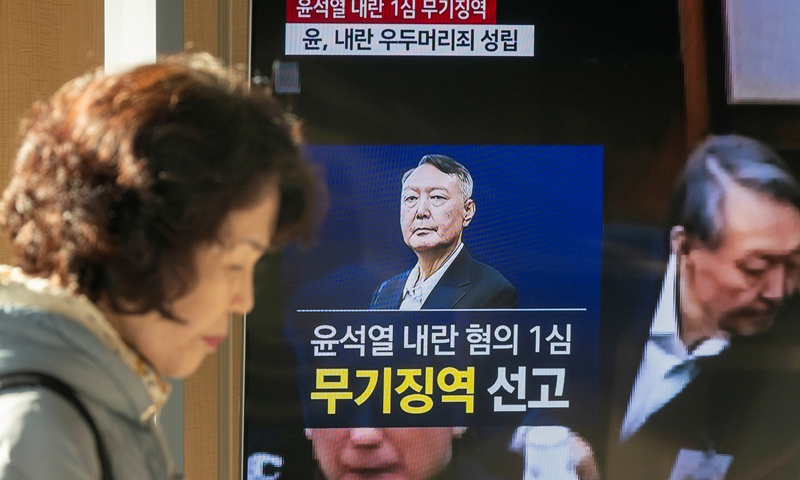
A TV screen at a station shows a news report on South Korea's ex-President Yoon Suk-Yeol sentenced to life imprisonment in Seoul, South Korea on Thursday. Photo: VCG
South Korea's former President Yoon Suk-yeol was sentenced to life in prison on charges of insurrection stemming from his declaration of emergency martial law, the Xinhua News Agency reported on Thursday.
A Chinese expert noted that the ruling represents the harshest realistically enforceable penalty in South Korea's judicial system since the country has de facto ended the use of the death penalty since 1997.
The Chosun Daily on Thursday quoted the presiding Judge Jee Kui-youn as stating that sending troops to the National Assembly after declaring emergency martial law was "the core of this case," adding that "the intent to disrupt the constitutional order is recognized."
"It is difficult to deny that former president Yoon inwardly aimed to make the National Assembly unable to function properly for a considerable period by blocking and paralyzing the National Assembly's activities by means of sending troops to the National Assembly to seal it off and arrest key politicians," Jee Kui-youn, the presiding judge, said during the hearing attended by Yoon and broadcast live on national television, Yonhap News Agency (YNA) reported on Thursday.
YNA also pointed out that under the Constitution, an insurrection is defined as an act aimed at removing state authority from part or all of the country or the staging of a riot with the purpose of subverting the Constitution. The court said the declaration of martial law in itself cannot constitute an insurrection, but that in Yoon's case, the charge held because he aimed to paralyze the functions of a constitutional body.
The sentence made Yoon the first elected head of state in the country's democratic era to receive the maximum custodial sentence, The Guardian reported on the same day.
According to the Chosun Daily, Yoon arrived at the Seoul Central District Court building at around 12:50 pm on Thursday in an escort vehicle. Outside the courthouse, supporters holding placards reading "dismiss the indictment" and "Yoon again" gathered to greet him.
South Korean news outlet Nate News reported that the verdict of Yoon was broadcast live as the court allowed the request for live coverage. The verdict was delivered in Courtroom 417 of the Supreme Court, which was the same room where former President Chun Doo-hwan was sentenced to death. Chun's sentence was later commuted to life imprisonment in the appeals court, and the sentence was finalized by the Supreme Court, according Nate News.
A report from the Korea Times titled "Ex-President Yoon Suk Yeol sentenced to life in prison for leading insurrection" noted that the case "is widely seen as a test of the legal boundary between presidential emergency powers and the constitutional limits on executive authority."
Seoul Economic Daily also reported on the verdict of Yoon on Thursday afternoon. While in a previous report on the same day, it cited some members of the Democratic Party of Korea, who call Yoon "to receive the death penalty." Democratic Party Chairman Chung Chung-rae posted on social media that "If we do not punish today's crime, we give courage to tomorrow's crime," Chung wrote. "I hope we do not encourage future insurrections," according to the report.
According to The Korea Times, under Korean criminal law, the offense of leading an insurrection carries only three possible penalties: death, life imprisonment with labor or life imprisonment without labor.
Yet, South Korea has maintained a de facto end to the use of the death penalty since 1997, with no executions carried out since December 30, 1997 - even though capital punishment remains legally on the books, Xiang Haoyu, a distinguished research fellow at the China Institute of International Studies, told the Global Times on Thursday.
In 2008, a South Korean scholar Byung-Sun Cho published a paper titled, "South Korea's Changing Capital Punishment Policy: The Road From de Facto to Formal Abolition," which stated that the most recent executions in South Korea occurred in December 1997. Since 1999, legislators have three times proposed legislation that would replace capital punishment with life in prison without parole.
Against this backdrop, the ruling represents the harshest punishment South Korea's judicial system can realistically enforce, aiming to establish a firm judicial precedent that unconstitutional martial law constitutes insurrection, thereby preventing any future abuse of executive power, Xiang added.
According to Xiang, the decision may provoke some backlash from the conservative camp behind Yoon - particularly from far-right forces. However, because the verdict aligns with the majority sentiment in society, its impact on South Korean political landscape remains limited.
Since the establishment of South Korea in 1948, a considerable number of presidents, starting with Syngman Rhee (the first president, 1948-1960), have faced severe consequences after leaving office, including prosecution, imprisonment, exile, assassination, or suicide - often linked to corruption, abuse of power, treason, or involvement in coups. This has also been dubbed by Chinese netizens as the "Blue House curse."
For instance, according to BBC, Rhee was forced to resign amid massive protests over rigged elections and corruption allegations; exiled to Hawaii, where he died in 1965; Park Chung-hee, the president from 1961 to 1979, was assassinated at a dinner party in October 1979 by his own spy chief.
Lee Myung-bak, president from 2008 to 2013 was indicted on embezzlement, bribery, later received a presidential pardon, cutting short his 17-year prison sentence for corruption, Yonhap News reported.
Moon Jae-in is a relatively unique figure among former South Korean presidents. Unlike many of his predecessors, he returned to his hometown of Yangsan after his time in office, where he now runs a small bookstore called Pyeongsan Bookstore at his private residence, multiple South Korean news outlets show.
RELATED ARTICLES