ARTS / FILM
Pegasus 3 roars to China’s Spring Festival box office glory, but why?
China' s total box office revenue for 2026 reached $970 million, surpassing North America and temporarily ranking first among single markets worldwide, according to Maoyan, a Chinese movie-ticketing and film data platform on Saturday. On February 19 local time, Deadline Hollywood, an online outlet covering the US entertainment industry, published a report highlighting China's Spring Festival season. The piece stated, "The biggest movies at this weekend's worldwide box office won't be from Hollywood — sorry, Wuthering Heights — but rather China," and noted that Spring Festival sales chart led by Pegasus 3 are expected to dominate the global box office this weekend.
The piece introduced the rough plots of five Chinese New Year release films: Pegasus 3, Scare Out, Boonie Bears: The Hidden Protector, Blades of the Guardians, and the Jackie Chan-starring Panda Plan: The Magical Tribe.

The author of the report, Anthony D'Alessandro, noted that in the first three days of the Chinese Spring Festival holiday season, Pegasus 3 grossed $219.5 million at the box office, citing Gower, who predicts that this film, which attracts moviegoers from kids to 80-year-olds, will ultimately claim the top spot in the Chinese Spring Festival box office with $400 million.
If it ultimately holds the lead, this would mark the first time that the Pegasus series has won the Chinese New Year box office championship. When the first installment, Pegasus (2019), was released, it was outperformed by the breakout Chinese sci-fi epic The Wandering Earth. In 2024, Pegasus 2 saw its championship hopes dashed by Jia Ling's YOLO. Now, with the third installment, along with Shen Teng's wild racer character Zhang Chi, has finally ascended to the winner's podium.
To review the "race" of this Chinese New Year season, we need to understand exactly what propelled Pegasus 3 to the lead.
As a loyal fan of the Pegasus series, this writer felt a certain degree of disappointment upon exiting the theater after viewing of Pegasus 3. Compared to the second instalment's near-universally acclaimed "god-tier" reputation, the third one's plot progression feels somewhat formulaic and clichéd at times.
In the first film, Zhang Chi was driven to prove himself, facing the obstacle of having no money to compete, while his rival Lin Zhendong was ultimately revealed as the most loyal "teammate" in the series, who truly understood him. In the second film, a middle-aged Zhang confronted five years of accumulated grievances and unfair behind-the-scenes rules of the sport. His journey from endurance to explosive breakout allowed audiences during the Chinese Spring Festival to witness a story of "old soldiers never die" — a middle-aged man still burning with passion — who overcomes the dark forces, defeats the corruption and wins the team championship. It delivered the ultimate feel-good reversal narrative, perfectly aligning with the holiday audience's desire for a "happy ending." It also resonated deeply with many 1980s-born viewers, reflecting director Han Han's own legendary path — transforming from writer to racer to acclaimed film director — and the extreme romanticism he captured on big screen with the breathtaking Bayanbulak racetrack.
However, Pegasus 3 feels somewhat forced in its attempt to manufacture hardship. With the second film having already delivered a perfectly conclusion, Zhang's goal in the third installment is, after receiving an invitation from the major corporation SKYLAD to form a national team for the Asian Muchen 100 Rally, to select the best drivers for the "Chinese team" through what is supposed to be an absolutely fair process. During the selection, the film incorporates a "team-building" segment styled after the popular variety show Let's Go Now, bringing together a star-studded cast including Fan Chengcheng, Wang Anyu, Huang Jingyu and Hu Xianxu, giving fans plenty to feast their eyes on.
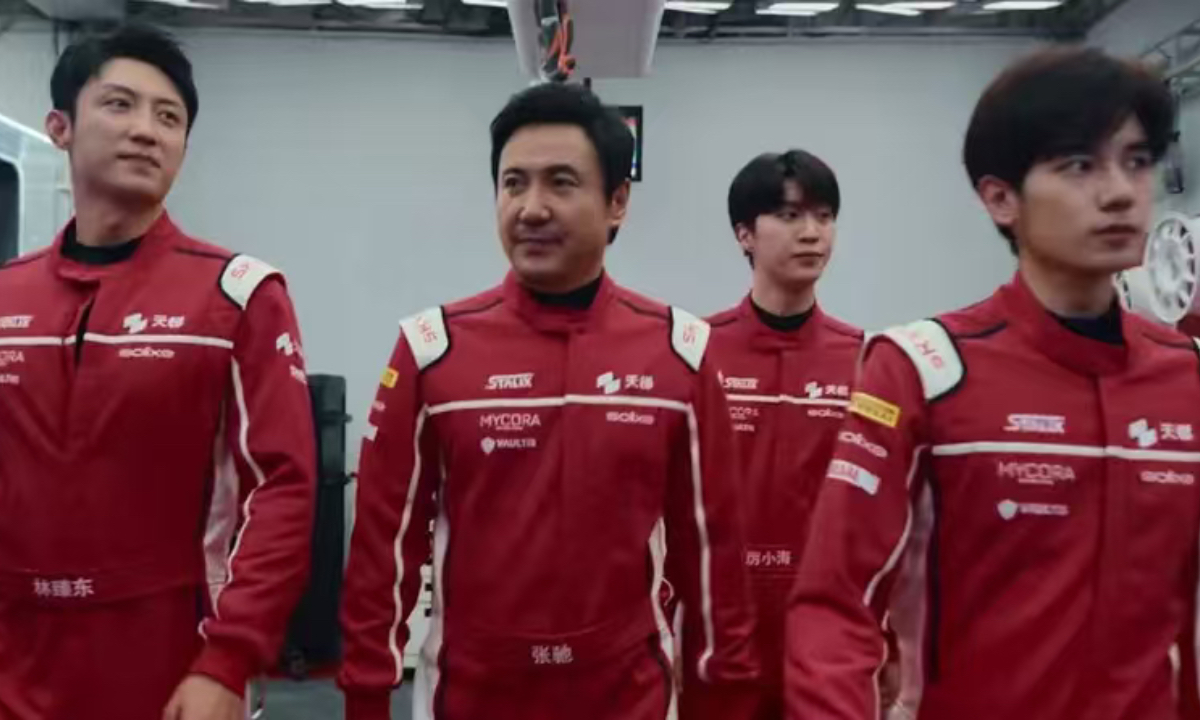
However, right after that, the true face of SKYLAD's top executive Bai Qiang (played by Sha Yi) is exposed: The entire selection process is merely a sham, with the finalists already predetermined to be the sponsor's son and the team's own hand-picked drivers. Thus, Zhang Chi, together with his partners Yu Qiang and Ji Xing, enlist the help of Lin Zhendong and their former rival Manager Ye to launch a "revenge" operation. They enter the race as independent drivers and ultimately seize the championship.
This is an ending that every viewer can foresee from of the movie — an utterly predictable, cliched confrontation between justice and corruption that becomes obvious to audiences halfway through.

Yet director Han Han's true skills lie in this: Even with such a formulaic setup, the movie remains thoroughly enjoyable, the story feels complete, and viewers leave the theater with their blood pumping, emotions surging, and an irresistible urge to floor the accelerator on the drive home.
Simply telling a story in a complete way is already a high bar for many contemporary Chinese films. Han not only delivers completeness but excels in pacing.
Unlike the roughly 25-minute climactic race sequence in the second film, Pegasus 3's racing scenes exceed 45 minutes. Moreover, it departs from the staggered-start, individual-time-trial format of the previous two entries. The Muchen 100 Rally features all drivers starting simultaneously, choosing between two paths, with a variety of surfaces including asphalt, gravel, Gobi desert, and more. It's genuine rally racing — full of door-to-door battles, overtakes and even flying-car jumps one after another. Zhang has heart-stopping blind-driving moments due to a hood malfunction, while Lin pays homage to Initial D with a high-speed overtake while turning off his headlights. In the final sprint, Han elevates the stakes further: Lin sacrifices his own position to boost Zhang, and Zhang, in a key moment, offers a crucial reminder to Li Lun — who should have been his rival — showcasing a grand, united image of Chinese drivers standing together against external competition.
These 45 minutes of intense, thrilling footage are enough to earn rave reviews from Douban users calling the film "China's version of F1," sufficient to make audiences overlook any shortcomings in the first half's emotional buildup. Standout performances from Sha Yi and Wei Xiang also fuel more hot searches and discussions, keeping people talking.
Director Han's greatest success, however, is the film's sense of immersion and relatability. It allows many viewers — including this writer — to see their own ordinary yet stubborn selves in Zhang Chi. Watching him battle monsters, overcome injustice, and stage comebacks feels like cheering moviegoers ourselves on. It gives us the courage, when facing life's various difficulties after leaving the theater, to declare, "I'm ready," or "Sometimes in life, you just have to go full throttle."
In the film, Bai Qiang says, "Some races are already decided in the conference room."
But Zhang Chi tells the audience, "Not all races take place in the conference room."
He also proves with the triumph of a wild racer that, in the end, racing is about the human spirit — not the machine, and certainly not any AI-assisted system.
Thus, Zhang Chi's victory is the one the audience's heart truly longs for.
The championship of Pegasus 3 rests on that same simple truth.
Postscript
As of 10:35 pm on February 21, the total box office for the Chinese Spring Festival period had reached 4.474 billion yuan ($647.4 million), with Pegasus 3 leading the pack at nearly 2.329 billion yuan. The spy thriller Scare Out, which tells a story of counter-espionage on the national security front, ranked second with 712 million yuan. Blades of the Guardians, featuring four generations of martial arts stars and riding a wave of strong word-of-mouth, staged a comeback to overtake Boonie Bears: The Hidden Protector and claim third place with 589 million yuan, while the perennial family/children's favorite Boonie Bears held steady in fourth at 570 million yuan.
In its coverage of the Chinese Spring Festival box office, Deadline Hollywood quoted sources as saying that Chinese audience's moviegoing preferences are changing rapidly and "embracing more Hollywood-style local titles with broad stories," offering rich narratives and excellent visual effects... Yet in reality, apart from Zootopia 2, several Hollywood films in recent years have suffered major flops in the Chinese market. It seems that Deadline Hollywood is suggesting that Chinese films defeated Hollywood by adopting a "Hollywood style." What's your opinion?
The piece introduced the rough plots of five Chinese New Year release films: Pegasus 3, Scare Out, Boonie Bears: The Hidden Protector, Blades of the Guardians, and the Jackie Chan-starring Panda Plan: The Magical Tribe.
Photo: Screenshot of a report by Deadline Hollywood
The author of the report, Anthony D'Alessandro, noted that in the first three days of the Chinese Spring Festival holiday season, Pegasus 3 grossed $219.5 million at the box office, citing Gower, who predicts that this film, which attracts moviegoers from kids to 80-year-olds, will ultimately claim the top spot in the Chinese Spring Festival box office with $400 million.
If it ultimately holds the lead, this would mark the first time that the Pegasus series has won the Chinese New Year box office championship. When the first installment, Pegasus (2019), was released, it was outperformed by the breakout Chinese sci-fi epic The Wandering Earth. In 2024, Pegasus 2 saw its championship hopes dashed by Jia Ling's YOLO. Now, with the third installment, along with Shen Teng's wild racer character Zhang Chi, has finally ascended to the winner's podium.
To review the "race" of this Chinese New Year season, we need to understand exactly what propelled Pegasus 3 to the lead.
As a loyal fan of the Pegasus series, this writer felt a certain degree of disappointment upon exiting the theater after viewing of Pegasus 3. Compared to the second instalment's near-universally acclaimed "god-tier" reputation, the third one's plot progression feels somewhat formulaic and clichéd at times.
In the first film, Zhang Chi was driven to prove himself, facing the obstacle of having no money to compete, while his rival Lin Zhendong was ultimately revealed as the most loyal "teammate" in the series, who truly understood him. In the second film, a middle-aged Zhang confronted five years of accumulated grievances and unfair behind-the-scenes rules of the sport. His journey from endurance to explosive breakout allowed audiences during the Chinese Spring Festival to witness a story of "old soldiers never die" — a middle-aged man still burning with passion — who overcomes the dark forces, defeats the corruption and wins the team championship. It delivered the ultimate feel-good reversal narrative, perfectly aligning with the holiday audience's desire for a "happy ending." It also resonated deeply with many 1980s-born viewers, reflecting director Han Han's own legendary path — transforming from writer to racer to acclaimed film director — and the extreme romanticism he captured on big screen with the breathtaking Bayanbulak racetrack.
However, Pegasus 3 feels somewhat forced in its attempt to manufacture hardship. With the second film having already delivered a perfectly conclusion, Zhang's goal in the third installment is, after receiving an invitation from the major corporation SKYLAD to form a national team for the Asian Muchen 100 Rally, to select the best drivers for the "Chinese team" through what is supposed to be an absolutely fair process. During the selection, the film incorporates a "team-building" segment styled after the popular variety show Let's Go Now, bringing together a star-studded cast including Fan Chengcheng, Wang Anyu, Huang Jingyu and Hu Xianxu, giving fans plenty to feast their eyes on.
Photo: Still from Pegasus 3
However, right after that, the true face of SKYLAD's top executive Bai Qiang (played by Sha Yi) is exposed: The entire selection process is merely a sham, with the finalists already predetermined to be the sponsor's son and the team's own hand-picked drivers. Thus, Zhang Chi, together with his partners Yu Qiang and Ji Xing, enlist the help of Lin Zhendong and their former rival Manager Ye to launch a "revenge" operation. They enter the race as independent drivers and ultimately seize the championship.
This is an ending that every viewer can foresee from of the movie — an utterly predictable, cliched confrontation between justice and corruption that becomes obvious to audiences halfway through.
Photo: Still from Pegasus 3
Yet director Han Han's true skills lie in this: Even with such a formulaic setup, the movie remains thoroughly enjoyable, the story feels complete, and viewers leave the theater with their blood pumping, emotions surging, and an irresistible urge to floor the accelerator on the drive home.
Simply telling a story in a complete way is already a high bar for many contemporary Chinese films. Han not only delivers completeness but excels in pacing.
Unlike the roughly 25-minute climactic race sequence in the second film, Pegasus 3's racing scenes exceed 45 minutes. Moreover, it departs from the staggered-start, individual-time-trial format of the previous two entries. The Muchen 100 Rally features all drivers starting simultaneously, choosing between two paths, with a variety of surfaces including asphalt, gravel, Gobi desert, and more. It's genuine rally racing — full of door-to-door battles, overtakes and even flying-car jumps one after another. Zhang has heart-stopping blind-driving moments due to a hood malfunction, while Lin pays homage to Initial D with a high-speed overtake while turning off his headlights. In the final sprint, Han elevates the stakes further: Lin sacrifices his own position to boost Zhang, and Zhang, in a key moment, offers a crucial reminder to Li Lun — who should have been his rival — showcasing a grand, united image of Chinese drivers standing together against external competition.
These 45 minutes of intense, thrilling footage are enough to earn rave reviews from Douban users calling the film "China's version of F1," sufficient to make audiences overlook any shortcomings in the first half's emotional buildup. Standout performances from Sha Yi and Wei Xiang also fuel more hot searches and discussions, keeping people talking.
Director Han's greatest success, however, is the film's sense of immersion and relatability. It allows many viewers — including this writer — to see their own ordinary yet stubborn selves in Zhang Chi. Watching him battle monsters, overcome injustice, and stage comebacks feels like cheering moviegoers ourselves on. It gives us the courage, when facing life's various difficulties after leaving the theater, to declare, "I'm ready," or "Sometimes in life, you just have to go full throttle."
In the film, Bai Qiang says, "Some races are already decided in the conference room."
But Zhang Chi tells the audience, "Not all races take place in the conference room."
He also proves with the triumph of a wild racer that, in the end, racing is about the human spirit — not the machine, and certainly not any AI-assisted system.
Thus, Zhang Chi's victory is the one the audience's heart truly longs for.
The championship of Pegasus 3 rests on that same simple truth.
Postscript
As of 10:35 pm on February 21, the total box office for the Chinese Spring Festival period had reached 4.474 billion yuan ($647.4 million), with Pegasus 3 leading the pack at nearly 2.329 billion yuan. The spy thriller Scare Out, which tells a story of counter-espionage on the national security front, ranked second with 712 million yuan. Blades of the Guardians, featuring four generations of martial arts stars and riding a wave of strong word-of-mouth, staged a comeback to overtake Boonie Bears: The Hidden Protector and claim third place with 589 million yuan, while the perennial family/children's favorite Boonie Bears held steady in fourth at 570 million yuan.
In its coverage of the Chinese Spring Festival box office, Deadline Hollywood quoted sources as saying that Chinese audience's moviegoing preferences are changing rapidly and "embracing more Hollywood-style local titles with broad stories," offering rich narratives and excellent visual effects... Yet in reality, apart from Zootopia 2, several Hollywood films in recent years have suffered major flops in the Chinese market. It seems that Deadline Hollywood is suggesting that Chinese films defeated Hollywood by adopting a "Hollywood style." What's your opinion?
RELATED ARTICLES