SPORT / OLYMPICS
Chinese delegation wraps up 2026 Olympics with record overseas medal haul
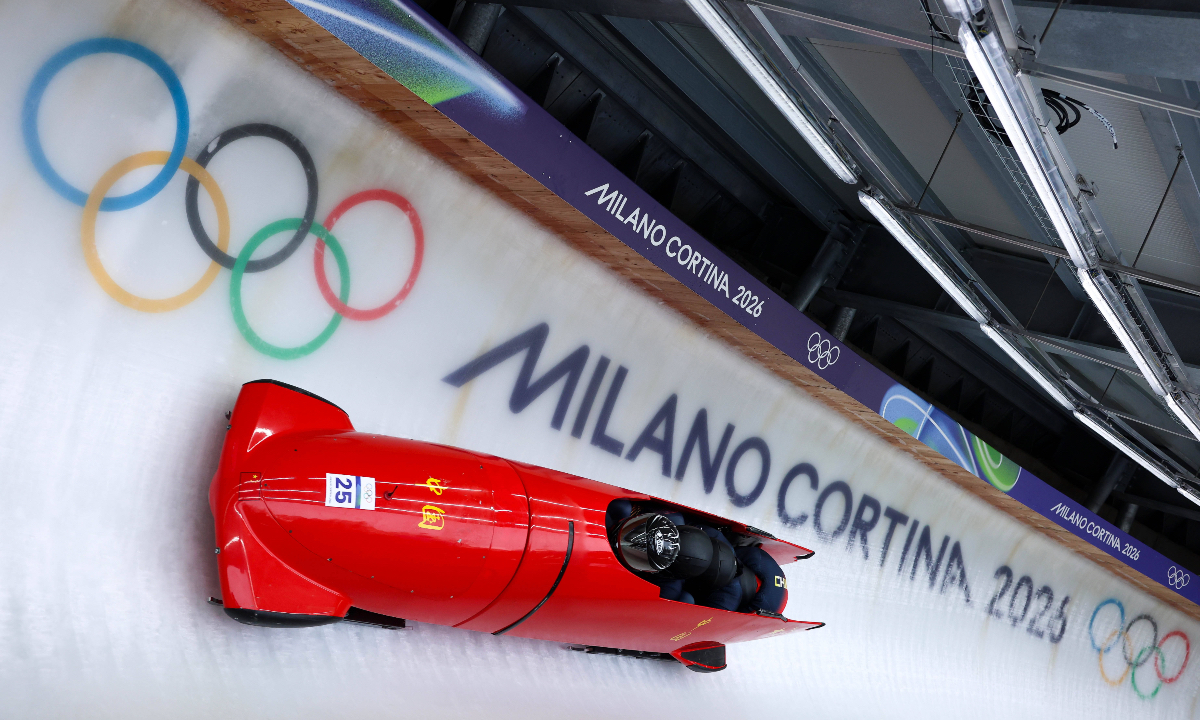
Chinese athletes Sun Kaizhi, Zhang Jin, Shi Yaolong and An Tai compete in the men’s 4-man bobsleigh competition on February 21, 2026 at the Cortina Sliding Centre in Cortina, Italy during the Milano Cortina 2026 Winter Olympics. Photo: VCG
The Chinese delegation at the Milano Cortina 2026 Winter Olympics concluded their campaign on Sunday, with the medal haul of 15 medals (5 gold, 4 silver and 6 bronze) surpassing the previous overseas Winter Olympics record of 11 medals set at both the Turin 2006 and Vancouver 2010 Olympics.
This performance was achieved by China's largest-ever overseas Winter Olympic team, with 126 athletes competing across 91 events in 15 disciplines, highlighting the nation's growing competitiveness in winter sports.
China's snow sports program delivered consistent and impressive results, underscoring the team's depth and generational talent.
Freestyle skiing aerials emerged as a standout discipline, with veteran Xu Mengtao successfully defending her women's title from Beijing 2022 to claim gold. Xu's husband, Wang Xindi, followed suit by soaring to gold in the men's aerials, making them a rare married couple to both win individual Olympic gold medals at the same Games.
Female skier Shao Qi, 24, earned bronze in the women's event, a progress from a 17th place finish at Beijing 2022, while Li Tianma secured bronze in the men's competition in his Olympic debut. The trio of Xu, Wang and Li further contributed to a bronze in the mixed team aerials.
Snowboarder Su Yiming, who will serve as China's flag bearer at the closing ceremony, defied all odds to win the first gold medal for the Chinese delegation by claiming victory in men's slopestyle, after winning a bronze in big air.
Freestyle skier Gu Ailing showcased her versatility with one gold in women’s freeski halfpine as well as two silvers in women's slopestyle and big air, executing high-difficulty maneuvers despite not repeating her multi-gold performance from Beijing 2022. These achievements reflect the stable output from key athletes, solidifying China's prowess in snow disciplines.
On the ice, China achieved historic breakthroughs in speed skating. Ning Zhongyan shattered the Olympic record to claim gold in the men's 1500m, breaking the long-standing dominance of European and North American skaters and marking China's first-ever Olympic gold in this event.
This victory capped a remarkable journey for Ning, who also contributed to a bronze in the men's team pursuit. His achievement underscores the rising competitiveness of China's speed skating.
While not all progress translated to podium finishes, several disciplines showed notable breakthroughs, signaling potential for future success. For example, in ski mountaineering, a new Olympic event, Chinese athletes Bu Luer and Cidan Yuzhen finished in the eighth place in the mixed relay, representing China's expansion into emerging winter sports.
Despite these successes, the Games served as a wake-up call for some of China's traditional powerhouses.
The national short track speed skating team, a longtime medal contributor for China at the Winter Olympics, managed only one silver from Sun Long in the men's 1000 meters, even though it was an Olympic medalists-studded squad. This ended a streak of gold medals in every Winter Olympics since Yang Yang's breakthrough at Salt Lake City 2002.
Figure skating also raised concerns, with the team event finishing eighth and no individual medals secured, a step back from previous progress. These results emphasized the importance of addressing competitive gaps to maintain dominance in ice disciplines moving forward.
Overall, the Milano Cortina 2026 Winter Olympics has showcased China's evolving winter sports landscape, blending veteran excellence with emerging talent while identifying areas for targeted improvement ahead of the next Olympic cycle.
RELATED ARTICLES