ARTS / CULTURE & LEISURE
Veterans and newcomers drive China’s Winter Olympic breakthrough
Competitive contenders
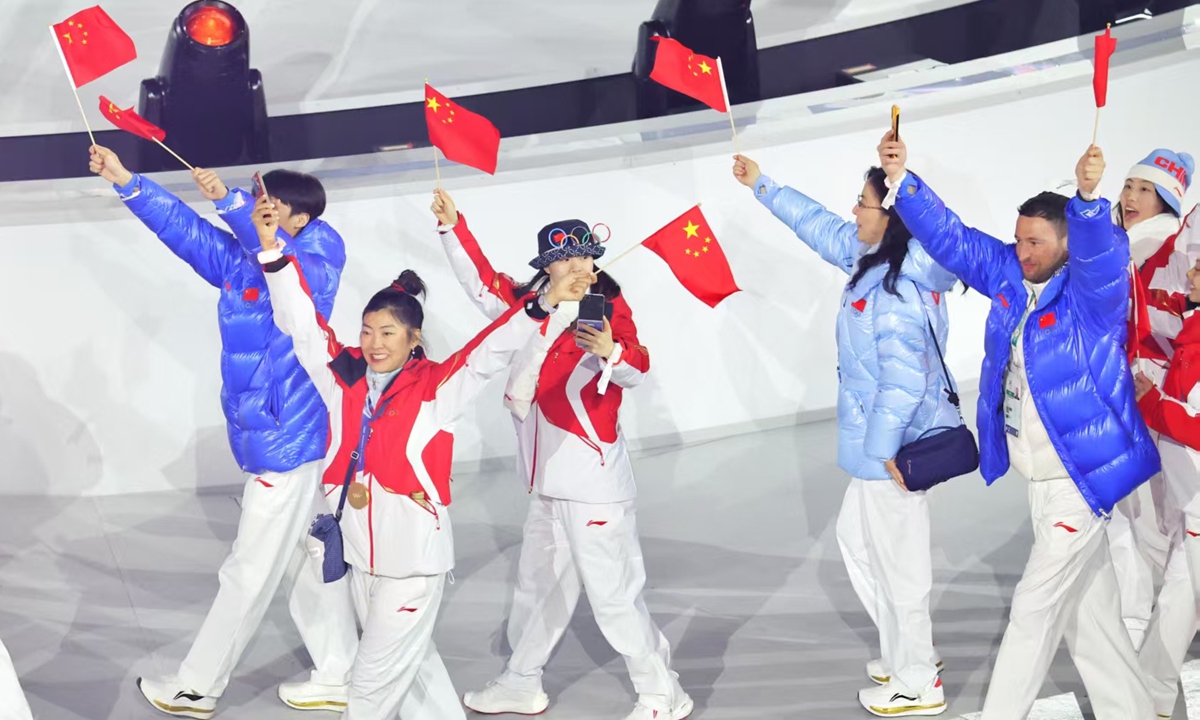
Members of the delegation of China parade during the closing ceremony of the Milan Cortina Olympic Winter Games in Verona, Italy, on February 22, 2026. Photos: VCG
As the Olympic flame faded in Milano Cortina, the Chinese delegation concluded its campaign with five gold, four silver and six bronze medals, totaling 15 podium finishes, matching the medal count from Beijing 2022 and marking the nation's best-ever performance at an overseas Winter Olympics.
The good result capped a campaign that began with uncertainty. Despite the presence of multiple star athletes, China struggled to convert early opportunities into gold medals.
It was only when snowboarder Su Yiming captured the men's slopestyle title on Thursday that China's gold tally was finally opened, triggering a late surge in momentum.
Tong Lixin, deputy head of the Chinese delegation, summarized the progress, noting that China has shifted from being "participants" in winter sports to becoming "competitors," though its broader role as "chasers" of traditional winter sports powers remains unchanged.
Broader participation
China's medals came from eight disciplines, including speed skating, short track speed skating, freestyle skiing and snowboarding events such as aerials, halfpipe, big air and slopestyle.
According to Tong, the delegation maintained balanced development between the ice and snow sports that emerged at Beijing 2022.
Tong noted that overall strength improved markedly, with 49 top-eight finishes, a 32.4-percent increase from Beijing 2022's 37.
Progress was evident in 18 sub-events across speed skating, skeleton, luge, ski jumping, and Nordic combined, representing about 19.6 percent of contested events, shifting many from mere participation to genuine contention, according to Tong.
Events such as snowboard big air and slopestyle, ski jumping, and Nordic combined, previously reliant on single athletes, now featured multiple or even full-quota entries, with several advancing to finals, a transition from solo efforts to group prowess.
Veterans lead the show
The 2026 Olympics also showcased a generational transition among Chinese athletes.
Veterans such as freestyle skiing aerials specialists Xu Mengtao and Qi Guangpu, snowboarders Cai Xuetong and Liu Jiayu, and skaters Fan Kexin, Han Cong and Sui Wenjing provided leadership and stability.
A wave of young athletes made their Olympic journey with promising performances. Speed skater Liu Hanbin, freestyle skiers Shao Qi, Li Tianma, Li Fanghui and Liu Mengting, snowboarder Zhang Xiaonan, ski jumper Zeng Ping, and ski mountaineers Bu Luer and Cidan Yuzhen demonstrated competitive potential across multiple disciplines.
The sled and jumping programs, traditionally weak areas for China, showed visible progress.
Skeleton, bobsleigh and luge, introduced at Beijing 2022, delivered their best-ever results in five sub-events, with all five skeleton athletes finishing in the top eight, signaling realistic podium potential in future cycles.
Ski jumping also reached new milestones, with finalists in both men's and women's events boosting China's Nordic combined prospects.
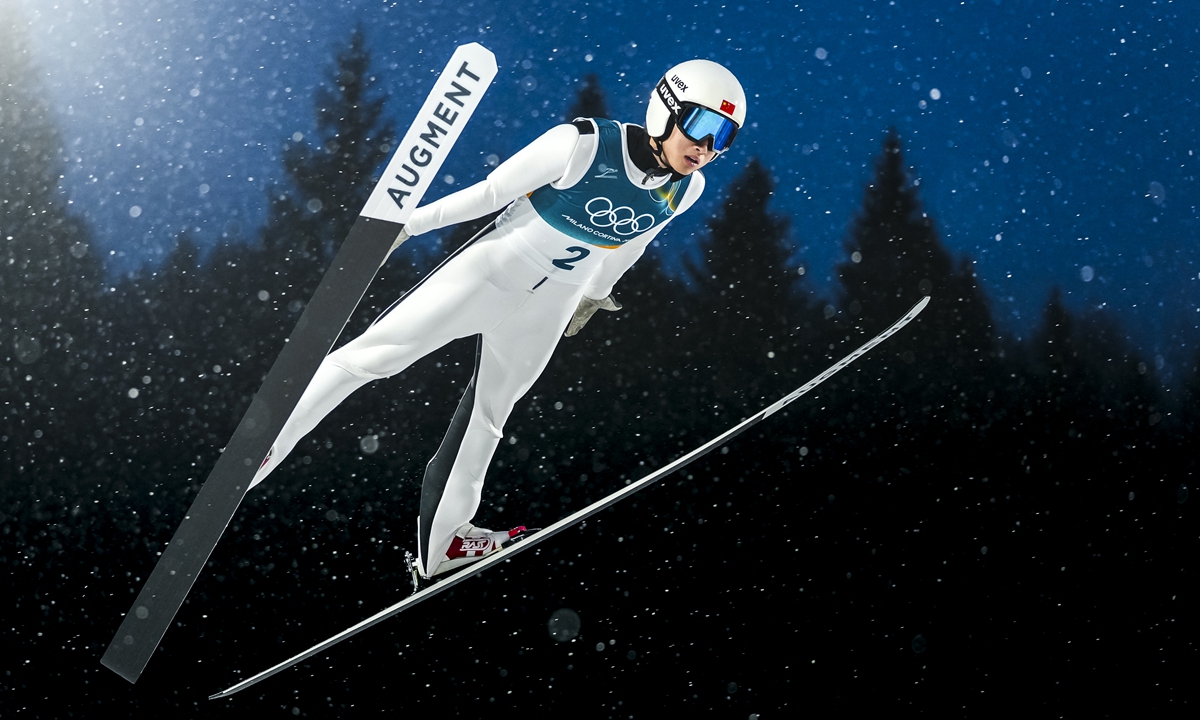
China's Song Qiwu competes during the Men's Large Hill Individual at the Games in Italy on February 14, 2026.
Major breakthroughsSpeed skating emerged as one of the most significant breakthroughs. Long dominated by European and North American athletes in middle- and long-distance events, the discipline saw China expand its historical footprint.
Ning Zhongyan stunned the field by setting an Olympic record en route to gold in the men's 1500 meters, while also contributing to a medal in the men's team pursuit. His triumph reshaped perceptions of China's capabilities in endurance-based skating events.
He described US rival Jordan Stolz, a two-time Olympic gold medalist and seven-time world champion, as an "insurmountable mountain" for years, but said that Milan marked the moment he finally crossed it.
Ning's journey underscored the value of delayed success. He left Beijing 2022 without a medal. He admitted that an earlier triumph might have altered his trajectory. Instead, he returned stronger in Milan, collecting three medals in total and setting a new Olympic benchmark.
On snow, China's established strongholds delivered. The freestyle skiing aerials team claimed two golds and three bronzes, reaffirming its global dominance. Xu Mengtao became the first athlete to defend the women's aerials Olympic title, completing her fifth Olympic appearance at age 35.
"To be one of China's oldest Winter Olympic champions feels like a mission and a legacy," Xu said, emphasizing her responsibility to inspire the next generation. Her husband, Wang Xindi, captured men's aerials gold, making them one of the Games' most celebrated Olympic couples.
Snowboarder Su played a symbolic role in China's medal narrative. After winning bronze in big air, he pledged to make the national anthem ring out at the Games. He delivered on that promise with gold in slopestyle despite immense pressure.
Freestyle skiing star Gu Ailing further cemented her Olympic legacy with six medals in big air, slopestyle and halfpipe, after leading a 1-2 Chinese finish in the halfpipe with Li Fanghui.
Despite the achievements, structural gaps remain. Biathlon, cross-country skiing and alpine skiing continued to lag behind global leaders, though the Chinese athletes gained valuable experience by competing.
Short track speed skating, a discipline that has defined China's Winter Olympic identity since 2002, underperformed, as did curling. Sun Long's silver in the men's 1000 meters was the single bright spot in short track.
Tong cited insufficient preparation and an underestimation of global competition as contributing factors.
"The Chinese delegation will conduct a systematic summary, deeply investigate problems, and continuously improve our work," Tong said.
Beyond podium finishes, the delegation embodied resilience and determination.
Figure skating pair Sui Wenjing and Han Cong returned to the Olympic ice despite injuries. Liu Jiayu competed in the snowboard halfpipe after suffering a head injury, and Nordic combined athlete Zhao Zihe finished his event bloodied yet unyielding.
Tong acknowledged that the global competitive landscape has intensified since Beijing 2022, with records falling across speed skating and other disciplines. The Games served as a reality check, revealing both progress and some gaps.
Despite the mixed picture, optimism prevails.
The Chinese sports authority has plans to deepen reforms in its winter sports system, embrace global training and competition trends, and leverage international events to accelerate talent development, according to Tong.
Officials reiterated the long-term ambition of consolidating the "300 million people participating in ice and snow" initiative, strengthening youth pipelines and expanding the ice and snow economy as a pillar of national growth.
RELATED ARTICLES