US' reported Iran strike plan emerges amid lingering tensions; military options are likely being used as leverage, says expert
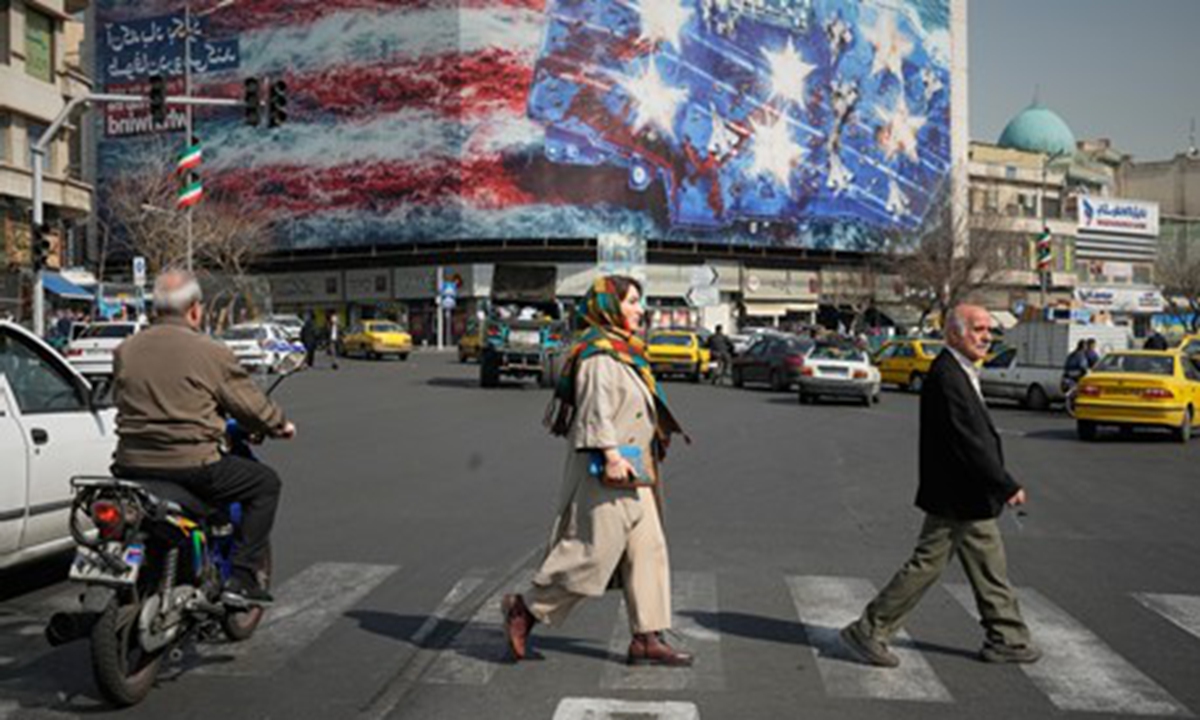
Pedestrians walk past a billboard depicting a U.S. aircraft carrier with damaged fighter jets on its deck at Enqelab-e-Eslami (Islamic Revolution) Square in Tehran, Iran, on February 22, 2026.
Tensions between the US and Iran saw new developments as diplomatic engagement has existed alongside reports of growing military preparations, with expert saying US administration continuing to apply maximum pressure.
According to the New York Times' report on Sunday, though no final decisions have been made, US President Donald Trump has been leaning toward conducting an initial strike in coming days intended to demonstrate to Iran's leaders that they must be willing to agree to give up the ability to make a nuclear weapon. Targets under consideration range from the headquarters of Iran's Islamic Revolutionary Guard Corps to the country's nuclear sites to the ballistic missile program.
The news came after Iranian President Masoud Pezeshkian said on Sunday in a post on his social media that "recent negotiations involved the exchange of practical proposals and yielded encouraging signals." He added that Iran continues "to closely monitor US actions and has made all necessary preparations for any possible scenario."
Pezeshkian's remarks were made after Trump warned Iran on Thursday it must make a deal over its nuclear program or "really bad things" will happen, and set a deadline of 10 to 15 days, drawing a threat from Tehran to retaliate against US bases in the region if attacked, according to Reuters.
Omani Foreign Minister Badr Albusaidi, who AP News reported as a mediator between the two sides, said on Sunday on his X account that the next round of US-Iran negotiations is "set for Geneva this Thursday, with a positive push to go the extra mile towards finalizing the deal." As of press time, neither Washington nor Tehran had officially confirmed the arrangement.
Amid the tensions, the US has increased aircraft deployments at bases in Jordan and Saudi Arabia, the Financial Times reported on February 20 that citing satellite tracking analysis and defense experts. A tracker operated by Tel Aviv University estimates that at least 66 fighter jets are currently stationed at Muwaffaq Salti Air Base in Jordan, per report.
Al Jazeera reported on the same day that the USS Gerald R. Ford is joining the USS Abraham Lincoln carrier strike group in the Arabian Sea, further underscoring heightened US military presence in the region.
The move was held as the second round of indirect talks between the two sides was held in Geneva on February 17. Iran and US reached an understanding on the main "guiding principles" aimed at resolving their longstanding nuclear dispute, though that does not mean a deal is imminent, Iran's Foreign Minister Seyed Abbas Araghchi said, according to Reuters.
Further report from Sputnik of Russia citing Bild of Germany, which quoted former CIA officer John Kiriakou saying that decision has been made to attack Iran on Monday or Tuesday based on information from a source inside the White House.
The Indian Embassy in Tehran on Monday released an advisory on its X account urging Indian nationals in Iran to leave the country by all available means amid rising US-Iran tensions.
"All Indian nationals in Iran are requested to keep their travel and immigration documents, including passports and IDs, readily available. They are also advised to contact the Indian Embassy for any assistance in this regard," the advisory added.
"While the US has continued to pressure Iran and threaten military intervention, it has simultaneously maintained diplomatic engagement, and whether a military strike on Iran will actually take place exactly on the 23rd or 24th remains impossible to predict," Sun Chenghao, a research fellow at Tsinghua University's Center for International Security and Strategy, told the Global Times.
Sun said that in his view, this appears at this stage to be part of US president's maximum-pressure strategy toward Iran. Signals of potential military action have been released for some time. However, given Iran's complex geopolitical environment and its relatively strong capacity for regional mobilization, the situation remains highly sensitive.
"Military strikes are not the ultimate objective," Lü Chao, a professor at the Liaoning Academy of Social Sciences, told the Global Times."The talks on February 17 and the upcoming negotiations on February 26 both signal that the two sides are preparing for the worst-case scenario. At present, by showcasing military capabilities and enhancing deterrence credibility, each side seeks to increase bargaining leverage and compel concessions on key issues, particularly the nuclear issue."
In a CBS News interview broadcast on Sunday, Araghchi said that "I think as a sovereign country, we have every right to decide for ourselves, by ourselves" about a nuclear program.
Araghchi said the deal should include Iran's "peaceful nuclear program" as well as lifting US sanctions against Iran, reaffirming Tehran's resolve to secure its right to uranium enrichment under the national nuclear program.
He also stressed that Tehran has right to self-defense if the US attacks Iran. "We have to hit, you know, the American base in the region."
"While the US administration may indeed be showing signs of impatience, overall it seems more likely that military options are being used as leverage, alongside continued diplomatic engagement, a dual-track approach combining pressure with negotiations," Sun said.
RELATED ARTICLES