China achieves new breakthroughs in shipping, energy, space exploration during Spring Festival holiday
Cascading waves of innovation
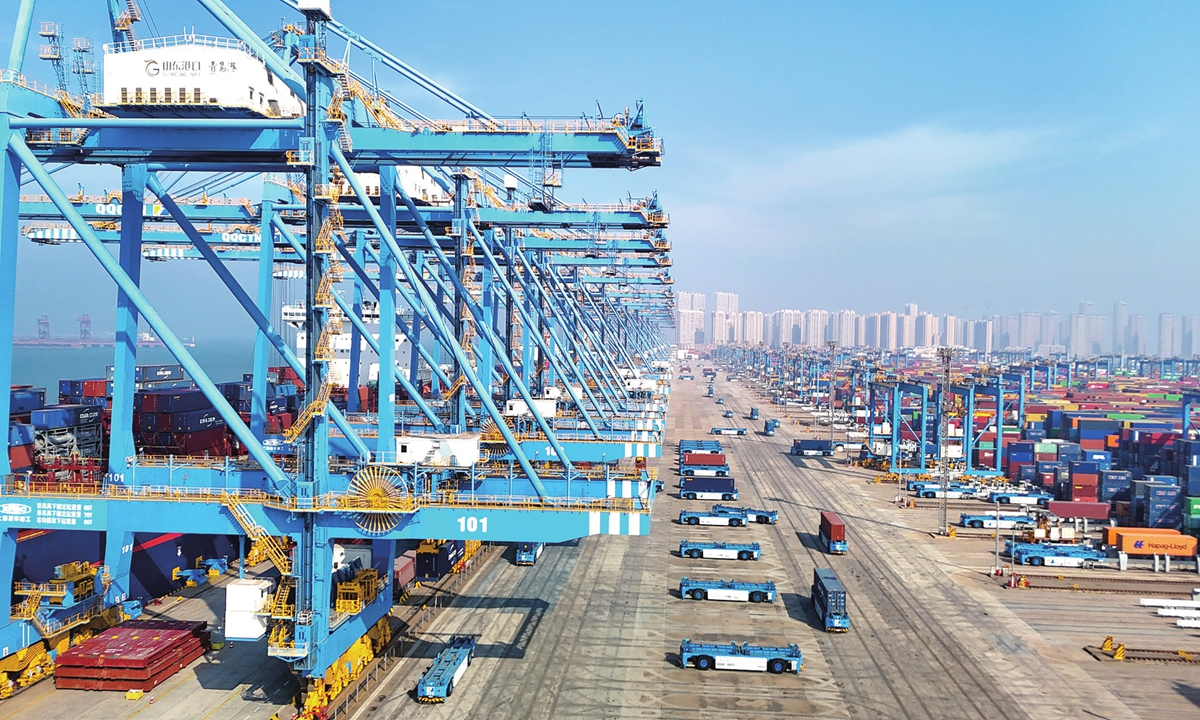
Automated guided vehicles are handling cargo at the fully automated terminal of Shandong Port Group's Qingdao Port, on February 4, 2026. Photo: VCG
Leading enterprises in China have achieved a series of new breakthroughs in shipping, energy, space exploration and other sectors, as showcased by key projects and innovations during the nine-day Spring Festival holiday which concluded on Monday.Chinese analysts said that the achievements demonstrate the depth of China's scientific and technological exploration, bolstered by the country's manufacturing prowess.
It further proves that technological innovations and new quality productive forces are reshaping China's economic landscape, injecting fresh momentum into the country's high-quality development during the 15th Five-Year Plan period (2026-30).
Innovation breakthroughs
On Saturday, China's first commercially operated smart container ship, Zhi Fei, slowly approached an automated berth in Qingdao Port in East China's Shandong Province relying on autonomous navigation. Then, the vessel completed automated operations, seamlessly coordinated with the terminal's lifting cranes, intelligent guided vehicles, and other fully automated loading and unloading equipment, before completing cargo operations.
The operation marks the first time that China has achieved full-process unmanned operations for a container ocean ship, covering navigation, berthing and cargo loading. The milestone marks a new stage in the collaborative development of China's intelligent shipping and smart ports, Qingdao Port told the Global Times on Tuesday.
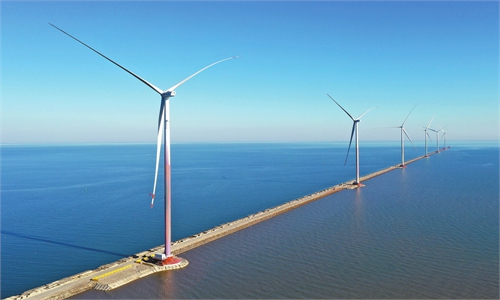
A day later, on the western Sichuan Plateau at an altitude of 3,000 meters, the world's largest hybrid pumped-storage power station - the Lianghekou hybrid pumped-storage station - reached two major construction milestones. Excavation of the underground powerhouse was completed while concrete pouring began for the downstream reservoir, the Xinhua News Agency reported. After completion, the project is expected to generate 1.4 billion kilowatts hours of clean electricity each year.
And, during the Spring Festival, a research team from the renowned Tsinghua University developed a model named ASTERIS (Astronomical Spatiotemporal Enhancement and Reconstruction for Image Synthesis), which uses computational optics and AI-powered algorithms.
According to the findings published on Friday in the journal Science, the model can help extract extremely faint astronomical signals, identify galaxies more than 13 billion light-years away and generate the deepest deep-space images.
"China's rapid progress in innovation stems from the determination and efforts to achieve high-level self-reliance in science and technology. This indicates that with the country's persistent drive for across-the-board innovations, China's science and technology sector has advanced steadily in recent years," Cao Heping, an economist at Peking University, told the Global Times on Tuesday.
It's worth noting that China is now a global leader in many frontier technologies. According to the World Intellectual Property Organization Global Innovation Index 2025 report, China has risen to the 10th position in innovation rankings in the world.
High-tech driven growth
According to the Recommendations of the Central Committee of the Communist Party of China for Formulating the 15th Five-Year Plan for National Economic and Social Development, the country aims to achieve greater self-reliance and strength in science and technology through advancing the development of new quality productive forces during the coming five years.
Six future industries, including quantum technology, bio-manufacturing, hydrogen and nuclear fusion power, brain-computer interfaces, embodied artificial intelligence and 6G telecommunications, are explicitly highlighted in the document which was released in October.
China's Ministry of Industry and Information Technology held a conference on February 3, calling for intensified efforts to mobilize resources, deepen the implementation of national major science and technology projects and national key R&D programs, systematically conduct research on original and pioneering technologies, and promote technological breakthroughs in those future industries.
Pan Helin, a member of the experts committee of the Ministry of Industry and Information Technology, told the Global Times on Tuesday that a series of policies are set to prop up top-level planning for the growth of major industries, backed up with supporting mechanisms.
Looking ahead, China's scientific community should firmly seize the new opportunities in scientific and technological innovation and industrial development, accelerate efforts to achieve high-level self-reliance in science and technology and continue striving for breakthroughs, Cao noted.
"With the cultivation of new quality productive forces at its core, China is expected to step up breakthroughs in cutting-edge technologies such as biotechnology and artificial intelligence, driving global industrial chains toward higher value segments. Meanwhile, China's ultra-large market provides application scenarios for global innovation achievements, accelerates technological iteration and industrial upgrading, creates new space for economic growth," Cao said.
Thanks to rapid 5G roll-out in China, digital transformation has become a key lever for multinational enterprises to enhance their competitiveness. A recent KPMG report on the outlook for multinational companies operating in China sent to the Global Times showed that 90 percent of the multinationals surveyed plan to ramp up digitalization investment.
China's structural innovation and upgrading are driving multinational enterprises to re-examine their strategies in China, Jiang Liqin, head of clients and markets for KPMG China, was quoted as saying.
"As can be seen from the report, multinationals have expressed confidence in long-term development prospects in China. An increasing number of enterprises are shifting their strategic focus from a sole pursuit of business expansion to transforming their profit models. By leveraging localized innovation and digital investment, they aim to improve operational efficiency, optimize pricing strategies, boost profit margins, and build strategic competitiveness in the Chinese market," Jiang said.
RELATED ARTICLES