Trump breaks own record of longest SOTU speech; dramatic confrontations and sharp rhetoric underscore entrenched US partisan divide: expert
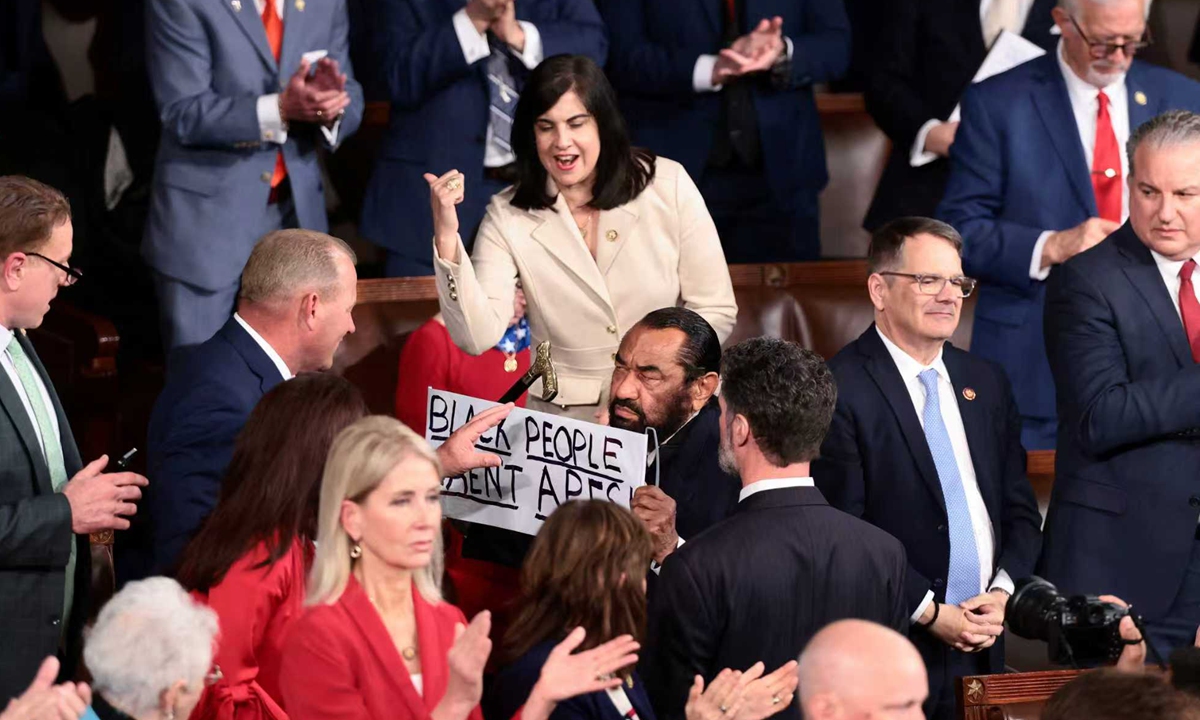
Democratic US Representative Al Green holds a sign as US President Donald Trump delivers the State of the Union address to a joint session of Congress at the US Capitol in Washington, DC, on February 24, 2026. Photo: IC
Without apparent applause from the Democratic side of the chamber and roughly half of House and Senate Democrats absent, as Axios and CNN reported, the US President Donald Trump on Tuesday night local time delivered the longest State of the Union (SOTU) address in the US history, openly confronting the Democrats and criticizing the judiciary.Speaking for an hour and 47 minutes, Trump beat his own record for the longest annual address to Congress on record since at least 1964 - which he set last year, reported CNN.
A Chinese observer found the speech marking one year of Trump returning to White House wordy and repetitive, adding that dramatic confrontational tone and sharp rhetoric throughout the address underscored the entrenched partisan divide in US politics, turning the annual speech into a highly charged political spectacle.
CNBC reported that Trump told Democrats in the House chamber to "stand up and show your support" for what he called the US government's duty "to protect American citizens, not illegal aliens," before scolding those who remained seated, saying, "You should be ashamed of yourself not standing up."
Republicans rose and applauded, while Democrats stayed seated. Trump later accused Democrats of cutting off funding for the Department of Homeland Security, calling them "crazy" and saying they were "destroying the country."
Trump also called for a ban on members of Congress trading stocks, a moment that CNBC described as drawing rare bipartisan applause in the chamber. "Let's also ensure that members of Congress cannot corruptly profit from using insider information," Trump said during the address.
According to Politico, the bipartisan applause quickly gave way to a dramatic scene after Trump gave what the outlet called "a derisive shoutout" to former House speaker Nancy Pelosi, asking from the podium whether she had stood up, prompting shouted responses from Democratic lawmakers who pressed the President over his own financial gains.
CNN reported that Trump also used the address to criticize a recent Supreme Court ruling against his tariffs, repeatedly calling the decision "very unfortunate" as four justices sat silently in the chamber. "It just came down," Trump said. "Very unfortunate ruling." While the moment appeared awkward, Trump's remarks were more restrained than his comments days earlier, when he had described the ruling as a "disgrace" and said justices in the majority were an "embarrassment to their families," per CNN.
Lü Xiang, a research fellow at the Chinese Academy of Social Sciences, told the Global Times on Wednesday that the conflict and disorder seen during the address were not a recent development. While this SOTU may not be the most confrontational - then House speaker Pelosi ripped up copy of Trump's speech in 2020 - the Tuesday occasion nevertheless is a concentrated display of a long-standing, largely unprincipled standoff between the two major parties.
Trump's act of openly pointing at Democratic lawmakers and labeling them "crazy" and intent on "destroying the country" effectively cast the opposing party as an enemy of the state, a form of rhetoric that is unusually harsh and relatively rare in political discourse across countries, Lü said.
Trump's tone toward the justices appeared retrained from his previous immediate reactions to the ruling, as openly attacking the judiciary during a SOTU would not add political points, Lü said.
The expert also noticed that Trump has downplayed diplomatic issues during the address, with only one indirect reference of "Chinese" rather than directly addressing China-related topics as previous times.
The SOTU left Lü the impression of wordy and repetitive, mostly maintaining current US President's past stance with few noteworthy, serious highlights.
Yet one moment is noteworthy. The 79-year-old Democratic Representative Al Green of Texas, one year after being ousted from a similar occasion for loudly heckling the president in March 2025, was on Tuesday escorted out of the House chamber only minutes into Trump's address after holding up a sign reading "Black people aren't apes!," which The New York Times said to be an apparent reference to Trump's social media posts portraying former president Barack Obama and first lady Michelle.
RELATED ARTICLES