SOURCE / PRESS RELEASE
'As convenient as refueling' — Suzhou builds a dense electric vehicle charging network
Data from the National Energy Administration shows that by the end of December 2025, China's electric vehicle charging infrastructure had exceeded 20 million units, forming the world's largest charging network. In Suzhou, a hub city in the Yangtze River Delta, the vision of green mobility is becoming increasingly tangible.
The Yangcheng Lake Service Area, located at the intersection of the Beijing-Shanghai Expressway and the Shanghai-Chengdu Expressway, sees over 100,000 vehicles daily, making it a key transport hub in the Yangtze River Delta. In 2025, the State Grid Suzhou Power Supply Company worked with the service area to complete a major power capacity upgrade project.
"Now the service area's total charging capacity stands at 5,120 kilowatts, 21 times that of five years ago, and can quickly charge 84 vehicles simultaneously," explained Zhao Meng, a specialist from the Marketing Department of the State Grid Suzhou Power Supply Company. Online, there is also a "digital twin" of the charging piles—an AI health management system that enables remote fault detection and repair.
Convenient charging experiences are covering every corner of Suzhou. On Taihu Ecological Island in Suzhou, a 2-kilometer charging network has been established, making island-hopping self-driving more convenient. In Kaixian Gong Village (Jiangcun) in Wujiang District, a fast-charging network within 10 minutes across the village and within 3 minutes in the scenic area has been formed, combining rural tourism with green mobility. To date, Suzhou has built over 460,000 charging piles, ranking first in Jiangsu Province.
Charging speed is reshaping people's understanding of charging new-energy vehicles. Near the Tongli Ancient Town scenic area in Wujiang, an integrated "photovoltaic-storage-charging-discharging" supercharging station is equipped with a DC high-power charging pile with a single-gun peak output power of 180 kilowatts. "A 10-minute charge provides 200 kilometers of range; it's as convenient as refueling," exclaimed Ms. Li, a tourist from Nanjing.
Even more advanced solutions are being implemented in Suzhou. At the Nanxingdu "Green Energy e-Station" in Kunshan City, during off-peak hours, the battery swapping system can feed stored electricity back to power the station's charging facilities. "This approach not only makes use of idle battery swapping capacity to prioritize charging needs during peak hours, but it can also help balance grid demand, while potentially generating additional revenue for operators," Zhao Meng explained. He added that the charging and swapping network is evolving from a simple energy replenishment point into a smart energy node participating in grid regulation.
Suzhou is steadily building a comprehensive and intelligent charging network. The expanding network reflects Suzhou's push to improve convenience, safety and sustainability in urban mobility.
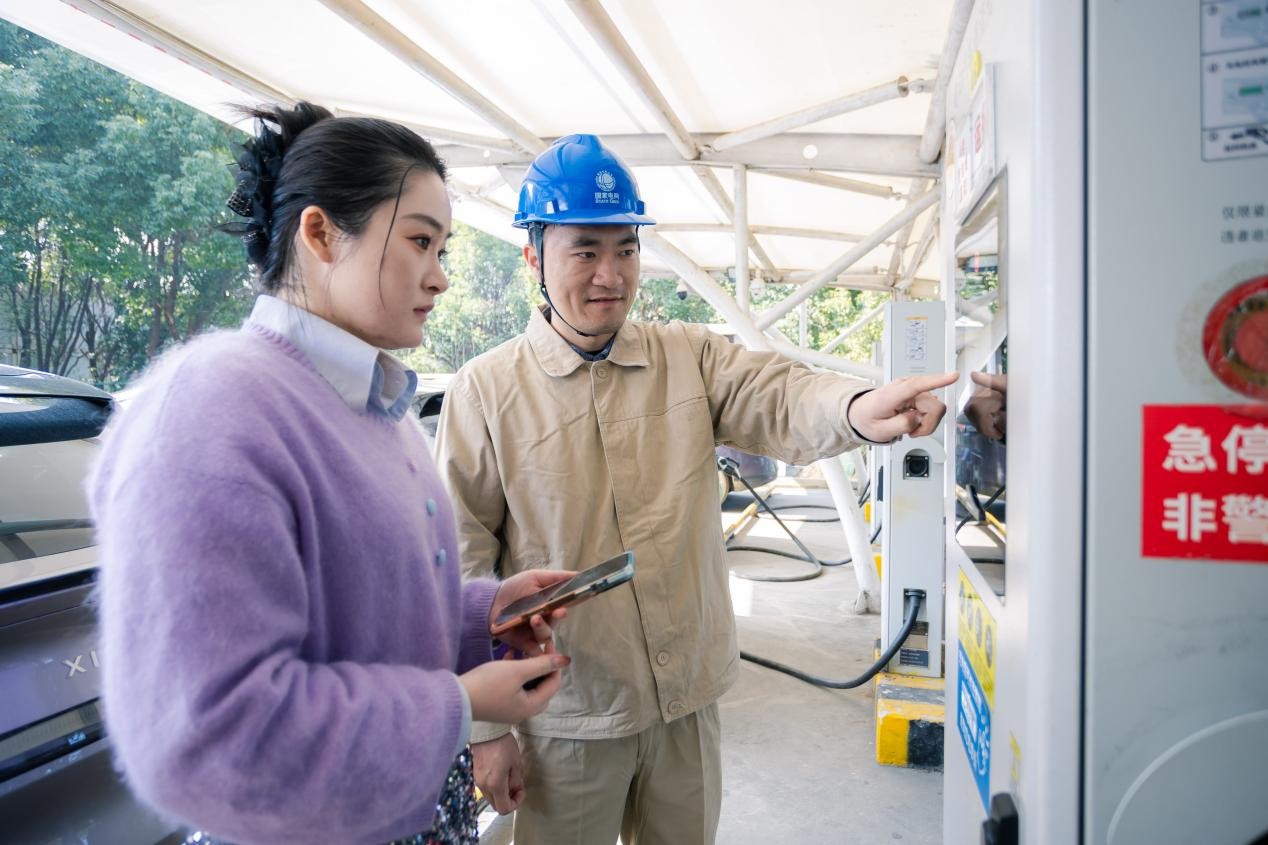
The Yangcheng Lake Service Area, located at the intersection of the Beijing-Shanghai Expressway and the Shanghai-Chengdu Expressway, sees over 100,000 vehicles daily, making it a key transport hub in the Yangtze River Delta. In 2025, the State Grid Suzhou Power Supply Company worked with the service area to complete a major power capacity upgrade project.
"Now the service area's total charging capacity stands at 5,120 kilowatts, 21 times that of five years ago, and can quickly charge 84 vehicles simultaneously," explained Zhao Meng, a specialist from the Marketing Department of the State Grid Suzhou Power Supply Company. Online, there is also a "digital twin" of the charging piles—an AI health management system that enables remote fault detection and repair.
Convenient charging experiences are covering every corner of Suzhou. On Taihu Ecological Island in Suzhou, a 2-kilometer charging network has been established, making island-hopping self-driving more convenient. In Kaixian Gong Village (Jiangcun) in Wujiang District, a fast-charging network within 10 minutes across the village and within 3 minutes in the scenic area has been formed, combining rural tourism with green mobility. To date, Suzhou has built over 460,000 charging piles, ranking first in Jiangsu Province.
Charging speed is reshaping people's understanding of charging new-energy vehicles. Near the Tongli Ancient Town scenic area in Wujiang, an integrated "photovoltaic-storage-charging-discharging" supercharging station is equipped with a DC high-power charging pile with a single-gun peak output power of 180 kilowatts. "A 10-minute charge provides 200 kilometers of range; it's as convenient as refueling," exclaimed Ms. Li, a tourist from Nanjing.
Even more advanced solutions are being implemented in Suzhou. At the Nanxingdu "Green Energy e-Station" in Kunshan City, during off-peak hours, the battery swapping system can feed stored electricity back to power the station's charging facilities. "This approach not only makes use of idle battery swapping capacity to prioritize charging needs during peak hours, but it can also help balance grid demand, while potentially generating additional revenue for operators," Zhao Meng explained. He added that the charging and swapping network is evolving from a simple energy replenishment point into a smart energy node participating in grid regulation.
Suzhou is steadily building a comprehensive and intelligent charging network. The expanding network reflects Suzhou's push to improve convenience, safety and sustainability in urban mobility.
