Airports in some Gulf countries reportedly struck amid escalating situation; some Chinese tourists stranded as flights canceled
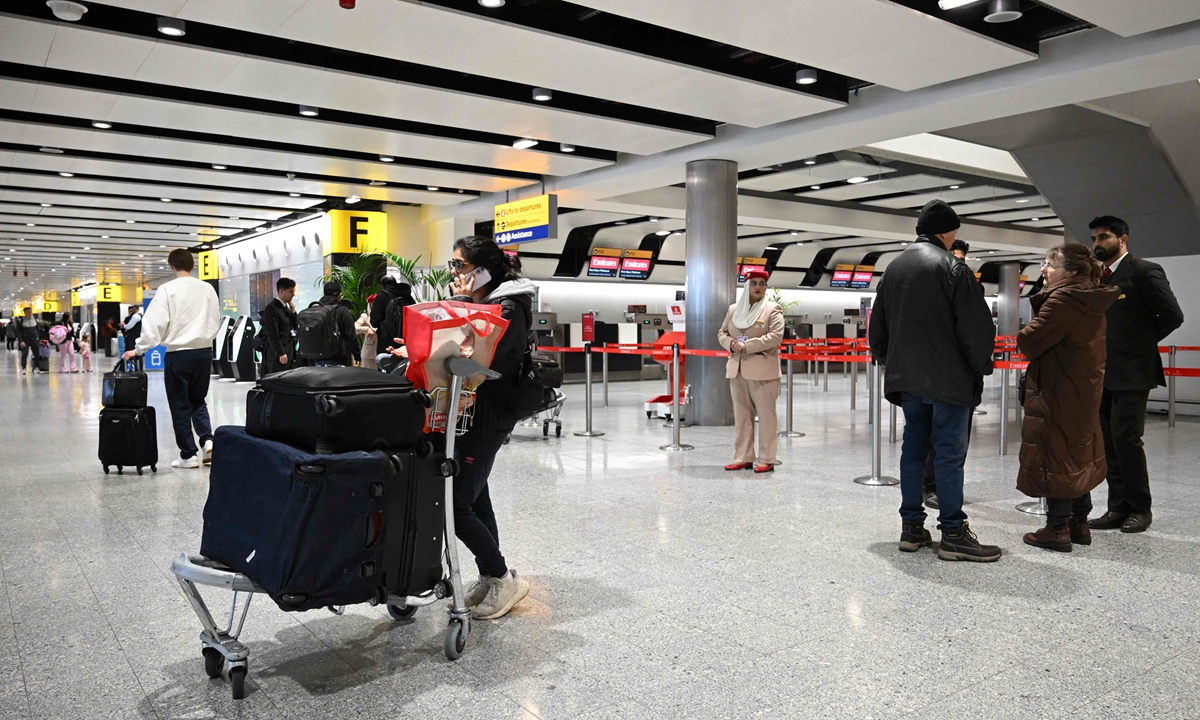
Passengers gather at the closed Emirates check-in area at London Heathrow Airport in west London on March 1, 2026, as flights are severely disrupted following the US and Israeli strikes on Iran. Photo: VCG
Air raid sirens sounded in Kuwait, the United Arab Emirates, Qatar and Bahrain in the early hours, news agencies reported, according to Iran International.
In Kuwait, civil aviation authorities confirmed that the country's main airport was struck. Kuwait's Directorate General of Civil Aviation, through its official spokesperson Abdullah Al-Rajhi, said a drone attacked Kuwait International Airport, causing minor injuries among several employees and limited material damage to the passenger terminal (T1), according to Erem News, a media outlet in Abu Dhabi.
A Chinese traveler stranded at Kuwait International Airport who requested anonymity told the Global Times that on Saturday evening local time, he heard a sound like "an explosion from an adjacent departure lounge." Airport staff later instructed passengers to wait for hotel arrangements and subsequently transferred him to a hotel near the airport.
Another stranded Chinese traveler at Kuwait International Airport surnamed Wu said the drone strike mainly affected Terminals 1 and 2, while Terminal 4 was relatively less impacted. He said more than 20 Chinese travelers joined a mutual-assistance group for Chinese nationals. All are currently accommodated in airport-arranged hotels awaiting further updates.
"We have all been arranged to stay at hotels inside the airport and have not entered Kuwait," Wu said.
According to Channel NewsAsia, the attacks hit airports in Abu Dhabi, Dubai and Kuwait. The Times of India reported that in an official statement posted by Dubai's media office, officials said the incident caused minor structural damage at Dubai International Airport and that those hurt, identified as airport staff, received urgent medical care.
Since the night of February 28, there was a noticeable increase in the frequency of attacks, with a hotel courtyard on Palm Jumeirah affected and catching fire. Several shopping malls conducted emergency evacuations. The Burj Al Arab was also struck earlier with a fire broke out, according to CCTV News reporter.
According to Emirates247.com's report on Sunday, over the past hours, UAE's airports and national carriers have handled approximately 20,200 passengers affected by the rescheduling of certain flights, and the General Civil Aviation Authority of the United Arab Emirates has announced the activation of operational plans to contain the repercussions of the developments taking place in the region.
Global airlines suspended flights across the Middle East on Saturday after the US-Israel strikes on Iran that prompted Gulf countries to close their airspace.
Latest schedule data from VariFlight shows that from March 1 to March 8, 16,660 of 92,654 scheduled Middle East-linked flights were listed as canceled, including 230 of 925 scheduled services between Chinese mainland and the region. As of 8:57 am on Sunday, schedules for Monday show 103 Middle East-linked flights listed as canceled out of 7,527 scheduled services, while 20 of 105 scheduled Chinese mainland-Middle East flights were marked as canceled.
A Chinese traveler surnamed Chen, who is stranded at Dubai International Airport with her family, told the Global Times that they've rebooked onto a flight scheduled for the evening of March 2. Whether it can depart will depend on whether the airspace reopens. If it doesn't, we'll have to keep waiting."
Meanwhile, Bahrain International Airport was also affected. Several Chinese nationals transiting through Bahrain told the Global Times that they received email notifications that flights scheduled for Monday and Tuesday had been canceled.
A Chinese traveler who was transiting in Bahrain en route to Shanghai said in another mutual-assistance Wechat group that a ticketing platform informed him that there are currently no available flights from Bahrain to Shanghai until March 8.
"Except for Gulf Air, there are almost no other airlines flying to China, but under the current situation it is very difficult to purchase tickets on any airline," the traveler said.
According to the Paper, several major online travel platforms on February 28 launched emergency support measures, with Trip.com, Qunar.com and Tongcheng Travel offering contingency guarantees for hotel bookings made before 5 pm that day for travel to multiple Middle Eastern countries between February 28 and March 5.
Xu Xiaolei, a representative from China CYTS Tours Holding, told the Global Times that the company has recently largely suspended new tour departures to the region and is arranging for remaining groups nearby to return home as soon as possible.
Aviation authorities across the region have advised travelers to closely monitor flight updates and contact airlines directly as the situation continues to evolve, according to travelers.
RELATED ARTICLES