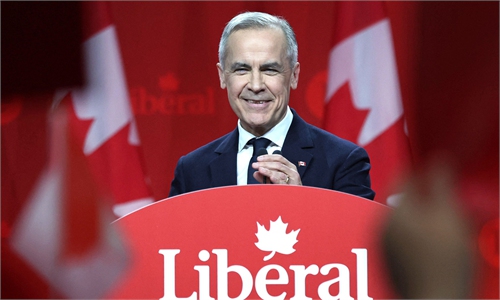
Canadian PM visits India to repair ties, reduce US reliance amid tariff pressure; move seen as Canada ‘de-risking’ : Chinese expert
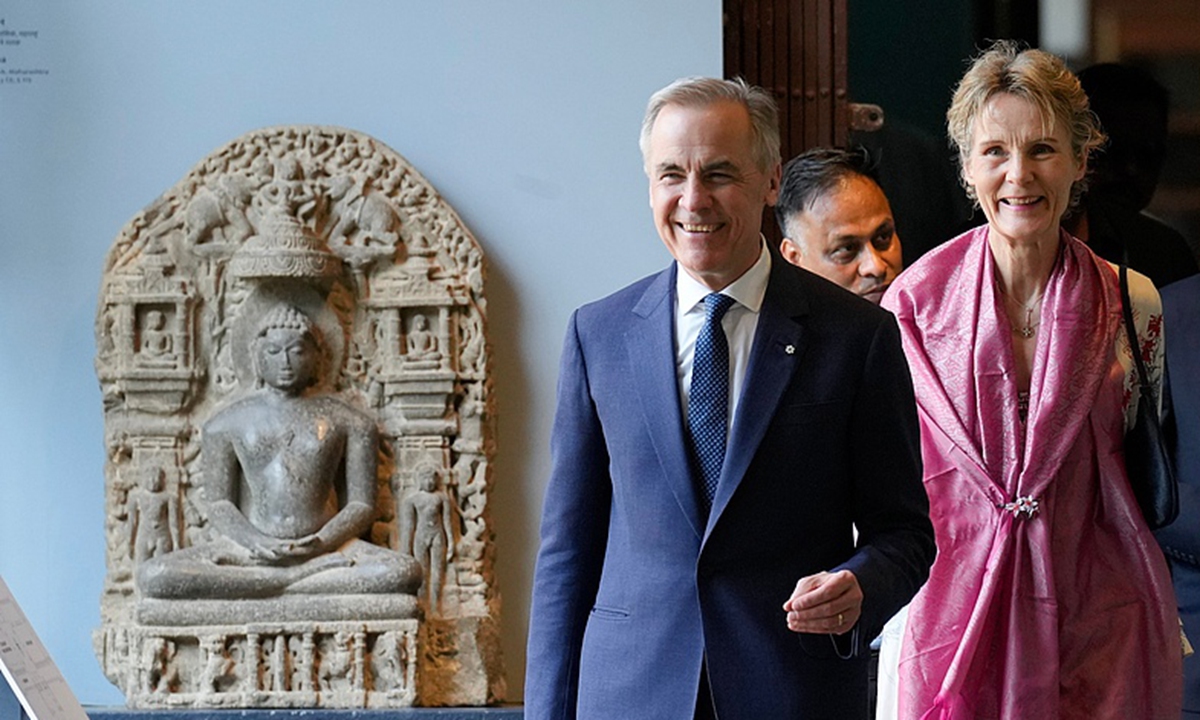
Canadian Prime Minister Mark Carney and his wife Diana Fox Carney tour the Chhatrapati Shivaji Maharaj Vastu Sangrahalaya museum in Mumbai, India, on February 28, 2026. Photo: VCG
In a move media have described as an effort to repair strained bilateral ties while diversifying trade amid US tariff pressures, Canadian Prime Minister Mark Carney is on his first official visit to India to strengthen economic ties and is set to meet Prime Minister Narendra Modi in New Delhi on Monday. A Chinese expert characterized the visit as a form of "de-risking" for Canada amid its over reliance on the US, with India also benefiting, as both countries face economic pressure from American tariffs.
Carney told a business audience in Mumbai Saturday that "We are now negotiating a comprehensive economic partnership agreement, with the intention to double two-way trade by 2030. Our goal, to be clear, is to sign that agreement by the end of this year," the Star reported.
During the trip, which began Friday in Mumbai, India's financial capital, Carney is also set to meet with Prime Minister Modi in New Delhi on Monday, and they will also take stock of ongoing cooperation in key pillars including trade and investment, energy, and critical minerals, according to a release of India's Ministry of External Affairs.
The visit this time is a major U-turn from Thanksgiving Day in October, 2024, when Canada expelled Sanjay Verma, who was then India's high commissioner in Canada, and five other Indian diplomats, with their relation to alleged violence, extortion and intimidation directed at the Sikh diaspora, per the report by The Globe and Mail.
Relations between Canada and India have soured for years after "explosive allegations," as Reuters reported, by then-Prime Minister Justin Trudeau that the Indian government was linked to the assassination of a Canadian citizen who was also a prominent Sikh separatist. India has repeatedly denied any such links.
The latest major diplomatic move by Carney came in the wake of Canadian tensions with the US over the latter's steep tariffs on key Canadian exports like steel, aluminum and car parts, leading Carney to speak of doubling his country's non-US exports over the next decade, according to Al Jazeera.
The report by Reuters said that Carney has sought closer ties with China and Middle Eastern countries as well as India, as he tries to reduce Canada's dependence on the US and forge a new global trading order led by what he calls middle-power countries.
From Canada's perspective, the current move can be seen as a form of de-risking, Lü Xiang, research fellow at the Chinese Academy of Social Sciences, said on Sunday. Traditionally, Canada has been heavily dependent on the US, which has often used its market access as leverage to pressure and constrain Canada. At the moment, Ottawa needs to and intends to build a broader network of markets, suppliers and economic partnerships globally.
Like many foreign-policy shifts executed by Canada in the past year, the reason for this reversal is the US' increasingly protectionist and mercurial approach toward traditional allies, The Globe and Mail also noted. Canada needs deeper overseas markets, more foreign investors and reliable trading partners.
India's Ministry of External Affairs also said on Friday in a post on X that the visit marked a "significant step" in strengthening ties. The BBC report said that both Canada and India seek to reduce their trade reliance on the US amid ongoing tariff pressures, and Carney and Modi are also likely to discuss tariff policies enacted by Trump, which have had an impact on both their economies.
Until recently, goods imported into the US from India were subject to a 50 percent tariff, while Delhi has also come under pressure from the Trump administration to stop buying oil from Russia, the report by BBC said.
Lü told the Global Times that Canada is busy with shuttle diplomacy, moving on multiple fronts to seek broader support and mitigate the impact of US policies. While its geographic proximity to the US makes the outcome uncertain, Ottawa is likely to continue pursuing greater strategic autonomy in an effort to secure more strategic space.
RELATED ARTICLES