ARTS / CULTURE & LEISURE
Micro dramas surge forward on back of advanced AI tools
Tech turns imaginary tales into visual reality
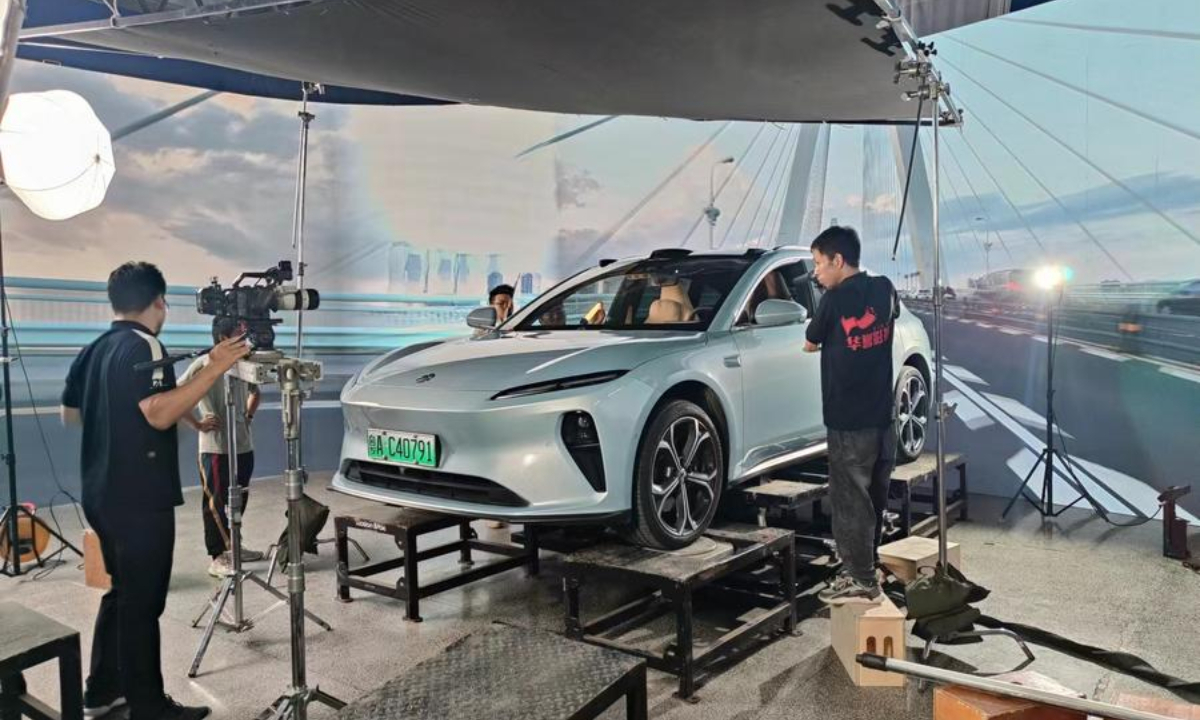
The filming site of a micro drama Photo: Xinhua
What does the fantastical world described in Chinese mythology look like? What secrets lie behind the ancient Shu Kingdom that created the mysterious Sanxingdui civilization? Once deemed too costly or technically unfeasible for the screen, such wildly imaginative stories are now moving from page to production.
With the rapid maturation of artificial intelligence (AI) video tools like Sora and Seedance 2.0, even the most unrestrained creative concepts can be transformed into AI-generated micro dramas, and produced at scale.
According to reports, the country's micro drama sector saw its total output reach 100 billion yuan ($14.58 billion) in 2025, doubling the figure from the previous year. AI-produced micro dramas, once experimental, are seeing a surge, with some formats reporting net profit margins above 50 percent.
"The rise of AI micro dramas is driven by lower costs and precise audience demand," Zhang Peng, a cultural researcher and associate professor at Nanjing Normal University, told the Global Times on Monday.
Generative AI has drastically reduced expenses in filming, post-production, and special effects, cutting per-episode costs from tens of thousands of yuan to just a few hundred, and shrinking production cycles from weeks to hours, making single-person crews possible, added Zhang.
At the same time, short-video platforms are seeing a surge in demand for fast-paced, high-density storytelling. AI short dramas meet that need, particularly in visually rich genres like fantasy and time-travel, where AI excels, noted Zhang.
The boom also reflects advances in AI video generation tools, which have made it possible to produce imaginative, visually complex stories at a fraction of traditional filming costs.
According to Zhang, the main driver behind the realism of AI micro dramas is the advancement of generative artificial intelligence. Modern AI productions go beyond simple image generation, combining text, sound, and motion in a multimodal workflow, making it relatively easy for newcomers to get started.
Additionally, massive libraries of film footage and visual assets support the process. AI systems learn from images of people under different angles, expressions, costumes, and lighting conditions, enabling the generation of visuals that adhere to realistic logic.
On the one hand, the democratization of AI tools is expected to generate massive amounts of user-generated content, becoming a new traffic engine for short-video platforms. On the other hand, professional teams are exploring hybrid models that combine AI previsualization with live-action filming to boost industrial-level production.
Micro dramas, typically released in short episodes optimized for mobile viewing, are known for quick production cycles and rapid distribution.
AI micro dramas can be mainly divided into three main types: highly realistic AI "live-action" dramas; AI animated comics, in which illustrated panels are brought to life; and lower-cost, humor-driven "emoji-style" comic shorts that rely on exaggerated expressions and imaginative plots, according to a report by the Economic Information Daily.
Some companies have even developed their own large language models to increase proficiency. Executives also see strong overseas potential. Industry data shows that 55 percent of overseas viewers are willing to pay for short dramas partially produced with AI, while 49 percent said they would pay for fully AI-generated series. Overseas revenue from Chinese micro dramas in 2025 is projected to top $4.5 billion, according to the report.
Several Chinese cities, including Shanghai, Hangzhou and Zhengzhou, are positioning AI micro dramas as a new economic growth driver. As AI reduces production costs and technical barriers, first-tier cities that once faced high filming expenses are seeking to capitalize on technological advantages.
In Zhang's view, AI micro dramas are unlikely to replace traditional film and TV. Instead, they will emerge as a new category, creating incremental markets in vertical niches such as customized advertising, interactive dramas, and IP extensions - ultimately pushing the industry toward human-AI collaborative production.
Despite optimism, the rapid expansion has also raised regulatory concerns. Some AI-generated micro dramas have been criticized for sensationalist themes or depicting questionable values. Currently, there are no dedicated national regulations specifically for AI micro dramas. Zhang said more detailed and stringent rules are expected in the near future with the development of the industry. As AI dramatically increases the accessibility of creation and accelerates content output, protecting intellectual property with AI has become a parallel frontier.
In 2025, Hengdian launched an AI-powered monitoring system that automates the entire process of identifying and collecting evidence of copyright infringement online.
East China's Jiangxi Province has established its first agency to protect the copyright of micro-short dramas by using AI to safeguard creation and distribution. From its establishment in 2024 to May 2025, the agency had resolved eight infringement cases, recovering tens of millions of yuan in losses.
RELATED ARTICLES