Trump's remarks on not ruling out US ground troops in Iran more a form of psychological warfare tactic: Chinese expert
By Published: Mar 03, 2026 12:57 PM

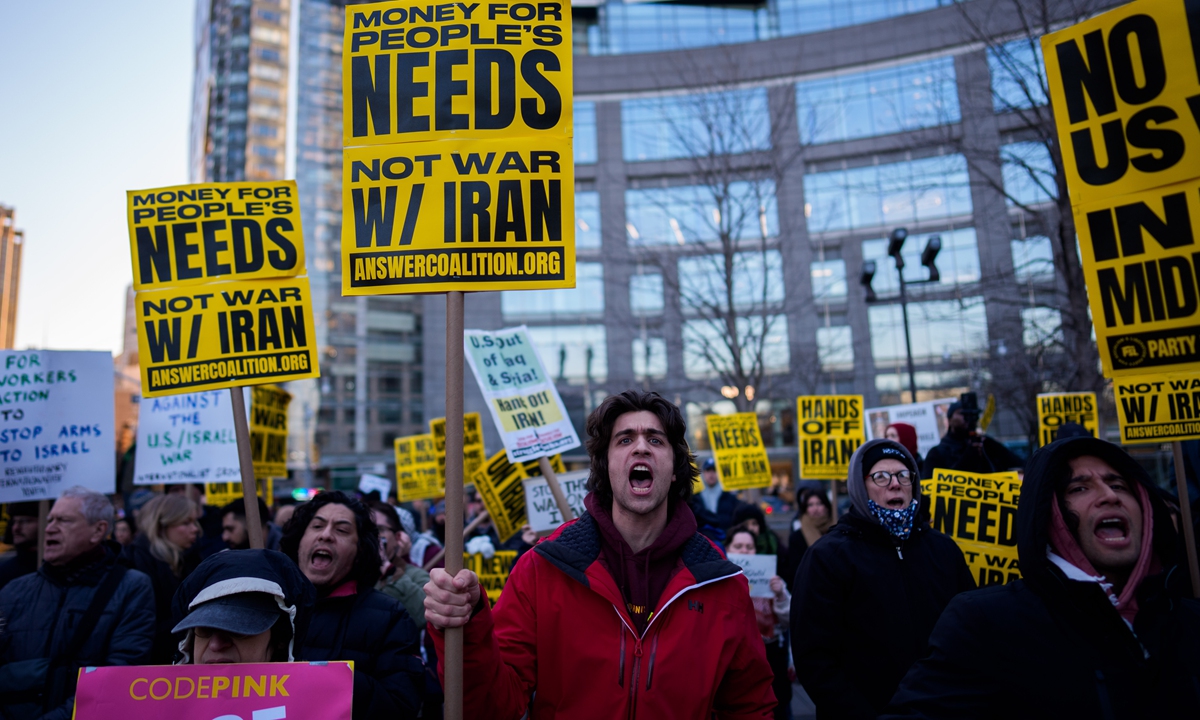
People protest against the war in Iran on March 2, 2026 in New York, the US. Photo: VCG
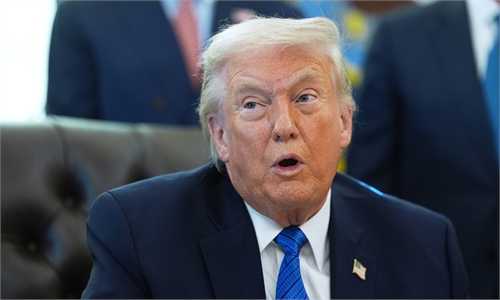
US President Donald Trump claimed in an interview with the New York Post on Monday that he is not ruling out sending US ground troops into Iran "if they were necessary," adding that the operation was "way ahead of schedule" after killing dozens of Iran's top officials. The messaging, along with similar remarks by the US defense chief, appears aimed at exerting psychological pressure on Iran and weakening its resolve to resist, as the anticipated rapid regime change has not materialized and Washington may yet to make sufficient preparations for deploying ground troops amid mounting pressure, said a Chinese expert."I don't have the yips with respect to boots on the ground — like every president says, 'There will be no boots on the ground.' I don't say it," Trump claimed after launching strikes Saturday to decapitate Iran's military and political leadership. "I say 'probably don't need them,' [or] 'if they were necessary,'" according to the New York Post report.
Trump told the Daily Mail on Sunday that he estimated the war would last "four weeks or so," but hinted to the New York Post on Monday that the timeframe could be shortened. Trump also claimed he wasn't concerned about Iran using terrorism to repay America for the weekend's attack. "We'll take it out. Whatever. It's like everything else, we'll take it out," Trump said.
US Defense Secretary Pete Hegseth also declined to rule out the deployment of ground troops during a press briefing Monday in his first public comments on the strikes in Iran at the Pentagon in Washington, D.C.
When asked specifically about whether American forces could be sent to Iran, Hegseth claimed that it would be "foolishness" to expect US officials to say publicly "here's exactly how far we'll go." "We're not going to go into the exercise of what we will or will not do," he added, according to the Time magazine.
Remarks about deploying ground troops are more a form of psychological warfare tactic aimed at pressuring Iran than a practical policy option, as the US has not made sufficient preparations for sending ground forces into Iran, Sun Degang, director of the Center for Middle Eastern Studies at Fudan University, told the Global Times on Tuesday.
Currently, Iran's resolve to resist seems to remain strong, and it has already launched retaliatory strikes against Israel and some regional countries hosting US forces, causing American casualties and forcing Israel into a defensive posture, said Sun, noting that the US appears to be seeking a quick and decisive outcome through deterrent strikes and targeted eliminations, hoping to encourage internal opposition to challenge Iran's leadership. However, Iran's political situation has stabilized with a new leadership structure taking shape, and the anticipated rapid regime change has not occurred.
Iran's three-member interim leadership council has been formed and begun its operations, Iranian President Masoud Pezeshkian said Sunday in a video message carried by state-run IRIB TV. Supreme Leader Ali Khamenei, Iran's former President Mahmoud Ahmadinejad, along with several other senior officials were killed in the massive attacks launched by the US and Israel.
Also on Monday, Secretary of Iran's Supreme National Security Council Ali Larijani said the country is prepared for a long war. "Iran, unlike the United States, has prepared itself for a long war," Larijani said in a post on social media platform X.
"As in the past 300 years, Iran did not start this war, and our brave Armed Forces have not engaged in any attacks except in defense. We will fiercely defend ourselves and our six thousand years old civilization regardless of the costs and will make the enemies sorry for their miscalculation," he said.
According to the Time Magazine, at least six US service members have been killed so far by Iran's retaliatory strikes, and 11 people in Israel were reported killed in Iran's subsequent missile and drone attacks.
Sun noted that amid approaching midterm elections, the Trump administration also faces growing domestic political pressure and concerns that prolonged conflict could hurt Republicans politically. The current mixed signals — issuing threats while also expressing willingness to negotiate — reflect growing anxiety over the evolving situation and uncertainty about how the conflict may unfold.
The New York Post on Monday also mentioned about a CNN/SSRS poll released on Monday, which similarly showed that 41 percent approved of the latest US attack, while 59 percent disapproved.
"I think that the polling is very good, but I don't care about polling. I have to do the right thing. I have to do the right thing. This should have been done a long time ago," Trump claimed, according to the New York Post report.
According to leading Democrats in Congress, Trump's justification is questionable, especially given his claims of having "completely obliterated" Iran's nuclear capabilities in separate US bombings last June, according to a report from the Los Angeles Times. It also cited Rep. Jim Himes as saying that "everything I have heard from the administration before and after these strikes on Iran confirms this is a war of choice with no strategic endgame."
The report also noted the debate on the latest Iran attacks echoed a similar if less immediate one around President George W. Bush's decision to go to war in Iraq after the Sept. 11, 2001, attacks, also based on claims that "weapons of mass destruction" posed an immediate threat. Those claims were later disproved by multiple findings that Iraq had no such arsenal, fueling recriminations from both political parties for years.
RELATED ARTICLES