Chinese tour companies strive to get travelers stranded in Middle East home
By and Tao Mingyang Published: Mar 03, 2026 11:16 PM

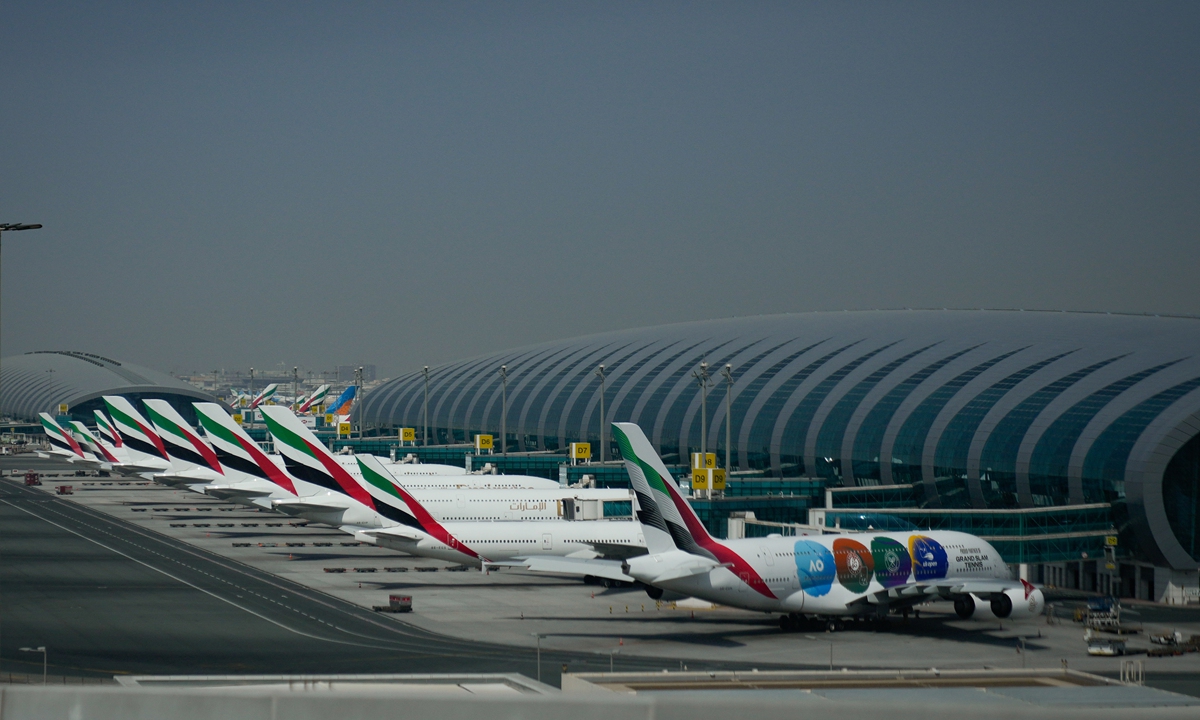
Emirates airplanes are parked at the Dubai International Airport after its closure in Dubai, United Arab Emirates, Sunday, March 1, 2026. Photo: VCG
As resumption of flights in the Middle East remains very limited, Chinese tour companies are making various efforts to get their travelers who have been stranded in various Middle Eastern countries home.
"Currently, we have one tour group in Bahrain and two in Dubai, totaling more than 40 people in the Middle East. The group in Bahrain made a transit to Saudi Arabia yesterday, spending seven hours waiting at the border crossing," Guan Jian, spokesperson of the GZL International Travel Service, told the Global Times on Tuesday.
He said that uncertainties remain before the group can board a plane, and the earliest possible flight, which was to travel from Dubai to Guangzhou on Wednesday, has been canceled, and the agency is busy arranging another flight back to China.
A group that was scheduled to fly back from Saudi Arabia, which was set to fly from Riyadh to Hong Kong on Friday with Cathay Pacific, has been canceled, and the agency is arranging another flight, he added.
Xu Xiaolei, marketing manager at CYTS Tours Holding Co, said that the current strategy for outbound travel market in the Middle East and North Africa involves rerouting affected travelers away from the immediate risk areas. Many are being transferred to countries including Azerbaijan, Turkey, and Greece, from which they can safely arrange their eventual return trips home.
However, Xu acknowledged that resource allocation, particularly securing flight availability, is proving to be a major challenge.
He added that while some flights have been secured for immediate departure, companies are also having to rely on connecting flights and land-based transportation, such as buses, to ensure the efficient movement of both personnel and essential supplies.
The military strikes by the US and Israel on Iran on Saturday caused widespread flight disruptions across the Middle East and beyond. In response to the attacks, numerous countries in the region closed their airspace, while key airports serving as vital connectors among Europe, Africa, the West, and Asia were directly affected.
Data from information provider VariFlight sent to the Global Times on Tuesday afternoon showed that that Middle East-related air traffic remains heavily disrupted, but the region's main exit corridors have not closed entirely.
On Sunday, 5,722 of 10,253 related flights operated, while 3,707 were canceled, and on Monday, 5,346 of 9,671 flights operated and 3,555 were canceled. As of 3 pm on Tuesday, four airports that had recorded zero operating departures a day earlier had resumed at least one operating flight — Sharjah and Al Maktoum in the United Arab Emirates, AlUla in Saudi Arabia and Illizi in Algeria, VariFlight said.
The overall cancelation rate in the forward schedule eased from 22.4 percent on March 4 to 17.2 percent on March 8 before edging back up to 18.7 percent on March 9, it added.
The China Association of Travel Services issued a statement on Monday, calling for enhanced travel safety measures in light of the ongoing situation in the Middle East. The statement called for travel agencies to immediately contact all tour groups and custom tour travelers currently in the region—specifically in Saudi Arabia, the UAE, Qatar, Oman, and other affected areas—to confirm their safety and accommodation status.
On Saturday, affected by the situation in the Middle East, multiple domestic airlines including Air China, China Eastern Airlines, and China Southern Airlines announced special handling plans for flight tickets involving the Middle East region.
Air China said that passengers who had purchased tickets by 8 pm on February 28, for flights departing for or arriving in Dubai, Abu Dhabi, or Riyadh between February 28 and March 15, 2026 (inclusive), may apply for changes or refunds. First-time changes will be exempt from handling fees, although passengers must pay any fare difference due to class availability.
RELATED ARTICLES