ARTS / CULTURE & LEISURE
New CSL season reshaped by unprecedented point deductions
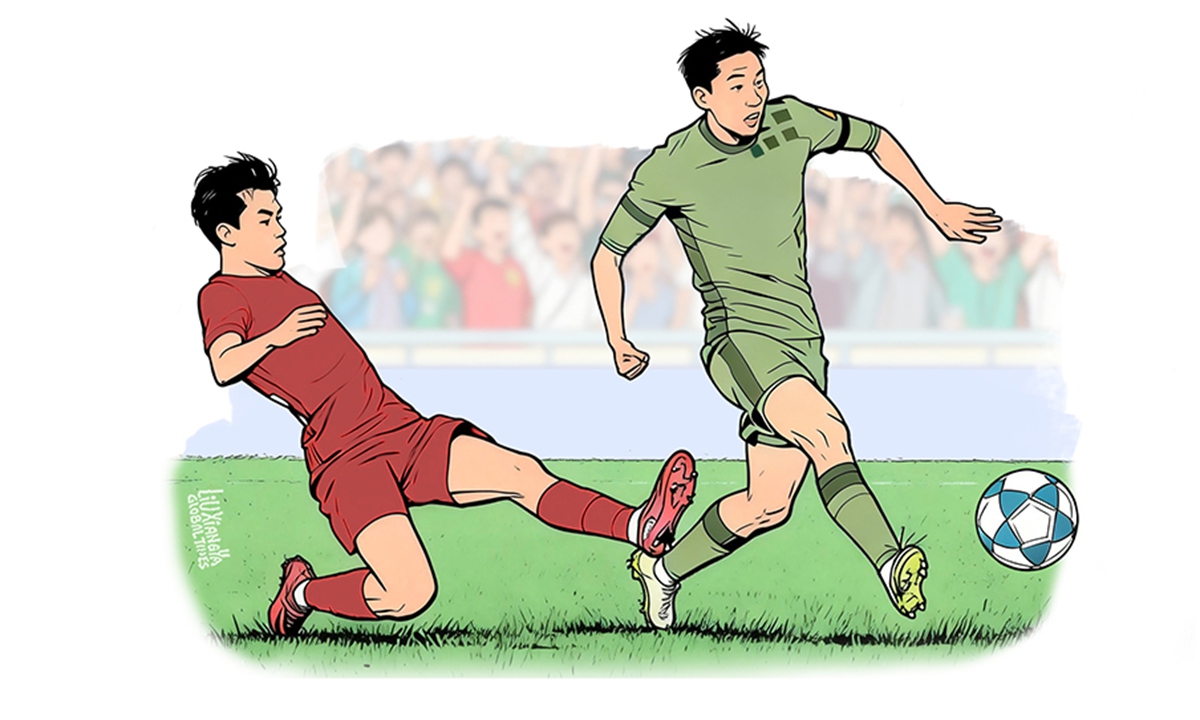
Illustration: Liu Xiangya/GT
When the 2026 Chinese Super League (CSL) season kicks off on Friday with Chengdu Rongcheng hosting Shenzhen Peng City in Southwest China's Sichuan Province, it will be under a cloud of uncertainty and, perhaps, renewal. Never before has the league begun with such a dramatic reshuffling of fortunes: A record nine clubs will start the season with point deductions for historical violations.Add to that a derby-heavy fixture list and a schedule that will not pause during the FIFA World Cup in June and July, and this campaign may prove to be one of the most unpredictable in CSL history.
The most striking variable is the unprecedented "negative start." Nine teams will begin the season in the red, fundamentally altering the league's competitive logic. Six of last season's top seven finishers have been penalized with deductions ranging from five to 10 points. Defending champion Shanghai Port must claw back from a five-point deficit before it can even think about defending its crown.
The title race is left wide open given the deductions, Wang Dazhao, a Beijing-based sports commentator, told the Global Times on Tuesday. "Last season's runner-up Shanghai Shenhua is likely to have already dropped out of the title race with a 10-point deduction," he said.
In practical terms, the margin for error has vanished. Title contenders can no longer afford a slow start, while mid-table sides suddenly glimpse opportunity. What might have been a predictable hierarchy now feels like a reset button pressed on the entire competition, Wang noted.
The punitive measures are painful, but they also signal a league intent on drawing a line under past disorder. If enforcement is consistent and transparent, this "negative beginning" may paradoxically lay the groundwork for a more credible and disciplined future.
In a season already shaped by points deficits, fixture congestion could amplify volatility. Injuries, rotation strategies and sports science management may prove just as decisive as tactics. Clubs that invested wisely in versatile, durable players could reap disproportionate rewards.
Equally noteworthy is the rise of Australian managerial influence. This season features a record number of Australian coaches in China's top-flight league, including Zhejiang FC under Ross Aloisi, Chengdu led by John Aloisi, and Beijing Guoan guided by Nick Montgomery with his Australian A-League credentials. Together with Shanghai Port's Kevin Muscat, they form a distinct coaching bloc.
This trend reflects a pragmatic survival strategy. Australian coaches possess deep familiarity with the Asian football ecosystem. That understanding shortens adaptation periods and reduces the cultural friction that has sometimes plagued high-profile European appointments.
In contrast to European star coaches commanding multi-million-euro salaries, Australian managers offer more sustainable wage expectations while still delivering modern tactical frameworks. Their emphasis on collective structure, high-intensity pressing and rapid transitions mirrors global trends.
At the same time, the league continues to nurture domestic leadership. Seven local head coaches will patrol the sidelines this year. Last season, Shao Jiayi's impressive CSL performance propelled him to the national team helm, offering a tangible career pathway and renewed confidence for Chinese managers.
Wang noted that the number of domestic coaches is reasonable. In a league recalibrating its identity, this balance between external expertise and local growth feels intentional rather than accidental.
Perhaps the clearest structural shift is the firm departure from the lavish spending on foreign players. The CSL that once chased global stars at staggering prices has embraced a far more rational transfer philosophy.
Beijing Guoan, for instance, secured three practical foreign signings for a combined fee of just 850,000 euros ($986,000), a figure that would once have covered little more than an agent's commission in the league's heyday. The focus now is on cost-effectiveness, squad balance and long-term sustainability.
This recalibration may not produce immediate glamour, but it could foster something more durable: competitive balance. When budgets narrow, recruitment sharpens. When margins tighten, coaching quality and youth development carry greater weight.
The departure from the big spending model means academies and domestic talent pipelines are no longer secondary considerations. This could accelerate opportunities for young players and emerging prospects. If Australian coaches bring an emphasis on structured pressing and collective systems, young players who are often more adaptable and physically dynamic may thrive in such frameworks.
The 2026 season promises drama rooted in structural change: negative starting points, pragmatic coaching choices, and disciplined spending.
The CSL's turbulent past has forced hard lessons. Whether those lessons translate into a healthier ecosystem remains to be seen, said Wang.
In that uncertainty lies both challenges and opportunity and, perhaps, the beginning of a more sustainable chapter for professional Chinese football.
The author is a reporter with the Global Times. life@globaltimes.com.cn
RELATED ARTICLES