SPORT / MISCELLANY
Sports awards could inspire new hope even during tough times
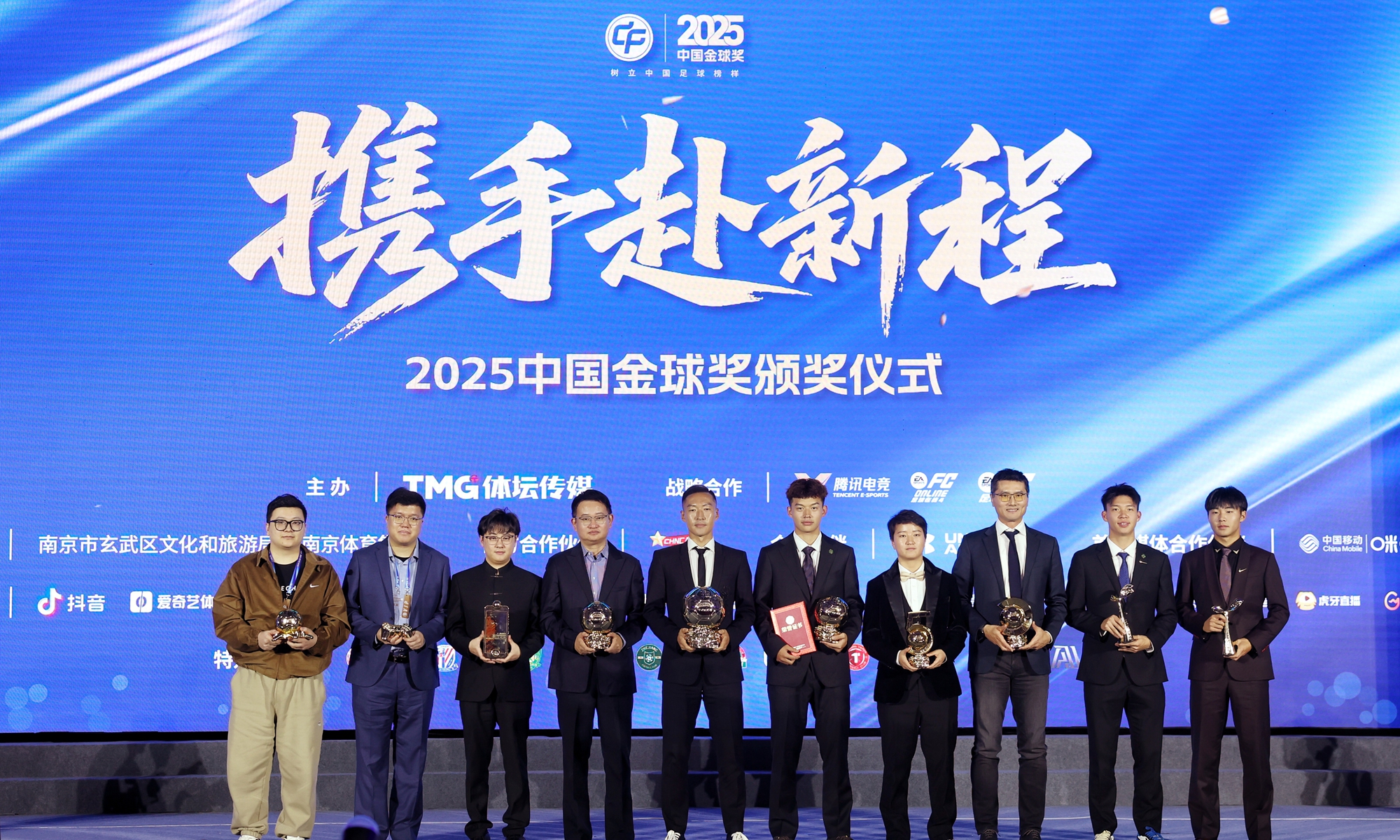
Photo: Cui Meng/GT
With the underwhelming performance of the senior national team and lingering scandals in domestic football, some fans have questioned the necessity of holding the Chinese Footballer of the Year Awards ceremony just days ahead of the start of the 2026 season of the Chinese Super League.Yes they have a point. Chinese football has endured a particularly grueling period in recent years.
The men's national team crashed out of the 2026 World Cup qualifiers in 2025 after a string of demoralizing defeats, including a humiliating 7-0 thrashing by Japan and a 3-0 loss to South Korea. Narrow losses to teams like Indonesia further underscored the technical gaps plaguing the squad, causing it to be eliminated from the qualifying group.
The U20 team also faced setbacks, failing to make a strong impact at the home U20 Asian Cup, missing the opportunity to qualify for the U20 World Cup, adding to the overall sense of stagnation.
Adding to the woes, corruption scandals and club dissolution have eroded public trust, with the sport often described as "sliding into the abyss." In such a climate, it's easy to see why skepticism abounds. But why celebrate when the overall picture is so bleak?
But this is where the Chinese Footballer of the Year Awards prove their worth. By spotlighting individual and collective excellence, they remind fans and players that progress is possible even amid setbacks.
The U23 team was the only team that brought fresh hopes to Chinese football, as they qualified for the finals for the first time in its U23 Asian Cup participation history even though their achievement came in 2026 rather than the award's 2025 time frame.
The ceremony emphasized youth development, with Zhejiang FC's Wang Yudong winning the U21 Golden Boy award for his impressive club and national team contributions, and 16-year-old Shuai Weihao from Chengdu Rongcheng taking the U17 honor as the youngest goalscorer in the professional league in nearly two decades.
The U23 national team received a special prize, highlighting emerging talent that could form the backbone of future squads. This recognition goes beyond trophies; it signals that investment in grassroots and academy systems is yielding results, countering the narrative of inevitable decline.
A notable anecdote from the awards underscores their impact. Prominent Chengdu Rongcheng player Wei Shihao took to social media to express mild discontent over not winning the award, a reaction that ironically affirms the prestige of the honor.
Such visibility keeps the conversation alive, drawing attention to the sport's competitive spirit.
Chinese Football Association Vice President Xu Jiren aptly noted that the persistence of these awards could make the public and media realize that Chinese football is played "with dignity and honor." In tough times, this reframing is crucial as it can transform isolated successes into collective motivation.
This principle extends beyond football and even national borders, as seen in the Ballon d'Or, the most prestigious individual award in global football.
One compelling case is Fabio Cannavaro's 2006 victory. That year, Italian football was engulfed in the Calciopoli scandal, a massive match-fixing controversy that led to Juventus being stripped of titles and relegated.
Amid this chaos, Italy triumphed at the World Cup, with Cannavaro captaining the side to glory through his impenetrable defense. Cannavaro's Ballon d'Or win, as the only defender to claim it in recent decades, symbolized resilience and hope, reminding fans that excellence could rise above institutional turmoil and inspire a rebuilding effort in Italian football.
The Chinese Footballer of the Year Awards have also evolved to encompass more than just on-field prowess. They now recognize contributions to public welfare, such as supporting youth training programs and community football initiatives.
This broader scope injects moral power into the sport's revival, aligning with global trends where awards promote ethical growth. By commending these efforts, awards encourage investment in infrastructure, anti-corruption measures and participation, essential for Chinese football's long-term health.
The author is a reporter with the Global Times. life@globaltimes.com.cn
RELATED ARTICLES