AI and green growth key to deeper China-Singapore cooperation under China’s 15th Five-Year Plan: Singapore envoy
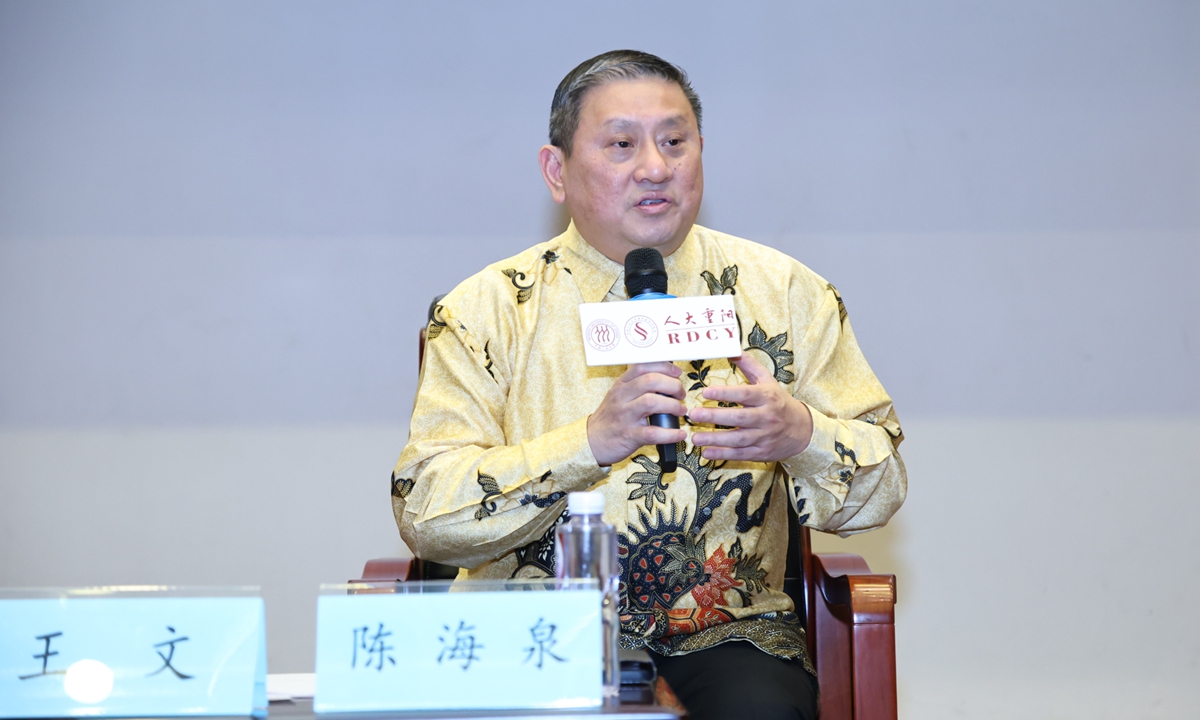
Singaporean Ambassador to China Peter Tan speaks at the Ambassador Forum hosted by the Chongyang Institute for Financial Studies, Renmin University of China on March 3, 2026. Photo: Courtesy of the Chongyang Institute for Financial Studies, Renmin University of China
Speaking fluent Chinese, Singaporean Ambassador to China Peter Tan addressed an audience at Renmin University of China in Beijing on Tuesday, offering his insights on the future of China-Singapore relations.In response to a question from the Global Times on Singapore's key priorities and desired areas of cooperation under China's 15th Five-Year Plan (2026-30), Tan noted that the two countries could further deepen collaboration in sectors such as the green economy, sustainable development and artificial intelligence (AI).
As the event coincided with the Lantern Festival, Tan also extended festive greetings to the audience at the Ambassador Forum held by Chongyang Institute for Financial Studies, Renmin University of China. He recalled performing at last year's Hainan Satellite TV Spring Festival Gala, where he sang a classic song familiar to both Chinese and Singaporean peoples, Spring Kisses My Face. He also interacted with the audience on the spot, asking if they knew the song.
Tan noted that since 2023, bilateral ties between China and Singapore have been upgraded to an "all-round high-quality future-oriented partnership." He stressed that while traditional areas of cooperation will continue, both sides should also look ahead to new frontiers.
Addressing demographic challenges, Tan cited the "silver hair economy" as an example. He noted aging is an issue of serious concern in Singapore, where the proportion of elderly citizens is rising even faster than in China.
Last week, Singapore's Deputy Prime Minister Gan Kim Yong announced in parliament that the country's total fertility rate had fallen further in 2025 to 0.87. Tan said the combination of a growing elderly population and a persistently low birth rate is compounding demographic pressures.
"To address labor shortages, we have adopted more proactive immigration policies to fill jobs that younger people are unwilling to take," he said. "But you cannot always keep the door open. There must be solutions - and one of them is AI."
Tan said AI can complement human labor, undertake tasks people are reluctant to perform, and improve efficiency through better resource allocation, workforce retraining and technological innovation.
He also acknowledged public concerns that AI could replace human workers. Using the example of autonomous taxis, he noted that drivers may worry about losing their jobs, which could lead to social discontent. In a small country like Singapore, where the number of taxis on the road is regulated, the introduction of self-driving vehicles would directly affect drivers' livelihoods, he said.
"AI is already a reality, not a symbol of the future. I do not believe AI will replace humans. Rather, people who know how to use AI will replace those who do not," said the ambassador.
On AI's broader role in economic planning, he emphasized that the key question is not what role AI can play, but how governments, businesses and individuals choose to harness it. "If you fear AI, you will be defeated by it. The important thing is how you use AI to help you perform better and become stronger," he said, expressing confidence in the technology's future.
In a lighthearted moment, Tan referenced the well-known Hokkien song Effort Is The Only Road To Success, Ai Pin Cai Hui Ying, playing on its title to illustrate his point. "You all know the famous song. What is 'Ai'? AI," he joked. "With AI, we can compete better, achieve more and reach higher."
Reflecting on his personal ties with China, Chen said he first visited the country on a business trip in 1996 and last came in 2016 before assuming his post as ambassador in 2023. Over the decades, he has witnessed China's rapid development firsthand.
He said that while China was once seen as learning from Singapore, its progress over the past 30 years has been remarkable. After visiting cities across different tiers, he found it increasingly difficult to distinguish clearly among them.
Pausing briefly, Tan posed a rhetorical question to the audience: "Does China still need to learn from Singapore?" He smiled and added, "That remains a question mark - even I am not sure."
He stressed that what truly matters is preserving a spirit of mutual learning. "We should exchange experiences and reflect on each other's development journeys," he said, expressing the hope that such openness would not only deepen bilateral ties, but also contribute to broader regional and multilateral cooperation.
RELATED ARTICLES