US sinking of Iranian warship near Sri Lanka sparks wider concern; domestic criticism mounts in India over government’s silence
By Published: Mar 06, 2026 01:57 PM

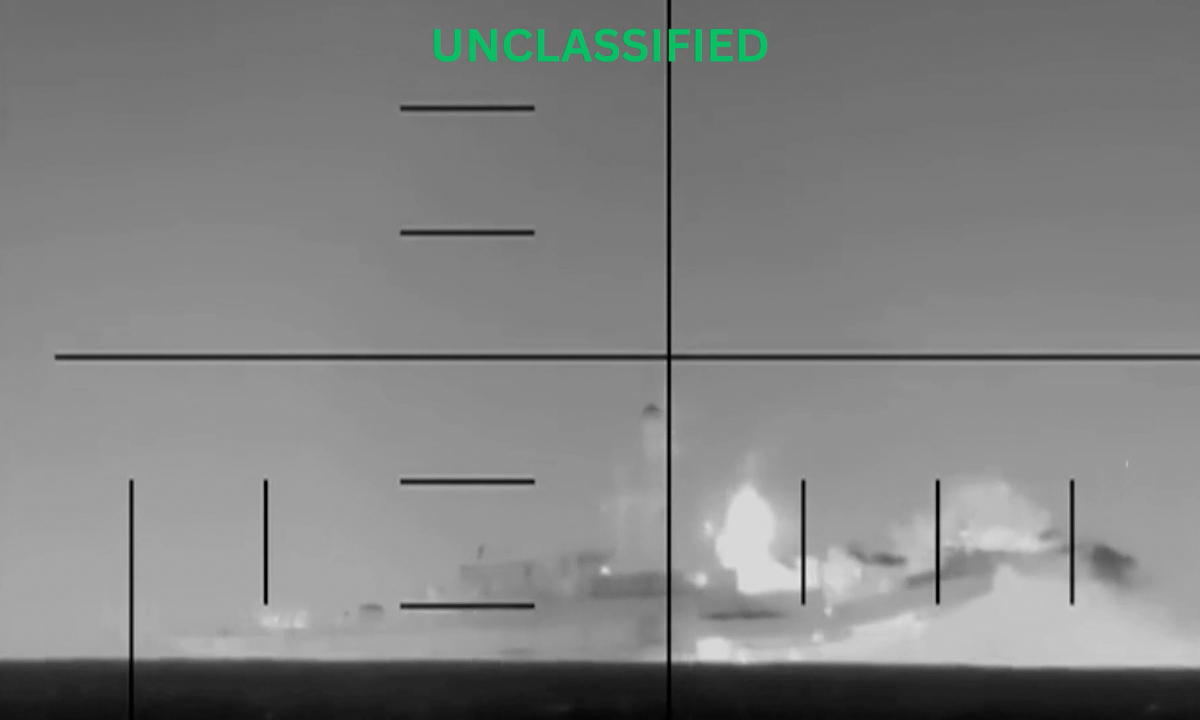
This image from video provided by US Defense Department shows explosion on an Iranian ship in the Indian Ocean during the joint US-Israeli military operation against Iran. Photo: VCG
The US sinking of an Iranian warship off Sri Lanka's coast, with more than 100 people reportedly missing or dead, has brought the Middle East conflict to the Indian Ocean, triggering international reactions and growing concern over the wider spillover of the joint US-Israeli military operation against Iran, while the Indian government has also come under criticism for its silence over the sinking of the vessel, according to media reports.A US submarine sank the Iranian frigate IRIS Dena off the coast of Sri Lanka on Wednesday, with 32 sailors rescued and more than 100 missing or dead. The episode was the first time since World War II that an American submarine had attacked a surface vessel, US Defense Secretary Pete Hegseth said, according to a Bloomberg report on Thursday.
The US Department of Defense reposted a video on its X account on March 4 in which Hegseth said, "In the Indian Ocean, an American submarine sank an Iranian warship that thought it was safe in international waters. Instead, it was sunk by a torpedo — quiet death." It also posted video footage that appeared to show a vessel catching fire after being struck, with waves surging around it.
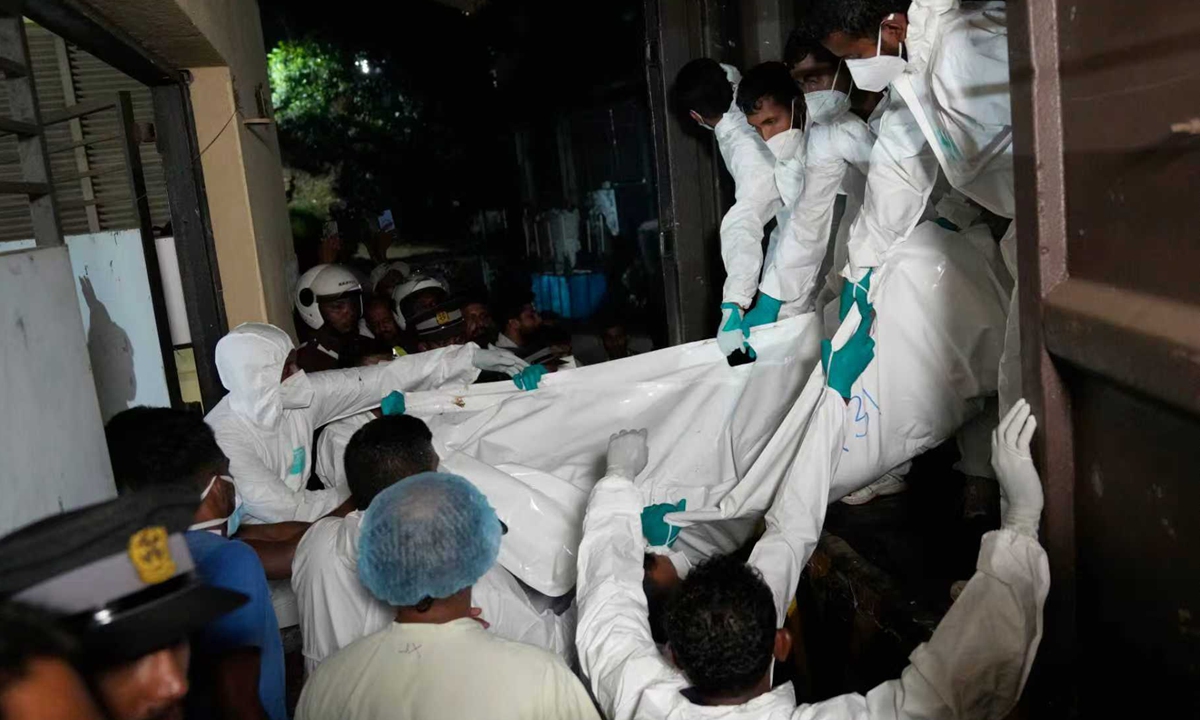
Healthcare workers unload the bodies of Iranian sailors from a vehicle who died when their IRIS Dena warship sank outside Sri Lanka's territorial waters, in Galle, Sri Lanka, on March 4, 2026. Photo: VCG
Sri Lankan coastguards received a distress call from the IRIS Dena at 5:08 am on Wednesday, with surviving crew describing an explosion. Thirty-two survivors, all seriously injured, were taken to Galle National Hospital. Eighty-seven bodies were recovered from the sea, Sri Lanka's Foreign Minister Vijitha Herath said. More than 10 sailors remain missing, according to a report from Al Jazeera.Sri Lanka President Anura Kumara Dissanayake announced on Thursday that his navy would take custody of the second Iranian naval vessel and move it to the northeastern port of Trincomalee for safekeeping, amid fears it could be targeted. He said his government held discussions with Iranian officials and the captain of the ship, Al Jazeera reported.
The US strike appears to violate the "just war" principle of proportionality, which holds that military force should be proportionate to the conflict and its objectives, Sun Degang, director of the Center for Middle East Studies at Fudan University, told the Global Times, noting that the Iranian vessel was reportedly outside the combat zone when it was sunk, causing significant casualties and the move has been seen as exceeding reasonable limits, escalating the conflict and drawing criticism and concern.
The US sinking of the Iranian vessel have caught wider attention. The Bloomberg report on Thursday noted that the US action off Sri Lanka's coast "expands the deepening Middle East war to India's doorstep" and it cited retired Indian officials as saying that it "was embarrassing to India and amounted to the war reaching a territory where India tries to project itself as the preferred security partner for smaller nations such as Sri Lanka"
A Guardian report on Thursday noted that "the torpedo strike prompted questions from former US officials about whether Washington's aim of eliminating all of Iran's military breached international law."
Iranian Foreign Minister Seyed Abbas Araghchi made a sharp response over the sinking of Iranian naval frigate and mentioned India in a post on X on Thursday. Araghchi wrote the frigate as "a guest of India's Navy" and slammed the US for perpetrating an "atrocity at sea, 2,000 miles away from Iran's shores." He noted that the vessel "was struck without in international waters without warning" and "mark my words: the US will come to bitterly regret precedent it has set."
The Indian government hasn't directly responded to the US sinking of the naval vessel. At a joint briefing with Finland's President Alexander Stubb on Thursday, Indian Prime Minister Narendra Modi called for dialog and diplomacy to end global conflicts from Ukraine to West Asia, per Bloomberg.
The Iranian warship had participated in the International Fleet Review and the multilateral naval exercise MILAN 2026, organized by the Indian navy in the port of Visakhapatnam from February 15 to February 25. The Iranian warship was seen sailing at sea during the exercises in a February 17 post on X by the Indian navy. Another image showed several of its crew members posing on deck with the Iranian flag in the background, according to Associated Press.
The Indian government's silence has drawn criticism. For example, Indian opposition leader Rahul Gandhi questioned the government's lack of response to the incident in a post on X on Thursday, writing: "The conflict has reached our backyard, with an Iranian warship sunk in the Indian Ocean. Yet the Prime Minister has said nothing."
Kanwal Sibal, former Indian foreign secretary, wrote on X on Thursday that "The Iranian ship will not be where it was if we had not invited it to talk part in our Milan exercise. We were the hosts. I am told that as per protocol for this exercise ships cannot carry any ammunition. It was defenseless."
Sibal wrote that "the US has ignored India's sensitivities as the ship was in these waters because of India's invitation. We are far from politically or militarily responsible for the US attack. Our 'responsibility' is at a moral and human plane."
Iran's ambassador to India, Mohammad Fathali, told reporters in the Indian capital on Thursday that there had been "no negotiations, no messages from India", when asked whether New Delhi had been in touch with Tehran over the sunken ship. "You can ask them [India]," he added, according to the National News.
Indian Congress president Mallikarjun Kharge accused the government of "destroying" India's foreign policy which had been carefully and painstakingly built and followed by successive governments over the years. "Modi Govt.'s reckless abdication of India's strategic & national interests is there for all to see," Kharge said in a X post.
The incident has also sparked criticism within India as some people in the country sees the US move at India's "doorstep" as an embarrassment for New Delhi. Zhang Junshe, a military affairs expert, told the Global Times, adding that India has long sought a larger role on the global stage and has repeatedly expressed ambitions to become a regional, even global power.
However, its muted diplomatic and military response to the incident does little to support such aspirations. For years, many Indian strategists have referred to the Indian Ocean as "India's ocean," yet the attack occurred in the Indian Ocean and near India's surrounding waters without a clear reaction from New Delhi, Zhang said.
Indian media News 18 said in an article that "for India, the sinking is a diplomatic and security nightmare." It wrote that "The incident forces India into a difficult corner: it must balance its growing strategic partnership with the US against the need to prevent the Indian Ocean from becoming a playground for foreign wars."
While an Al Jazeera article on Friday, which titled "How US sinking of Iranian warship blew hole in Modi's 'guardian' claims" said that "India sees itself a security provider in the Indian Ocean. On Wednesday, it couldn't save even its own guest."
RELATED ARTICLES