ARTS / CULTURE & LEISURE
Ambassador of Peru to China on ‘two sessions’: deeply impressed by the significant scale and extensive consultations
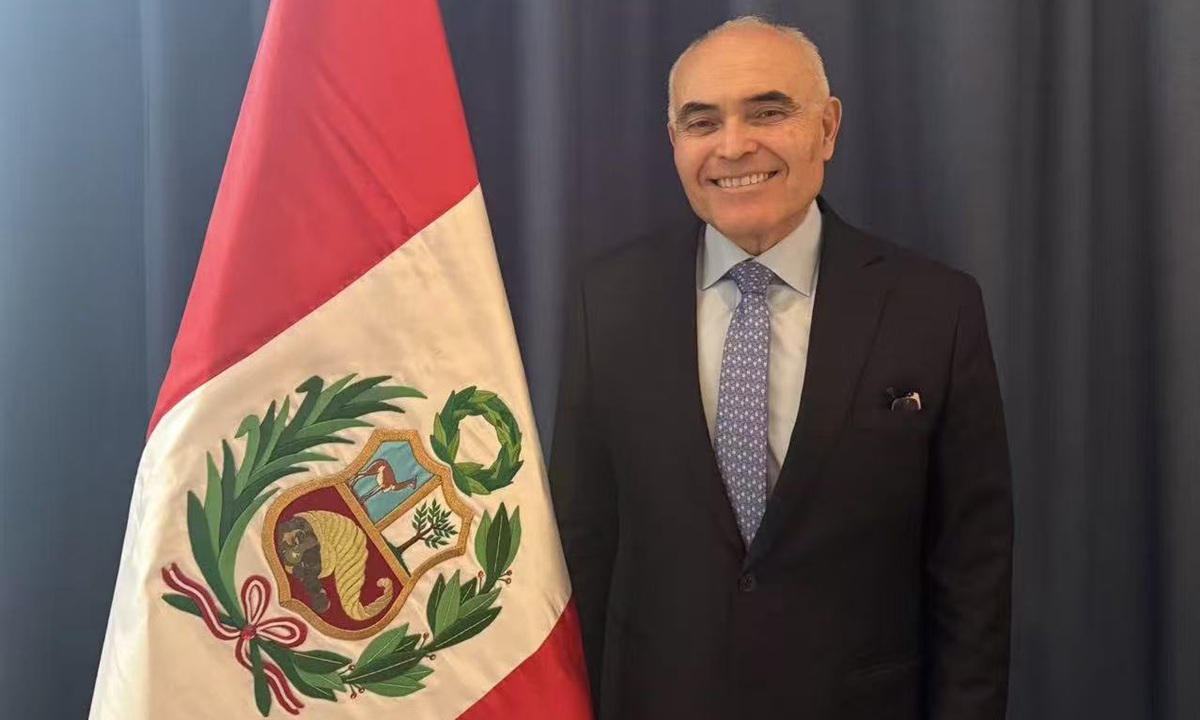
Ambassador of Peru to China Carlos Vasquez. Photo: Courtesy of the Embassy of the Republic of Peru in China
In an exclusive interview, Ambassador of Peru to China Carlos Vasquez told the Global Times on Thursday that he was deeply impressed by the significant scale of the "two sessions" in terms of the number of delegates and the extensive consultations conducted by the Chinese People's Political Consultative Conference to reflect the interests and aspirations of the Chinese people.This is his first time attending and observing the "two sessions." From his point of view, there are significant opportunities to further strengthen bilateral relations in light of China's 15th Five-Year Plan (2026-30).
The diplomat linked his own country to the development plan, which could mean new opportunities. "Peru currently faces a substantial infrastructure deficit, which opens space for deeper bilateral collaboration aimed at supporting economic growth. According to Peru's National Sustainable Infrastructure Plan for Competitiveness, the country's infrastructure gap is estimated at around $110 billion," he shared.
Science and technology represent another promising field for cooperation, particularly in the context of digital transformation. The integration of physical infrastructure with digital infrastructure is increasingly important for advancing development.
"At the same time, China's efforts to stimulate domestic consumption could create new opportunities for Peruvian exports of healthy and high-quality products," said Vasquez.
Talking about the achievements of bilateral business cooperation, he said that the start of operations at the Port of Chancay - a partnership between Peruvian investors and COSCO Shipping - represents an important milestone in Peru-China economic relations.
"The port was officially inaugurated during the Chinese leader's visit to Peru in 2024. Since becoming operational, it has already begun to facilitate significant trade flows between the two countries, with the new Chancay-Shanghai maritime route showing a rapid expansion in bilateral commerce," said Ambassador Vasquez.
In 2025 alone, 1,873 importers carried out operations through the Port of Chancay. The facility has considerably improved logistical efficiency, reducing shipping times between Peru and China from roughly 35-40 days to about 23 days, while also lowering logistics costs by more than 20 percent, he said.
Beyond its immediate commercial benefits, the Port of Chancay is expected to serve as a catalyst for the development of a broader logistics, technological, and industrial hub along the central coast of the South Pacific, Vasquez added.
Items such as avocados, for example, have become increasingly popular among younger Chinese consumers.
At a time of heightened global economic uncertainty, the ambassador acknowledges China's efforts to promote a more stable and predictable international environment, which can help countries better understand one another and strengthen cooperation.
"As a country that has traditionally supported a rules-based international order, Peru believes that the Global Development Initiative (GDI), proposed by China, has the potential to reflect the aspirations of developing countries and other states seeking the effective implementation of the 2030 Agenda," said Vasquez.
In this sense, the initiative could serve for the preservation and strengthening of the multilateral system and as a useful platform for advancing joint efforts toward sustainable development, he added.
Analyzing the international landscape, which is marked by intensifying geopolitical competition and recurring security challenges, the diplomat shared that "we acknowledge China's efforts and contributions to promoting global peace and security, as well as to strengthening multilateralism and a rules-based international order in an increasingly complex international environment."
In particular, we have followed the Global Governance Initiative proposed by China, which highlights key principles for the management of the international system, Vasquez stated.
At the outset of the new five-year period, areas including trade and investment, technological innovation, green transition, the digital economy, and people-to-people exchanges are highly significant for the bilateral relationship between Peru and China.
In 2024, both countries signed a Protocol to Upgrade the China-Peru Free Trade Agreement.
Peru's exports to China increased by more than 30 percent in 2025. The updated agreement incorporates 12 chapters aimed at deepening economic cooperation, Vasquez said.
From the Global Supply Chain chapter to the Intellectual Property chapter, these initiatives facilitate enhanced supply chain efficiency and connectivity.
"In 2026, we would like to settle additional agreements with China for the admission of new high-quality products into the Chinese market," said Vasquez.
RELATED ARTICLES