Trump hosts ‘Shield of the Americas’ summit, coercing ‘backyard countries’ to fall suit of US dominance: Chinese expert
By Published: Mar 09, 2026 12:24 AM
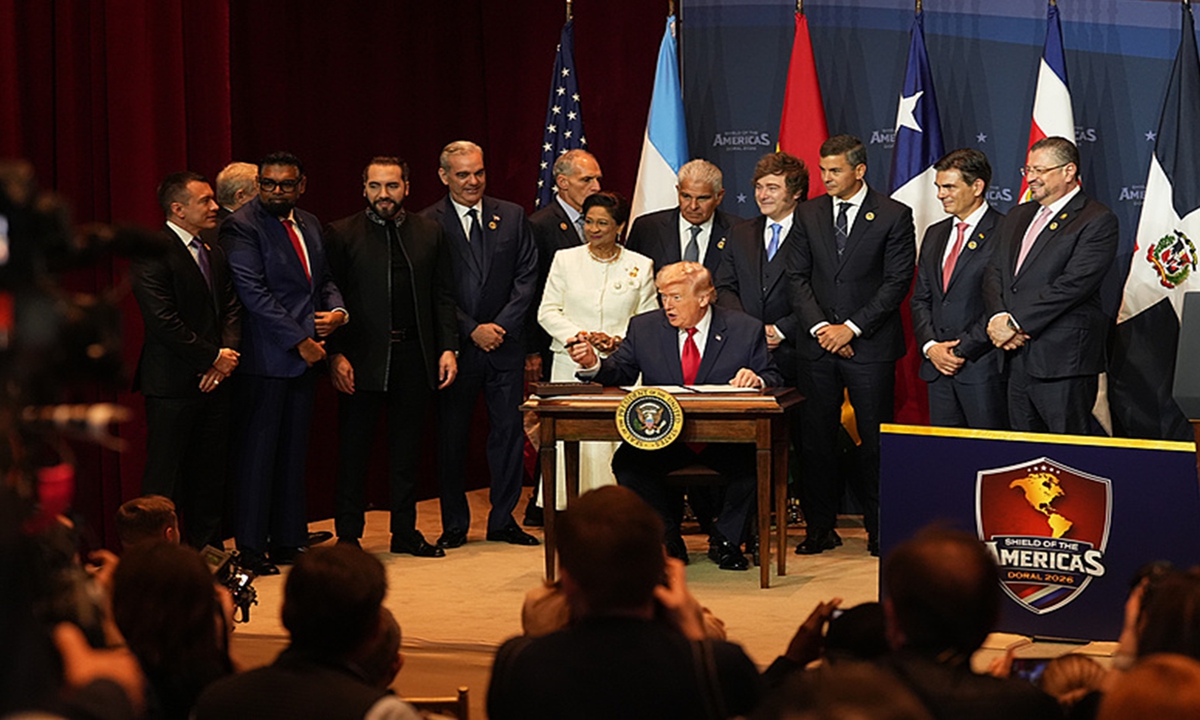
US President Donald Trump signs a proclamation committing to countering cartel criminal activity at the Shield of the Americas summit, Saturday, March 7, 2026. Photo: VCG
US President on Saturday hosted a dozen Latin American and Caribbean leaders in South Florida for what the White House dubbed the "Shield of the Americas" summit, where he encouraged regional leaders to take military action to combat criminal violence and announced the creation of a coalition - a group of politically aligned countries committed to fighting drug trafficking. A Chinese expert interpreted the move as US coercing what it views as "backyard countries" in Latin America to fall suit of US dominance.
Striking a dismissive tone in his speech, Trump pointed fingers at officials from the region, saying their countries had allowed gangs to seize territory, per Reuters. "Leaders in this region have allowed large swaths of territory in the Western Hemisphere to come under the direct control of transnational gangs, and they've run areas of your country," Trump was quoted by Reuters.
Trump singled out Mexico as the center of cartel activity and threatened a major political change in Cuba, according to Reuters.
Leaders from a dozen nations, namely, Argentina, Bolivia, Chile, Costa Rica, the Dominican Republic, Ecuador, El Salvador, Guyana, Honduras, Panama, Paraguay, and Trinidad and Tobago, attended the summit. But the conspicuous no-shows were the heads of state from regional heavyweights Brazil, Mexico and Colombia, according to media reports.
Flanked by the attending leaders, Trump described proclamation he signed later as "a commitment to using lethal military force to destroy the sinister cartels and terrorist networks," according to Politico.
The summit did not happen in a vacuum. Just two months earlier, Trump had ordered a US military operation to seize Venezuela's President Nicolás Maduro and forcefully take him and his wife to the US to face drug trafficking charges. And just weeks before the gathering, US law enforcement provided intelligence assistance in a raid in Jalisco, Mexico, that led to the capture of Nemesio Oseguera Cervantes - one of the world's most wanted drug lords, according to media reports.
These moves, taken together, point to a larger strategic intent - one that reaches far beyond the region itself, according to Wang Youming, director of the Department for Developing Countries Studies at the China Institute of International Studies.
"Presented as a coalition to combat drug trafficking, the summit was in reality a gathering of the ideologically aligned," Wang told the Global Times. "By bringing together Trump's loyal allies and leaders who won office with his backing, the administration sought to tighten its control over what it views as its strategic backyard - effectively solidifying a modern-day Monroe Doctrine to strengthen US dominance in the Western Hemisphere."
Ironically, despite Trump's full commitment to the summit, its effectiveness is unlikely to match its ambitions, the expert added.
Trump's selective invitation of certain Latin American countries underscores that the US has yet to achieve the kind of influence in the region where its call is heeded by all. "Playing games among small circles in Latin America does not wield genuine influence, but will only intensify divisions among regional countries," Wang stated.
Cuban President Miguel Díaz-Canel on Saturday described the summit as "small, reactionary and neocolonial" in a social media post, per AP.
China was not explicitly mentioned during Trump's speech at the summit, media reported. However, Al Jazeera's website claimed that the key reason for the Trump administration to hold this summit was to "counter China."
While the region as a whole has shifted to the right, most countries maintain strong strategic autonomy. Whether the "Shield of the Americas" can shield Trump's influence in the region, or merely expose its limits, is a question that only Latin American countries themselves can answer, Wang told the Global Times.
When ask how China responds to the challenge that the National Security Strategy of the US released last year shows that the US priority is to interfere in China-Latin America relations by pressuring Latin American countries, Chinese Foreign Minister Wang Yi said on Sunday that the resources of Latin America and the Caribbean (LAC) belong to the people there, the path of LAC countries should be chosen by their people, and the choice of friends is a decision for LAC countries.
Wang made the remarks at a press conference on the sidelines of the fourth session of the 14th National People's Congress. He added that cooperation between China and LAC countries does not target any third party and should not be subject to interference by any third party. We have great confidence in the future of China-LAC relations, he said.
RELATED ARTICLES