BRASIL 247 / MORE
Brazil adopts emergency flexibility in meat export certification due to Middle East conflict
Emergency measures aim to prevent logistical bottlenecks in Brazilian exports
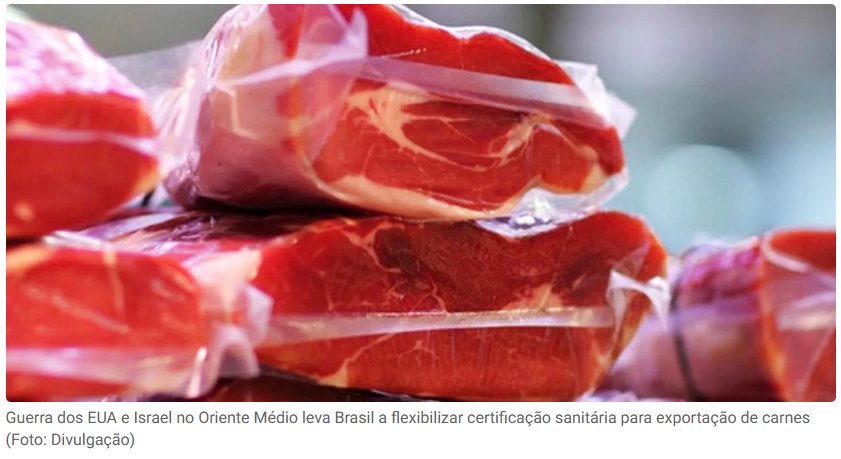
Photo: screengrab from the official website of Brasil 247
The Ministry of Agriculture and Livestock of Brazil (Mapa) has authorized emergency measures to reduce logistical impacts on Brazilian exports of animal products amid the worsening conflict in the Middle East. The decision allows temporary flexibility in sanitary certification rules and the handling of cargo that was ready for shipment but had its international routes interrupted.
The document, sent on March 6 to agricultural inspection units, according to CNN Brasil and Brasil 247, provides guidance on exceptional procedures aimed at preventing the accumulation of products in slaughterhouses, ports, and other distribution points.
According to the ministry, part of the cargo that already had the International Sanitary Certificate (CSI) was unable to continue to its intended destinations due to disruptions in commercial routes. This situation could lead to a buildup of goods ready for export and put pressure on the operational capacity of teams responsible for sanitary certification.
The adoption of these measures is based on the Regulation for the Industrial and Sanitary Inspection of Animal Products (RIISPOA), which provides for extraordinary inspection and certification procedures in exceptional situations that affect foreign trade.
Extension of document validity - Among the authorized measures is the extension of the validity period of sanitary documents used in the transport and export of animal products.
Under the new rules, the International Sanitary Certificate (CSI) and the National Sanitary Certificate (CSN) will now be valid for 360 days. Meanwhile, DCPOA transport documents will have their validity extended to 60 days.
The authorization applies both to documents yet to be issued and to those already issued previously. The rule also covers cargo that was already loaded or in transit when the measure was adopted. During the emergency period, however, the revalidation of international sanitary certificates will be prohibited.
Return of cargo to slaughterhouses - The circular also allows previously certified products that were at ports, airports, or border inspection posts to return to establishments registered under the Federal Inspection System without the need to issue a new national sanitary certificate.
Upon receiving these shipments, slaughterhouses must verify a series of sanitary conditions, including the integrity of container seals, storage temperature, the condition of packaging, and the consistency of information with the original sanitary certificate.
In addition, companies must produce documentary and photographic records of the inspections carried out when the products arrive.
Exceptional storage in containers - Another flexibility authorized by the ministry is the temporary storage of finished products inside containers, a practice normally not allowed under sanitary regulations.
To adopt this procedure, companies must maintain auditable controls to ensure the preservation of the cold chain, cargo traceability, and adequate sanitary conditions during storage.
Redirection to new markets - The document also allows the replacement of sanitary certificates when it becomes necessary to redirect shipments to other international markets.
In such cases, the certificate can only be replaced if the new importing country has sanitary requirements equivalent to or stricter than those of the original destination. Documentary proof of all stages of production, including slaughter and processing, will also be required.
According to the Ministry of Agriculture and Livestock, the measures are temporary and emergency in nature and may be revised or revoked depending on how the international logistical situation evolves amid the conflict in the Middle East.
(Reported by Brasil 247 on March 9, 2026)
